
Robot Gripper
A robot gripper is a type of end effector designed to physically grasp and hold a part using mechanical fingers, jaws or pads, as opposed to lifting it with vacuum suction. Grippers are one of the two most common ways a robot picks up an object, and come in a wide range of designs, from simple two-finger parallel grippers to adaptive, multi-fingered designs that can conform to irregular shapes.
Why robot grippers are important
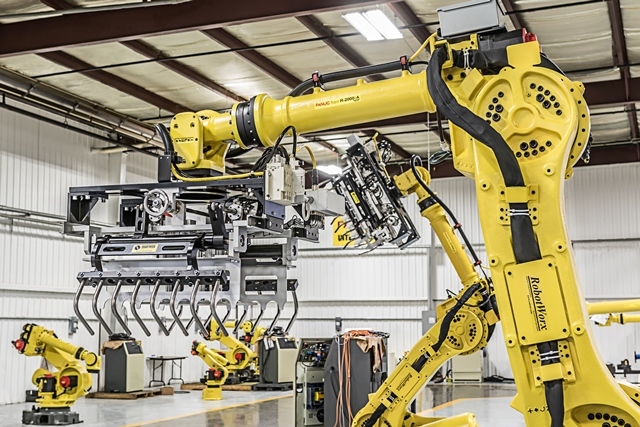
The gripper is usually the cheapest single component in a robot cell, but getting it wrong is one of the most common reasons a cell fails to hit its target cycle time or drop rate. A gripper that is slightly undersized for the part’s weight, or that grips at the wrong point, can cause slippage, damage or inconsistent placement, problems that often only show up once the cell is running at full speed on real production parts, rather than during a slower demonstration. Because gripper technology has moved fast in recent years, with lower-cost adaptive and multi-finger designs now widely available, it is worth reviewing gripper options specifically rather than accepting whatever the integrator defaults to, particularly for cells handling more than one part variant.
How robot grippers work
Mechanical grippers use two or more fingers, jaws or pads, driven by a pneumatic cylinder, electric motor, or servo actuator, to close around a part and hold it through friction or form closure. Parallel grippers, the most common type, move two opposing fingers in a straight line and suit consistent, rigid parts. Angular grippers pivot the fingers instead, useful in tighter spaces. More advanced adaptive or multi-fingered grippers use several independently actuated digits, allowing the gripper to conform to irregular or varied part shapes and hold a wider range of items without a tooling change. Grip force, finger surface material and stroke length are the key specifications, and are usually matched to the part through direct testing rather than calculation alone, since real-world factors like surface finish and part-to-part variation can behave differently to a spec sheet. Pneumatic grippers remain the most common due to their low cost and simplicity, though electric grippers are gaining ground where precise force control or cleanroom compatibility is required.
Where are robot grippers used?
- Picking rigid components in assembly
- Handling boxes and cartons in palletising
- Kitting and parts transfer
- Machine tending part loading
UK Integrators Offering This Solution

Fox Precision Tooling
Precision Solutions for Automated Success

Piab
Vacuum automation, EOAT and gripping solutions for robots, cobots and automated production.

SCHUNK
Gripping, clamping, toolholding and automation technology for industrial robots and manufacturing.
Related Application Guides
Robot Palletising UK: Automating End-of-Line Stacking
Most production lines in the UK still end the same way they did 30 years ago with a person or persons lifting boxes onto…
View Guide
Robotic Pick and Place UK: Automation Guide
Robotic pick and place automates the repetitive movement of products, components or parts from one location to another.…
View Guide