

Most palletising speed figures you’ll see from vendors are based on the best possible conditions, short reach, light cases, a simple pallet pattern, no mixed SKUs, and a gripper that never misses. That’s not your production line.
This calculator lets you model cobot palletising cycle time against your actual application. Adjust the sliders to reflect your cell, check whether a cobot can genuinely meet your throughput requirement, and if it can’t, see what it would take to close the gap.
How to use this calculator
Start with the four cycle time sliders. Pick, travel, place, and settle each have a range based on industry-typical values, with labels at either end to help you position them honestly. If you’re not sure where to set a slider, err toward the pessimistic end. Conservative inputs give you a number you can defend in a business case. This calculator should give you guidance on whether a cobot palletiser will do the job or whether you need to look at more traditional options. No sure on the differences? Our guide on cobot palletising v traditional robot palletising might help.
The system overhead slider is the one most people haven’t seen before. It captures everything that happens in a real cycle that vendor specs don’t count: gripper actuation time, the brief wait while the conveyor indexes the next case into position, and the deceleration ramps the robot runs through on every move. On a well-set-up cell with a fast gripper and consistent infeed, 1.5 to 2 seconds is reasonable. On a more typical installation, 2 to 2.5 seconds is closer to reality.
Set your cases per pallet and cell utilisation, then enter your required cases per hour at the bottom to see whether a cobot can meet it.
What cobot palletising cycle time actually means
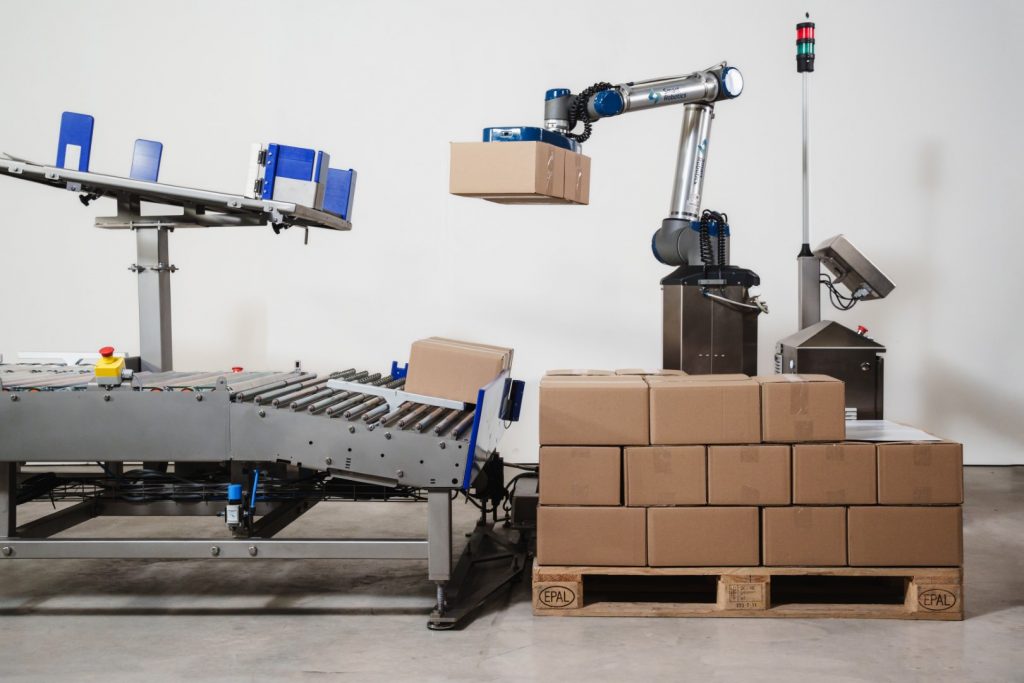
Cycle time is the time it takes a robot to complete one full pick-and-place sequence, from the moment it starts moving toward the case on the conveyor, to the moment it’s back in position ready for the next one.
Cobot palletising cycle time is not the same as the robot’s motion speed. A cobot might move fast between positions but still have a long effective cycle time because of settle delays, slow gripper actuation, or a conveyor that can’t keep up. The number that matters is how long the complete cycle takes, not how quick the arm moves.
Cases per minute (CPM) is simply 60 divided by the cycle time in seconds. Cases per hour (CPH) is CPM multiplied by 60, then adjusted for the percentage of shift time the cell is actually running.
The four components of a palletising cycle
Every palletising cycle breaks into the same four stages regardless of robot brand or cell design.
Pick time is how long it takes to acquire the case from the infeed conveyor. With consistent conveyor gaps and lighter cases, this typically runs 0.6 to 0.9 seconds. Add poor gap control or heavier products and it stretches toward 1.2 seconds. Poor gap control can introduce waiting time into system overhead rather than increasing pure pick time.
Travel time covers the move from pick position to the pallet. It’s influenced more by the distance involved and the height of the pallet build than by the robot’s top speed. Cobots automatically reduce speed as they approach maximum reach, which adds time on larger cells. Typical range is 0.8 to 1.8 seconds.
Place time is the placement itself, including any rotation required for label orientation or pattern rules. A simple pattern with no rotation at 0.5 seconds. Complex orientation requirements push toward 1 second.
Settle time is the pause after placement while the case stabilises before the gripper releases. It’s easy to underestimate. Skip it or cut it too short and you get shifting loads, damaged packaging, and unstable pallets. Typical range is 0.3 to 0.8 seconds. At higher throughputs or with dual pick, settle time often needs to increase to maintain load stability.
These components are interdependent, increasing reach, payload, or throughput typically affects multiple parts of the cycle, not just one.
The overhead no one puts in their brochure
Add those four stages up and you get a number that’s still optimistic.
Real cycles have friction. The gripper needs time to build and release vacuum, or to open and close. The conveyor takes a moment to index the next case into pick position. The control system processes the pattern logic between layers. The robot arm accelerates and decelerates; it doesn’t instantly reach top speed and it doesn’t stop without slowing down first.
None of this appears in manufacturer cycle time claims. In a real cell, these overheads typically add 1.5 to 3 seconds per cycle depending on tooling type, conveyor setup, and programming quality. That’s the slider labelled system overhead in the calculator.
It’s also why two integrator quotes for the same application can show meaningfully different throughput figures. The robot hardware is often identical. The difference is usually in how much overhead each integrator is accounting for.
If you are looking for actual cost information then have a read of our guide on the costs involved in a cobot palletising cell.
Dual pick and why the uplift isn’t 2x
Dual pick, where the gripper collects two cases per cycle, is a legitimate way to increase throughput without fundamentally changing the cell. But it doesn’t double your cases per hour.
A heavier load increases the inertia the robot has to manage. Travel times are slower, placement needs more care, and settle time tends to run longer. The realistic throughput increase is around 1.5 to 1.7 times, not 2. The calculator applies a dynamic factor based on your travel and overhead inputs: if your cell has short reach and a fast gripper, you’ll see the higher end of that range. If travel is long and overhead is significant, the factor drops accordingly.
Dual pick also has hard prerequisites, the gripper has to be designed for it, the payload capacity of the robot needs enough headroom once you add the second case and the tooling weight, and case dimensions need to be consistent enough for the gripper to handle reliably. If those conditions aren’t met, dual pick tends to cause more problems than it solves.
What throughput should you actually expect?
For a single SKU application with a well-set-up cell running single pick, 8 to 12 cases per minute is a realistic expectation. That’s 480 to 720 CPH before applying cell utilisation. At 85% utilisation (a reasonable figure for a well-run cell), you’re looking at around 410 to 610 CPH in practice.
Dual pick on a similarly optimised cell typically adds 50 to 70% on top of that. Mixed SKU operation roughly halves it, due to changeover time, more complex pallet patterns, and the logic overhead of switching between products.
If your required throughput sits above around 800 CPH on a consistent basis, it’s worth getting quotes on robot palletising system options alongside cobot quotes. Cobots can reach those figures in optimised conditions, but the margin for error is thin and the cell design needs to be right. A traditional robot built for the application will usually deliver more consistent results at that rate.
Frequently asked questions
What is a realistic cases per hour figure for a cobot palletiser?
For a single SKU application running single pick on a well-designed cell, 400 to 600 CPH is a realistic expectation once you account for cell utilisation at around 85%. Dual pick cells in optimised conditions can reach 700 to 850 CPH. Figures above 900 CPH from cobot systems should be treated with scepticism unless the integrator can demonstrate them under conditions similar to your own application.
Why do cobot palletising speed claims from vendors tend to be higher than real-world performance?
Vendor cycle time figures are typically measured under ideal conditions: maximum speed settings, short reach, light payload, a simple pallet pattern, and consistent case flow. Real cells have longer reaches, heavier products, orientation requirements, and conveyor irregularities. The system overhead items that add 1.5 to 3 seconds per real-world cycle rarely appear in published specs.
At what throughput should I consider a traditional robot instead of a cobot?
If your application consistently requires above 800 to 900 CPH, or involves payloads above roughly 25 to 30 kg including tooling, it’s worth getting quotes on traditional industrial robot cells. Cobots can theoretically reach those rates, but they’re operating at the edge of their capability. A purpose-built industrial robot system will typically deliver more headroom and more consistent performance at high throughput.