
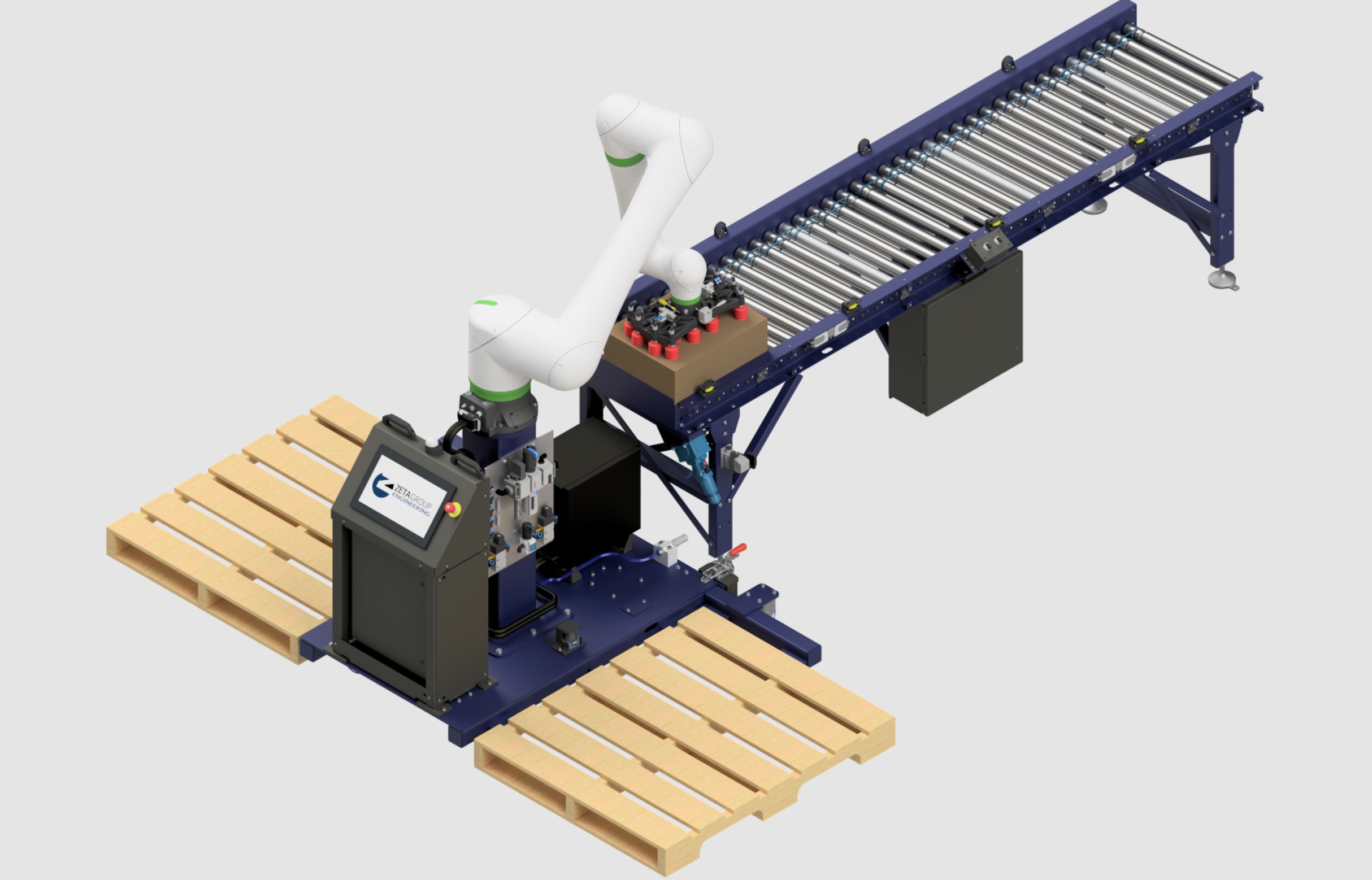
The most common frustration we hear from manufacturers who’ve requested cobot palletising quotes is the range. One supplier comes in at £38,000. Another says £95,000. A third doesn’t give a number at all until they’ve done a site visit.
Quick answer:
Most UK cobot palletising projects fall between £40,000 and £150,000 depending on scope.
- £40k–£60k: basic standalone cell (no conveyors or pallet handling)
- £70k–£150k: fully integrated turnkey syste
The biggest cost drivers are gripper complexity, SKU variation, and site infrastructure.
All three can be quoting for the same application and all three can be completely right. The variance isn’t a red flag, it’s usually a sign that each supplier has scoped something different. Understanding what drives the price is the most useful thing you can do before you start talking to integrators.
Once you know roughly what budget you’re working with, you can compare palletising integrators in the UK who fit that range.
Is a cobot palletiser the right choice for your application? Put your details into our Palletising System Selector tool and see what it says.
What does a basic cobot palletising cell include?
At the lower end of the market, around £40,000-£60,000, you’re typically getting a cobot arm, a standard gripper, a fixed base, and basic programming for a single product and pallet configuration. Some suppliers sell this as a packaged product rather than a custom project. It’s a real, working installation, but it assumes you’ve already got a conveyor feeding the pick point, somewhere to put the finished pallet, and someone available to swap pallets when they’re done.
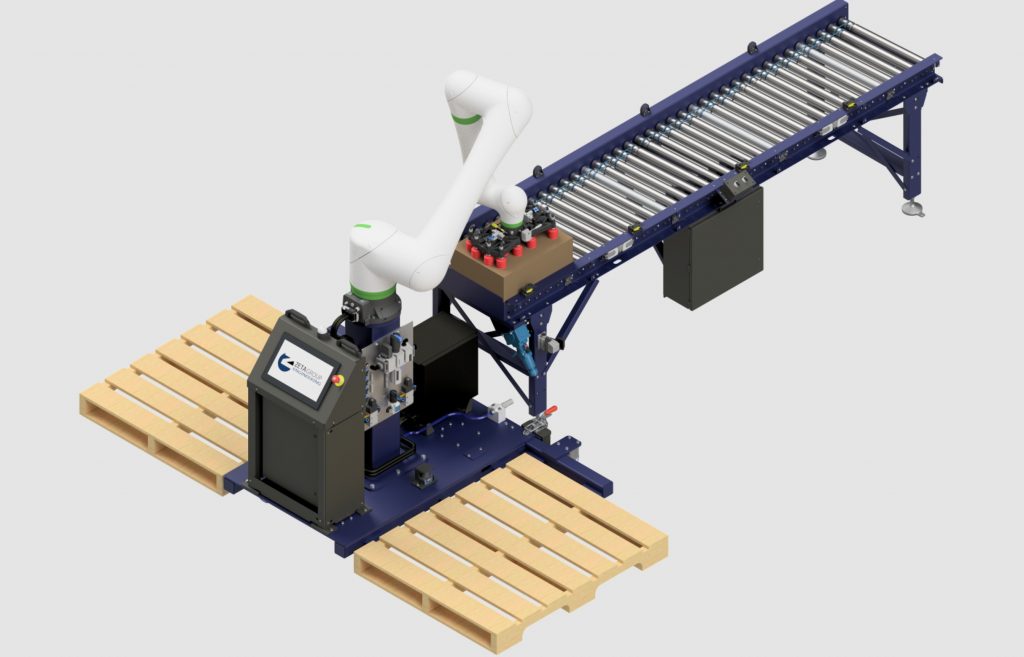
A more complete installation adds the infrastructure around the robot. This includes a conveyor infeed to bring products to the pick point, a pallet dispenser to feed empty pallets in and pallet conveyor to move full pallets away from the robot. That broader turnkey cell typically runs £70,000-£150,000 in the UK.
The gap between those two figures represents real infrastructure your operation either has or doesn’t. Being clear on that before you request quotes will save you a lot of time trying to compare proposals that are solving different problems.
What drives the cobot palletiser price up?
The gripper is the single biggest variable in a cobot palletising project. Picking uniform cardboard boxes with vacuum cups is a solved problem, quality off-the-shelf options already exist. Picking bags, flexible pouches or products that compress or shift under suction is a different challenge, and the engineering work to get that right adds cost. Not because integrators are padding the price, but because it genuinely requires more engineering time to specify, test and validate. (see our detailed breakdown of grippers)
Product variety matters too. A cobot palletiser running one box format on one pallet configuration is far simpler to integrate than one that handles 20 SKUs with different layer patterns, box weights and pallet specs. Each additional configuration adds programming time, and most of that is paid for upfront in the project cost. If you’re comparing different system types, see our guide to cobot palletiser vs robotic palletiser.
Site preparation is often the hidden variable. Level floors, suitable power supply, compressed air supply (if needed for the gripper) and clear access around the cell during installation sound obvious, but they frequently cause cost surprises. If your end-of-line area needs electrical work, floor treatment or significant rearrangement of surrounding equipment, you need to factor that into your expectations before quotes land.
The robot arm brand also affects the number. Universal Robots UR10e and UR20 are the most commonly deployed cobots for UK palletising and sit in a mid-range bracket. FANUC CRX and OMRON TM series are alternatives that some integrators specialise in. The arm itself typically accounts for 30-40% of total project cost on a standard installation.
Typical cost breakdown of a cobot palletiser
While every project is different, a typical UK cobot palletising system often breaks down roughly as follows:
- Robot arm: ~25–40%
- End-of-arm tooling (gripper): ~5–25% – very much dependent on your product(s)
- Frame, base, and safety system: ~10–20%
- Conveyors and pallet handling: ~10–40%
- Integration, programming, commissioning: ~10–30%
This is why two quotes for the “same” application can vary so widely.
The ongoing costs most quotes don’t show you
A turnkey quote gets you to go-live. What it often doesn’t cover is what happens after that.
Annual maintenance contracts for a cobot palletising cell typically run £3,000-£8,000 per year, depending on scope, whether preventive maintenance visits are included and how quickly you need an on-site engineer in the event of a breakdown. Some integrators bundle a first-year contract into the project price; most don’t.
Consumable gripper parts, vacuum cups, foam pads, wear items on a mechanical gripper, add a few hundred pounds a year on a well-specified installation, more on a demanding product or a gripper that wasn’t quite right to begin with. End-of-arm tooling is the hardest-working part of the system and worth asking about specifically: what’s the expected service life, what does replacement cost, and who carries the spares?
What payback do UK manufacturers actually see?
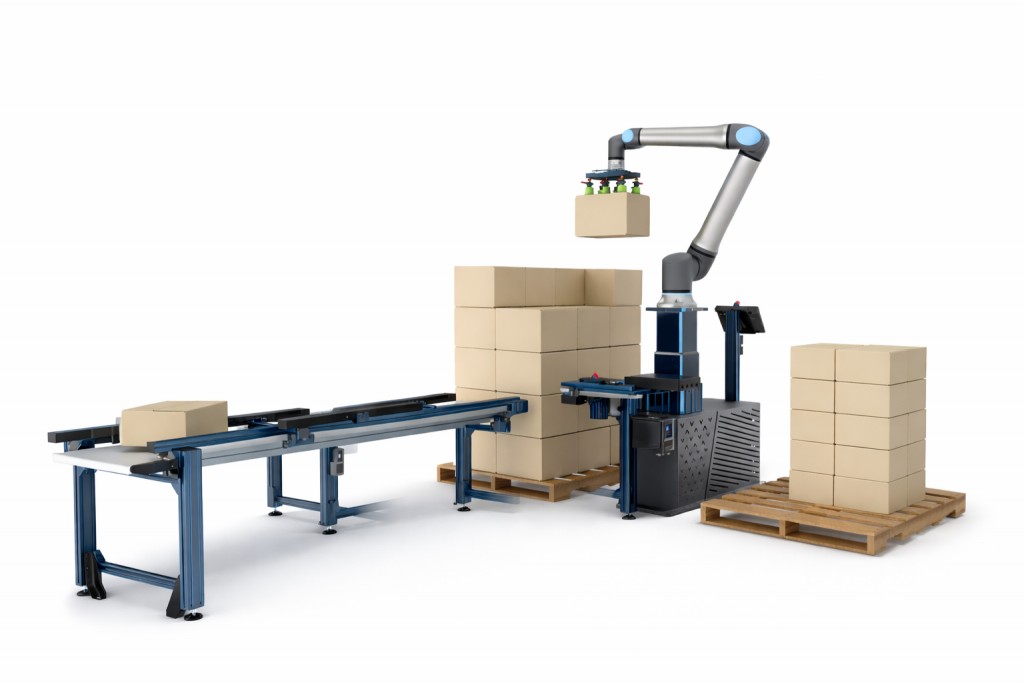
On a standard two-shift operation replacing one manual palletising position, most manufacturers see payback in the 18-30 month range (you can model this using our palletising ROI calculator). That calculation is based on the loaded cost of a palletising operative (typically £28,000-£35,000 per year including employment costs, holiday cover, and recruitment), the capital cost of the installation and consistent operation across those shifts.
The calculation gets more interesting when you factor in what the robot enables rather than just what it replaces. A cobot palletiser running overnight without supervision can generate a full shift’s output with zero additional labour cost. For a manufacturer who currently doesn’t run nights because they can’t reliably staff them, that’s not cost reduction, it’s capacity that didn’t exist before.
Payback is also sensitive to how intensively the robot runs. A cell that sits idle for 30% of the working day because the line upstream runs slow pays back more slowly than one that runs close to continuously. Modelling your actual throughput pattern rather than peak capacity gives you a more honest picture.
How to get an accurate quote
The most useful thing you can do before requesting quotes is pin down your product and pallet specification (If you’re unsure what level of automation you need, start with our cobot palletising overview.). Box dimensions and weight, number of SKUs, pallet patterns, number of layers, target throughput rate and whether the robot needs to switch between configurations automatically. The more precisely you can answer those questions, the more comparable the quotes you receive will be.
A site visit from a potential integrator is worth accepting even if you’re not sure you’re ready to buy. A good integrator will flag things about your site that you hadn’t considered and those conversations usually move the project further forward than any amount of brochure reading.
If you want a shortlist of UK cobot palletising integrators without the cold-call cycle, the directory below is filtered by application and capability. If you’d rather be matched to a shortlist based on your specific operation, the matcher takes about 3 minutes.
Prefer to browse first? Here are 10 UK cobot integrators worth knowing.
What UK manufacturers often get wrong
The most common mistake is comparing quotes line-by-line without checking what’s actually included.
A £40,000 system and a £120,000 system are rarely equivalent, they’re usually solving different parts of the problem.
The second mistake is underestimating upstream constraints. If your line doesn’t consistently feed product, even the best palletising system will sit idle for a percentage of it’s time.
Both issues are avoidable with a clear brief and a short initial conversation with a competent integrator.
Once you start getting into the higher end of the price range it may be better to start looking at more traditional robotic palletising cells.
Frequently Asked Questions
Can a cobot palletiser handle bags and flexible packaging?
Yes, but it’s one of the harder gripper challenges. Bags that compress under suction, shift during transit or vary in fill level need a custom gripper design. It’s a solvable problem but ask any integrator to show you examples from existing installations running similar products before you commit. A gripper that works in a demonstration often doesn’t survive a full production shift without refinement.
Do I need safety fencing with a cobot palletiser?
In most installations no full perimeter fence is required but it should not be assumed that, just because it’s a cobot, that safety isn’t a concern. Cobots are designed to reduce speed or stop on unexpected contact. UK installations of cobot palletisers typically use a combination of floor markings, low barriers and area scanners to define the robot’s working zone. Your integrator should conduct a formal risk assessment, the exact setup depends on your layout, the product, how the robot is deployed, how many operators will be working in the vicinity and any sector-specific regulations that apply to your site.
How long does installation actually take?
A standard cobot palletising cell on a pre-prepared site typically takes 2-6 weeks from delivery to go-live, with site preparation like electrical supply, floor marking, conveyor alignment usually running in parallel. The timeline risk most people underestimate is lead time on the robot arm and gripper components, which can run 8-14 weeks from order. If you’re working to a deadline, factor that in from the start of the project, not after the quote is signed.
Can a cobot palletiser run overnight without supervision?
Yes, and this is one of the stronger practical arguments for the technology. Once commissioned and stable, a cobot palletiser runs unattended across shifts provided product feed and pallet changes are either automated or built into a shift handover. Most operations pair the robot with a pallet dispenser and stretch wrapper to minimise human interaction. The key question is how your site handles a fault condition at 3am, make sure you know what the robot does when something goes wrong, and who you call.