
The sales pitch for cobot palletising has got considerably slicker over the last few years. Lower upfront cost, no hard guarding, quick to deploy. And for some operations, that pitch is completely accurate. For others, it leads manufacturers into buying a system that can’t keep up with their line.
The honest answer depends on 3 things: your throughput, your product weight, and how much floor space you’re working with. Get those right and the decision usually makes itself.
Want a guide on whether or cobot palletiser or a more traditional robot palletiser would be more suitable? Try our palletising automation selector tool.
What’s actually different between the two systems?
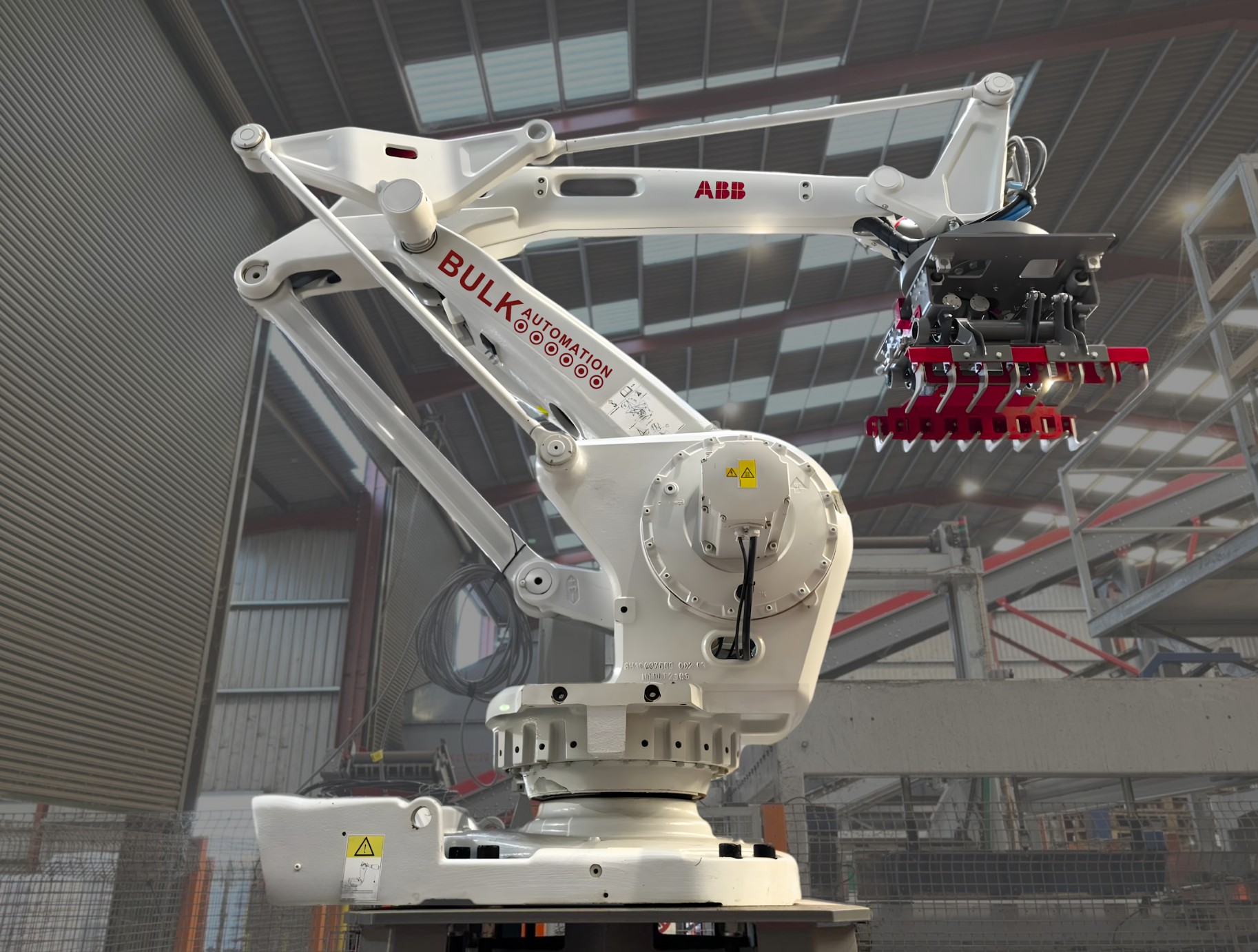
A traditional robotic palletising cell is built around a 6-axis industrial arm, typically a larger payload model from FANUC, ABB or Kuka. Hard guarding is standard because the arm moves fast and the loads are heavy, so fencing and interlocked gates around the full cell perimeter are the norm. The cell is purpose-built, with conveyor infeed, pallet dispenser and stretch wrapper all integrated around the robot.
Cobot palletisers work a little differently. Our Cobot Palletising Guide explains how these systems work, the applications they suit, typical costs and the factors to consider when specifying one. The robot arm itself is collaborative, usually from manufactures like Universal Robots or Doosan, and the safety system relies on area scanners and speed limiting rather than a physical cage. The footprint they take up is also usually smaller, and some systems are made to be semi-mobile, which matters more than people expect if your factory layout shifts seasonally.
Both technologies are mature and proven. The question isn’t which one is more reliable, it’s which one fits your application. To help with this we have built a handy tool that will analyse the cycle times you need to hit and tell you if a cobot or traditional robot are the answer.
Where cobots are the right choice
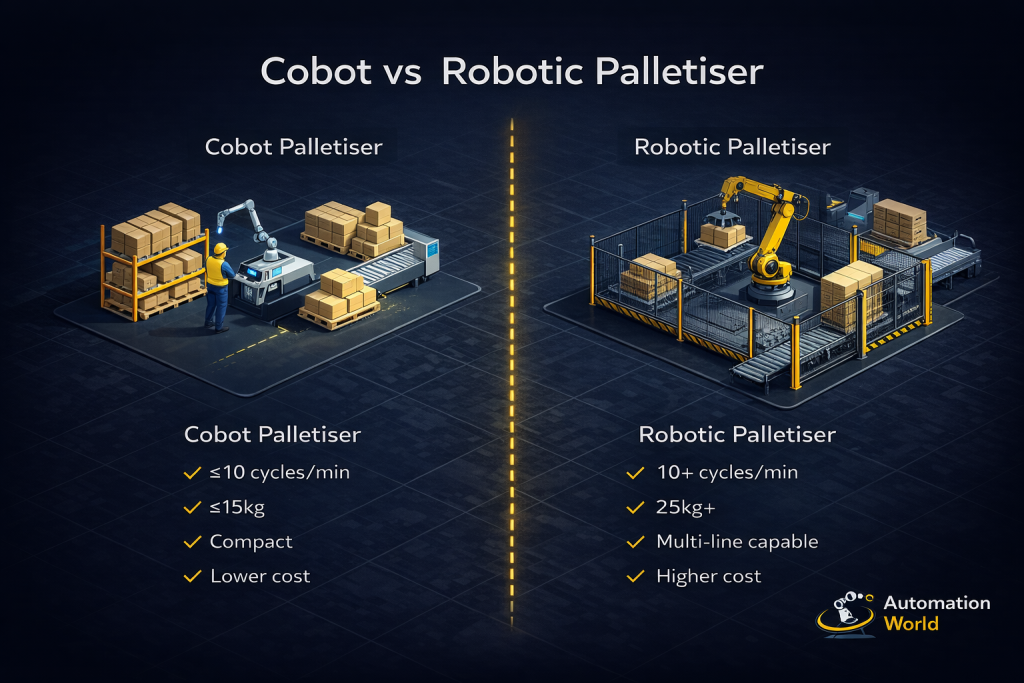
The cobot case is strongest when your throughput is on the lower side (roughly 10 cycles per minute, though this varies by system). Your product will also need to site within the payload capacity of the robotic arm, including the weight of the end of arm tooling. Most cobot palletisers handle between 10kg and 20kg for tool and product combined, so that limit is worth checking against your actual case weights before you go any further.
Food manufacturers running a single or double shift on a lower-volume line are often a good fit. So are operations where the palletising cell needs to sit close to people without a hard exclusion zone.
There’s also a genuine argument for cobots as a first automation project. The capital outlay is lower. A compact cobot cell can come in under £60,000 fully installed, and the disruption during installation is considerably less than a full traditional build. Operators tend to find the HMIs more approachable too, which cuts training time. If you’re new to automation and want to prove the business case internally before committing to a larger system, a cobot cell is a reasonable starting point (assuming your product and throughput meet the requirements of course)
One specific detail worth checking before going any further is the payload rating on a cobot. You need to factor in the weight of the gripper itself, not just your product, this is very important. A cobot rated to 20kg might realistically handle 10 to 12kg of actual product once the end-of-arm tooling is factored in. On most cobot palletisers, vacuum grippers are the standard choice precisely because most other gripper types consume too much of that weight budget before you’ve picked anything up. If your product needs a different gripping approach, a bag gripper, a clamp, an underneath pick for example, you really need to check the numbers carefully before assuming a cobot will work. This is one of the more common ways automation projects go sideways.
UK Integrators Offering Cobot Solutions

Cobots Online
UK cobot automation experts supporting manufacturers with cobot solutions that boost productivity and improve quality

Reeco Automation Ltd
End-of-Line Automation & Robot Palletising Experts
RARUK Automation
Integrator and distributor for MiR robots
Where traditional systems are the right call
One constraint that catches manufacturers out is that most cobot palletisers can only serve a single infeed line. The reach of the arm limits where the pick point can be, and there’s no practical way around that on a compact cobot cell. If you’re running 2 or more production lines that need palletising, a traditional system designed to serve multiple lines simultaneously is almost certainly the right build, regardless of what the throughput numbers look like on any individual line.
Throughput is the clearest limiter for cobots. Above 10 to 12 cycles per minute, a traditional 6-axis arm will run substantially faster on cycle time. If you’re running 3 shifts on a high-volume FMCG or food line, a cobot palletiser probably can’t physically keep up, regardless of how well it’s configured.
Payload matters just as much. Bags of cement, 25kg sacks of animal feed, heavy cases of canned goods — most cobots won’t handle these. The payload limits aren’t arbitrary; they’re built into the safety architecture of the technology. A traditional industrial arm, properly specified, has no such constraint.
Continuous operation in demanding environments is also worth thinking about. A traditional palletising cell running 24/7 in a tough industrial setting has decades of proven performance behind it. Cobot technology is reliable, but it hasn’t accumulated the same operational track record on the harshest long-run applications. That gap will narrow, but it hasn’t closed yet.
There’s also a build quality difference worth being honest about. Cobots are deliberately constructed to be lightweight, because that’s what allows them to detect small forces and stop safely. The trade-off is that they have a shorter operational lifespan than a traditional industrial arm and can lose precision and repeatability over time in a way that a heavier-duty system generally doesn’t. On a 7 to 10 year asset life calculation, that’s a factor worth considering.
UK Integrators Offering Traditional Palletising Solutions

Bulk Automation
Specialists in Automated Bagging & Palletising Systems

Geku Automation (Geku UK Ltd)
Robotic Automation Systems

Solent Automation
Democratising robotic technology
What the cost difference actually looks like
A cobot palletising cell typically runs from around £40,000 to £100,000 fully installed, depending on the peripheral equipment required. A traditional robotic palletising cell starts at roughly £60,000 for the simplest single-SKU configuration and can reach £600,000 or more for a high-throughput multi-line system with automated pallet transfer, wrapper and conveyors.
The gap narrows when you factor in the full cost of a cobot installation. Area scanners, safety-rated I/O and a properly engineered end-of-arm tooling (EOAT) can push costs up considerably from the base robot price. The robot arm isn’t the whole system, and quotes that only show you the arm price aren’t showing you the whole picture.
Running costs tend to differ too. Traditional systems can carry higher maintenance overheads and occasionally need specialist engineers on site. Cobot systems are generally easier for in-house maintenance teams to manage day-to-day, which adds up over a 7 to 10 year asset life.
To get a better idea of how to calculate the ROI on your potential palletising project, have a read of our guide.
The decision in plain terms
The most useful question isn’t “which technology is better?” It’s whether your line’s throughput, product weight and floor space actually fit the cobot envelope.
Under 10 cycles per minute, products under 15kg, working in a tight space, a cobot will almost certainly do the job and cost you less to get there. Above those thresholds in any meaningful way, a traditional system is probably the right build.
The place this goes wrong is when manufacturers choose a cobot because it’s cheaper, without checking whether it can handle the throughput and payload at peak. Integrators with experience across both technologies will tell you the same thing, undersizing a palletising system is a more expensive mistake than oversizing one.
For a full look at how robotic palletising systems work, including costs, timelines and what to look for in an integrator, the robotic palletising application guide covers it in detail. For collaborative robot applications beyond palletising, the cobot automation guide covers the broader picture, or see our list of dedicated UK cobot integrators.
If you’d like matched recommendations from UK integrators working across both technologies, the Project Matcher takes about 2 minutes.
Frequently Asked Questions
Can a cobot handle multiple SKUs on the same palletising line?
Yes, and this is one of the areas where cobots have genuinely kept pace with traditional systems. Changing a pallet pattern via the HMI is no slower than on a traditional arm. The complication comes when your SKUs vary significantly in weight or dimensions, because the EOAT needs to handle all of them reliably. That’s a conversation to have with your integrator early in the process, not after the system has been built and you’re discovering the limits during commissioning.
Do cobot palletisers really not need guarding?
They don’t need a hard cage in the way a traditional industrial arm does, but that doesn’t mean they operate completely without safety measures. Collaborative operation relies on area scanners, speed and force limiting, and a properly completed risk assessment. Some cobot palletising installations still include partial guarding, particularly around the pallet change area. Anyone telling you a cobot palletiser is entirely unguarded is either oversimplifying or selling you something.
Which takes longer to install?
A cobot cell is generally quicker to get running, often 2 to 4 weeks from delivery to live production on a typical application. A traditional cell will usually need 2 to 3 weeks for installation and a further 2 to 4 weeks for commissioning, longer if you’re programming multiple SKU patterns during live production. What people tend to forget is that both have a similar lead time upstream: 10 to 18 weeks at the integrator’s facility before anything arrives on site. The robot turning up isn’t the starting gun.