

A competitor installs a cobot. Your operations director reads about it. Someone senior asks why you haven’t done the same. And suddenly your business is six months into an automation project that nobody properly defined, solving a problem nobody clearly named.
This is how most factory automation projects actually start. Not with a process problem. With a technology decision.
It’s also why so many of them underdeliver.
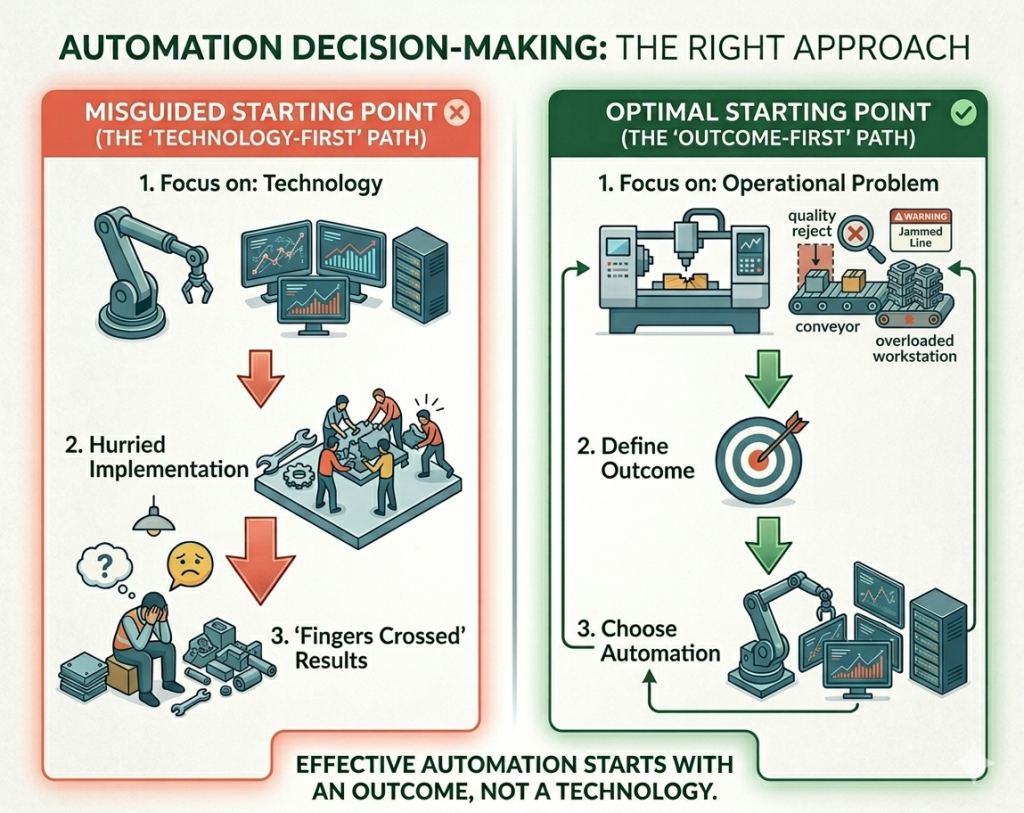
The technology-first trap
Buying or trialling automation because it seems like the right time, or because someone else is doing it, isn’t a strategy. It’s a bet. And more often than not, the payoff doesn’t come, not because the technology doesn’t work, but because nobody established what success would actually look like before the kit arrived.
The pattern is recognisable. You start with a technology. You implement it. Then you hope it helps. If it does, you can’t easily measure by how much. If it doesn’t, it’s hard to say exactly why it has failed.
It feels like progress because something is happening. But activity isn’t the same as improvement.
What the right starting point looks like
The manufacturers who get the most out of automation don’t start by choosing a robot. They start by naming a problem.
Not a vague one, “we need to be more efficient” just won’t cut it. A specific problem. A line that goes down too often. A task that takes three people and consistently causes quality issues. A bottleneck that caps your throughput at a point well below demand.
Once the operational problem is clearly defined, the second step is to define what a better outcome looks like. Not in general terms, but in terms that you can clearly measure. Faster cycle times, but by how much? Labour redeployed to where? Defect rate reduced to what threshold?
Only then, with a real problem and a defined outcome, does it make sense to ask which automation technology actually fits.
That sequence changes everything. Instead of hoping the technology helps, you’re choosing technology specifically because it solves a known problem that you have to a measurable standard. The integrator you bring in knows what they’re being asked to achieve. The ROI case writes itself. And if the solution doesn’t perform, you know exactly what benchmark it’s fallen short of.
Why this matters when you’re choosing an integrator
A good robotics integrator will ask you about your problem before they talk about what robotics they can offer. That’s not a sales technique, it’s how the work gets done properly. They need to understand the operational problems that you are having before they can design a solution that solves it through automation. You need to bear this in mind when choosing an integrator.
If an integrator leads with the technology, for example if the conversation starts with a specific robot model or a standard system before they’ve discussed and understood your process and issues, that’s worth pausing on.
The right integrator will want to know what’s going wrong and why. They will need to know what improvement looks like, and what constraints you’re working within. This could include factory space, operational budget, existing equipment that it might need to work with or operator skill levels. All of it matters before a solution begins to take shape.
The practical takeaway
Before you even start having discussions with potential integrators you should list down three things. The overall operational problem you are having, and be as specific as you can be. What success would look like and how it would be measured. What is currently stopping you from solving this problem manually. Making the decision purely on cost is almost always the wrong choice, as our guide to cobot palletising vs traditional robot palletising shows.
Knowing those three things as you enter into any discussions will make the conversation with an integrator much clearer and give the integrator a much better chance of proposing the right solution.
If you’re at that stage and ready to speak to integrators, the Automation World directory lists UK robotics integrators by capability and sector. Start with your problem. Find the right people to solve it.