Application guide Cobot palletising · 2026
Cobot Palletising End-of-line automation with collaborative robots
Cobot palletising is an increasingly popular way for UK manufacturers to automate the repetitive task of stacking boxes, cases, bags and other products onto pallets.
What is a Cobot Palletiser?
A cobot palletiser uses a collaborative robot arm, usually combined with a dedicated gripper and palletising software, to pick products from a conveyor or production line and place them onto a pallet in a programmed pattern. Unlike a traditional industrial robot palletiser, a cobot system can often be installed in a smaller footprint and may require less physical guarding, although every installation still requires a suitable safety assessment.
Cobot palletising can be particularly attractive for manufacturers with moderate production volumes, multiple product formats or limited floor space. The key questions are whether the cobot can handle your product weight, required throughput and palletising cycle time.
If you're considering automation, this guide explains how cobot palletising works, what it costs, where it is suitable and when a traditional robotic palletiser may be the better option.
A cobot palletiser is a collaborative robotic arm, usually mounted on a fixed base, fitted with a gripper and programmed to pick products from a conveyor or collection point and stack them onto a pallet in a set pattern.

A cobot can be configured for collaborative operation using safety functions such as power and force limiting or speed and separation monitoring. Whether people can safely share the robot's working space depends on the complete application, including the robot, gripper, product, speed and surrounding equipment, so a risk assessment is still required.
The trade-off is throughput and payload. Most cobot palletisers handle products up to around 12–20kg per pick and run at rates suited to lower-volume or mixed-SKU lines. Higher-throughput applications may be better served by a traditional industrial robot, particularly where the required cycle time, payload or number of production lines exceeds the practical capabilities of the cobot. We have a handy tool to help here, try our cobot palletiser cycle time calculator to see if a cobot will keep up with your throughput. Here is our full guide to robotic palletising.
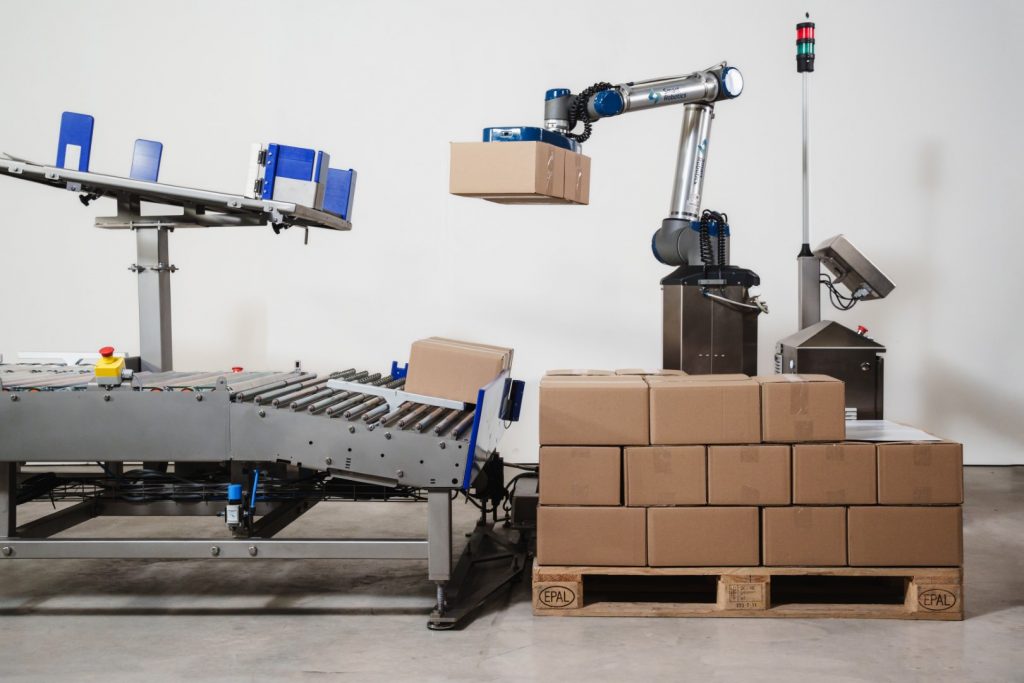
The gripper is where most of the real problem-solving happens.
Will a cobot keep up?
Most cobot palletisers handle 12–20kg per pick at rates suited to lower-volume or mixed-SKU lines. Once you get much above 10–12 picks a minute, a traditional industrial palletiser may be worth considering.
Read the robot palletising guideRunning several box formats on one line? Patterns switch on a touchscreen, without code.
Find cobot palletising integratorsWhy Use a Cobot Palletiser?
Manual palletising is hard, repetitive work. People get tired, they leave, and injuries are a constant risk. A cobot palletiser takes that job on and just gets through it, all shift, every shift, without slowing down or calling in sick.
-
All shift
Every shift, without slowing
A cobot can repeat the same palletising task consistently across a shift without the fatigue associated with manual handling.
-
+1 shift
Additional production capacity possible
For sites that can't run nights for lack of people, a cobot palletiser means producing more in the first place.
-
The same pallet every time
Pallets built the same way at a steady pace, which matters once they're moved, stored and shipped.
Honest qualifier Each stacking pattern still has to be set up and tested upfront. Switching between them is quick; creating new ones takes time and some training.
How Does Cobot Palletising Work?
Five stages, and the question worth putting to your integrator at each one.
-
Throughput and payload check
Confirm the cobot can handle your product weight, required throughput and cycle time before anything else.
Ask: Will a cobot keep up with my line speed?
-
Gripper selection Critical
Boxes usually suit vacuum cups. Bags, pouches and awkward shapes need foam grippers, clamps or both. Get this right early, or spend the project working around it.
Ask: Has the gripper been tested on our actual products?
-
Safety assessment Mandatory
Many cobot cells don't need a full cage, but a risk assessment confirms it and sets the guarding, light curtains or area scanners.
Ask: What guarding will our cell need?
-
Pattern set-up
Palletising software lets you set up and switch patterns on a screen rather than writing code.
Ask: Can our operators create new patterns themselves?
-
Pallet change
When a pallet is full, an operator swaps it, or a pallet dispenser, conveyor and wrapper handle it automatically.
Ask: Manual or automatic pallet change for our volumes?
Key components
-
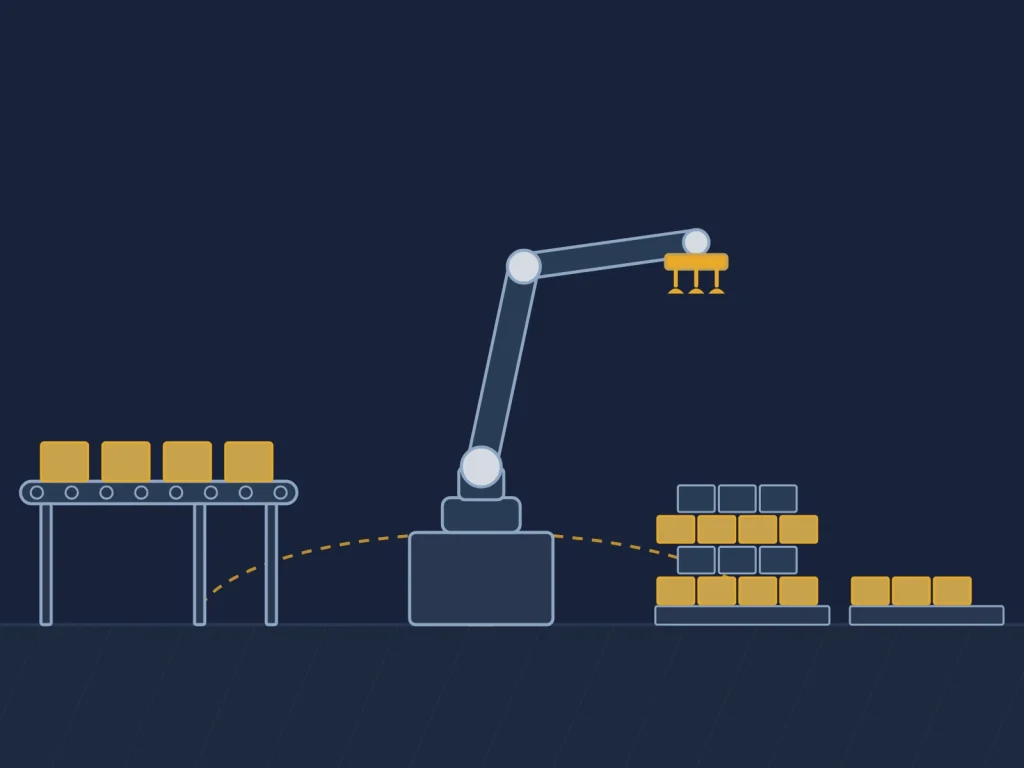
Cobot arm
Usually on a fixed base. Common arms in UK cells include:
UR10eUR20Fanuc CRXDoosanOmron TM
-
Gripper Make or break
Vacuum cups for boxes; foam grippers or clamps for bags, pouches and awkward shapes.
-
Infeed conveyor
Brings products to a fixed pick point.
-
Safety zone
Guarding, light curtains or area scanners mark the working area instead of a cage.
-
Pallet positions
Pallet detection, with an optional dispenser, pallet conveyor and wrapper for automatic changes.
What Industries Use Cobots for Palletising?
-
Food and drink manufacturing
Cases, trays and bags at the end of mixed-product lines.
-
FMCG and consumer goods
Frequent format changes, where switching patterns on a touchscreen earns its keep.
-
Contract packing
Many customers and formats through the same line.
-
3PL and distribution
Building outbound pallets in a compact footprint.
-
Pharmaceutical and healthcare
Lighter cases with strict, consistent load presentation.
-
E-commerce fulfilment
Mixed SKUs and changing volumes, with little room for a caged cell.
-
ROI calculator
Will cobot palletising pay back in your sector?
Put in your own wages, shifts and project cost to see a payback estimate in under a minute.
Work out your ROI
Is a Cobot Palletiser Right for Your Production Line?
A cobot palletiser can be an effective solution for manufacturers that need to automate palletising but do not require the speed or payload capacity of a large industrial robot. The right choice depends on the products being handled and the demands of the production line.
A cobot palletising system is worth considering when:
- Product weights are within the cobot's practical payload: The weight of the gripper must be included alongside the product when calculating the required payload.
- Throughput is moderate: Cobot palletisers are generally better suited to lower and medium-volume applications than very high-speed production lines.
- Products or pallet patterns change regularly: Cobot systems can be well suited to applications involving multiple SKUs and different stacking patterns.
- Floor space is limited: A compact cobot cell can often fit into areas where a larger robotic cell would be difficult to accommodate.
- You want a relatively flexible automation system: Some cobot palletising systems can be moved or reconfigured more easily than a traditional fixed robotic cell.
The most important test is whether the cobot can achieve your required cycle time while handling the product and gripper within its rated payload. Our Cobot Palletising Cycle Time Calculator can help you assess the required throughput before speaking to an integrator.
If your line requires high-speed palletising, heavy products, multiple production lines or continuous high-volume operation, a traditional industrial robot may be more appropriate.
How much does a cobot palletising cell cost?
Investment range Indicative UK costs, excluding VAT
-
Simple system
Robot arm, standard gripper, fixed base, pallet detection and basic integration. Assumes existing conveyor/infeed and limited pallet handling automation.
-
Medium complexity
Full turnkey cell with conveyor infeed, pallet dispenser, master control panel and integration. Multi-SKU programming included.
-
High throughput
Dual-arm or multi-line configurations, bespoke gripper tooling for difficult products, and high-throughput setups.
Project timeline 10–22 weeks, design to sign-off
-
3 – 5 weeks
Design
Site survey, product and pallet sign-off, gripper selection and stacking patterns.
-
5 – 12 weeks
Build
Robot and component lead times vary by manufacturer, integrator will confirm these during planning.
-
1 – 2 weeks
Installation
On-site mechanical installation, electrical connection, conveyor alignment.
-
1 – 3 weeks
Commissioning
Full product and pattern commissioning, operator training, go-live sign-off.
Typical UK ranges from integrator quotes, for guidance only. Your cost depends on the parts, cycle time, safety and site.
UK integrators
-
 View profile
Cobots Online Claimed
UK cobot automation experts supporting manufacturers with cobot solutions that boost productivity and improve quality
Automotive, General Manufacturing
-
 View profile
SP Automation & Robotics Claimed
Bespoke Automated Machines / Robotic Integrators UK
Food & Beverage, Pharmaceutical
-
 View profile
See all 17 suppliers listed under Collaborative Robots (Cobots)
Project Matcher
Get a shortlist of UK integrators for this job
Answer four questions about your project. We match you with UK integrators who do this work.
Get matchedFrequently asked questions
What's the difference between a cobot palletiser and a traditional palletising robot?
The main difference is the way the two systems are designed to operate safely. A traditional industrial robot palletiser normally operates at high speed inside a dedicated safety cell with guarding and interlocked access. A cobot palletiser uses a collaborative robot with safety functions such as force and speed monitoring, although appropriate safeguarding and a risk assessment are still required. Throughput and payload are also important differences. Cobot palletisers are generally suited to lower and medium-volume applications, while traditional industrial robots can handle higher speeds, heavier products and more demanding production requirements. If you're deciding between the two technologies, see our guide to Cobot Palletiser vs Robotic Palletiser for a detailed comparison.
Can a cobot palletiser handle multiple SKUs and pallet formats?
Yes, and for many operations it's one of the stronger arguments for choosing the technology. Most cobot palletising software lets operators switch between pre-programmed stacking patterns via a touchscreen without touching the underlying code, useful if you're running 8 box formats across the same line during a shift. The important caveat is that each pattern needs to be set up and tested upfront, which adds time and cost to the initial project. Be upfront with your integrator about the full range of products and pallet specs from the start, not halfway through commissioning.
How much floor space does a cobot palletising cell need?
A basic cell with robot, base, and pallet positions, typically fits into a relatively small footprint (say 4m x 4m), though the real number depends on your infeed conveyor layout, how many pallet positions you're running simultaneously and the clearances needed around the safety zone. One of the practical advantages of not needing a full perimeter cage is that the usable area around the cell stays accessible, which matters in tight end-of-line environments. A good integrator will do a floor layout as part of the early design stage, worth asking for that before you commit to a configuration.
Do we need specialist staff to run and reprogram it day-to-day?
For routine operation and pattern switching, no. Most cobot palletising systems are designed for use by line operators rather than programmers, changing between pre-set stacking patterns is typically a few taps on a screen. Creating a new stacking pattern from scratch requires more time and some familiarity with the software, but most integrators include training as part of commissioning and the better ones offer refresher sessions when you add new products. Where you'll want specialist input is if something in the underlying program needs changing, or if you're integrating a product type significantly different from anything already set up.