
Pallet Pattern
A pallet pattern is the specific arrangement in which boxes, cases or bags are stacked onto a pallet, including how each layer is oriented, how layers interlock, and how many layers make up the finished load. Palletising robots are programmed with one or more pallet patterns so they know exactly where to place each item to build a stable, correctly sized load.
Why pallet patterns matter
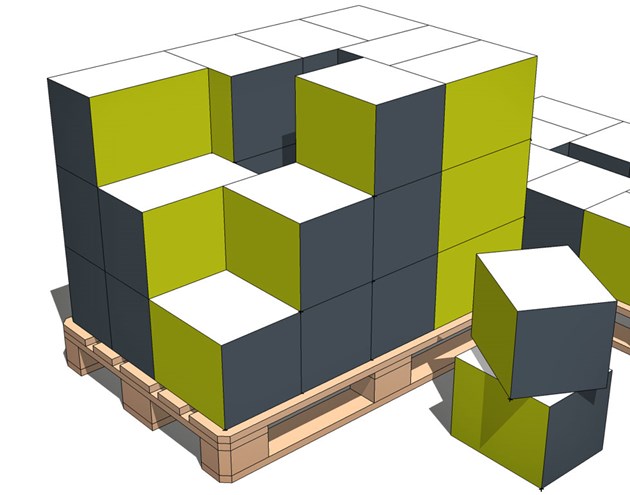
Pallet pattern design directly affects two things manufacturers care about: how much product fits on a lorry, and whether that pallet survives transport without collapsing or shifting. A poorly designed pattern wastes space, meaning more lorries and higher transport cost for the same volume of product, while an unstable pattern risks damaged stock and safety issues in the warehouse or at the customer’s goods-in.
Because pattern design has direct cost implications at scale, many manufacturers use dedicated pallet pattern software to optimise layouts before committing them to a robot’s program, and will run several pattern options during a project to compare stability and pallet efficiency before selecting a final layout for production.
How pallet patterns work
Pallet pattern software takes the case dimensions, weight, and the target pallet size (in the UK, commonly a 1200 x 1000mm pallet) and calculates layout options, typically aiming to interlock alternating layers, where each layer is rotated relative to the one below, to improve the load’s structural stability compared with simply stacking every layer identically.
Some patterns also build in air gaps for ventilation, where required for products like fresh produce, or specific edge overhangs to accommodate shrink-wrapping equipment downstream. Once a pattern is finalised, it is converted into a sequence of robot placement coordinates, either through the palletising robot manufacturer’s dedicated palletising software or a general offline programming tool, and loaded onto the robot controller as a program the robot runs repeatedly. Most systems support multiple pattern programs stored simultaneously, so an operator can switch between product lines or box sizes via the HMI without needing an engineer to reprogram the robot each time a product changes.
Where are pallet patterns used?
- Mixed-SKU pallet building
- Case and carton palletising for FMCG products
- Automated layer interlocking for load stability
- Quick product changeover via stored pattern programs
UK Integrators Offering This Solution

ABB Robotics
Global leader in industrial robots, cobots and AMRs for smarter, more flexible manufacturing

Fanuc
The world's largest robot manufacturer — precision, reliability and zero downtime since 1972

Kawasaki Robotics
Over 50 years of industrial robot expertise — from precision assembly to heavy payload handling
Related Application Guides
Cobot Palletising: End-of-Line Automation with Collaborative Robots
Cobot palletising is an increasingly popular way for UK manufacturers to automate the repetitive task of stacking boxes,…
View Guide
Robot Palletising UK: Automating End-of-Line Stacking
Most production lines in the UK still end the same way they did 30 years ago with a person or persons lifting boxes onto…
View Guide