
Palletising Robot
Why Palletising Robots are Used
Palletising by hand is one of the more physically demanding jobs on a factory floor. It involves repetitive lifting, bending, and rotating, often for hours at a stretch. The injury rate is high, staff turnover in these roles tends to be higher than elsewhere, and output is limited by human endurance.
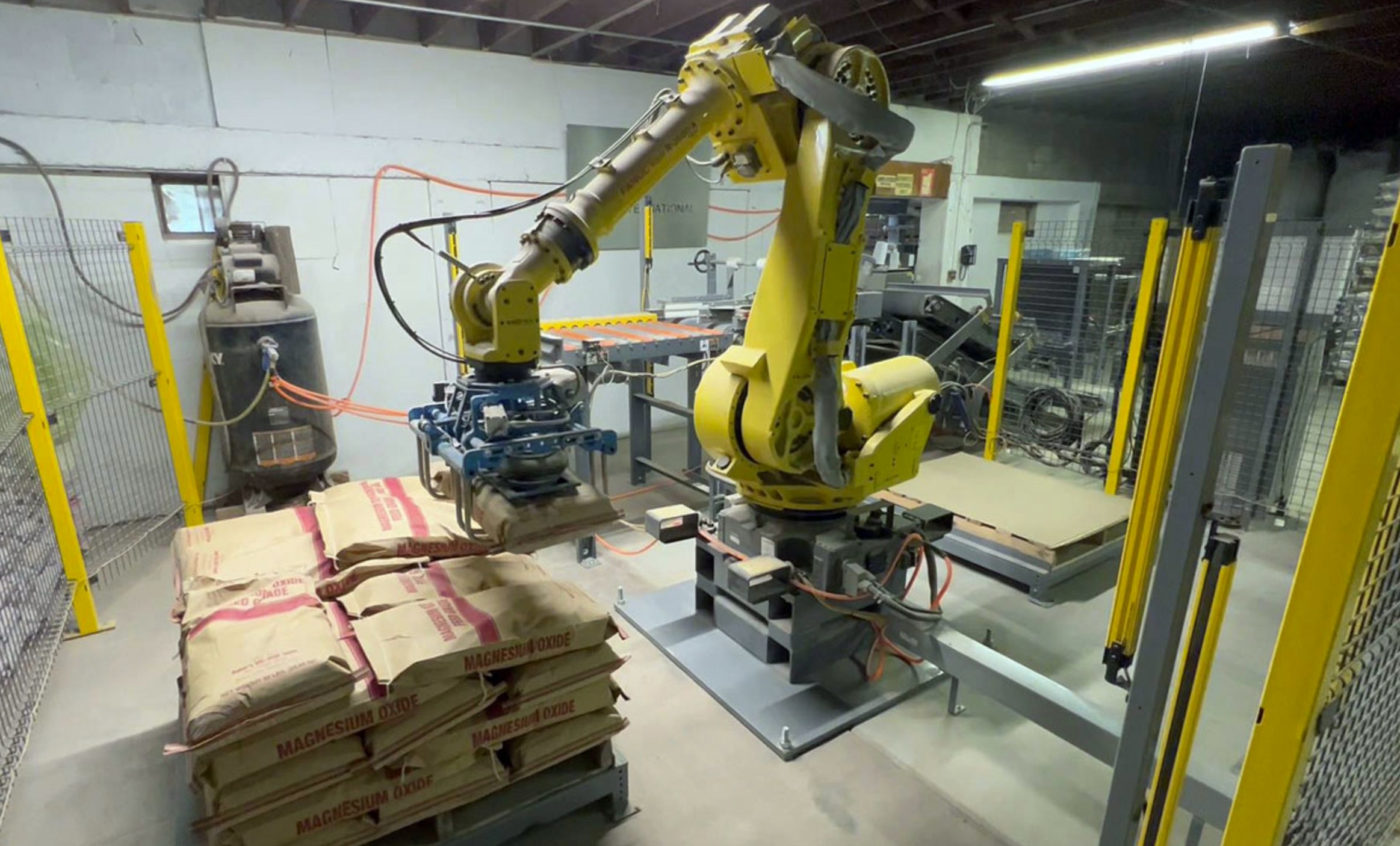
A palletising robot removes all of that. It works at a consistent rate, doesn't slow down at the end of a shift, and can stack heavier loads and more complex patterns than a person working safely. In most applications it also takes up less floor space than a manual palletising operation with equivalent throughput.
Businesses running two or three shifts, or anyone operating 24/7, typically see payback in two to four years. In high-volume operations, it's often faster.
How Does a Palletising Robot Work?
A palletising robot is typically a large-payload articulated arm, six-axis, high reach, mounted on a fixed base or a pedestal. Products generally arrive on an infeed conveyor and the robot picks them up using a specially designed End-of-Arm-Tooling (EOAT). The EOAT is usually a gripper or vacuum cup tool designed to handle the specific product type. It then places each item on the pallet in a pre-programmed sequence, building the pallet up layer by layer.
The stacking pattern is pre-programmed in advance. Pallet patterns matter, an interlocking arrangement gives a stable load that won't shift in transit. The palletising software handles the generation of pallet patterns, working out the most efficient arrangement for the case and pallet dimensions.
Most palletising cells will include a pallet dispenser to feed empty pallets to the robot, a stretch wrapper at the output end to secure completed loads, and a conveyor to move finished pallets away. Some facilities run multiple product lines into a single robot cell, with the robot switching between patterns automatically.
Safety guarding with interlocked access doors or light curtains define the working zone and prevent access while the system is running.
Example Palletising Applications
- End-of-line case palletising in food and beverage production
- Bag palletising for cereals, pet food, and agricultural products
- Mixed pallet building for retail-ready FMCG distribution
- Tier palletising of heavy automotive components
- Drum and container stacking in chemical and industrial manufacturing
- Packing and palletising in e-commerce fulfilment centres
UK Integrators Offering This Solution

ABB Robotics
Global leader in industrial robots, cobots and AMRs for smarter, more flexible manufacturing

Fanuc
The world's largest robot manufacturer — precision, reliability and zero downtime since 1972

Kawasaki Robotics
Over 50 years of industrial robot expertise — from precision assembly to heavy payload handling
Related Application Guides
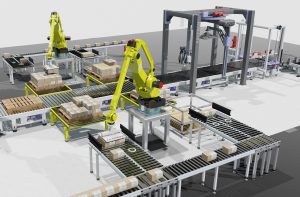
Robot Palletising UK: Automating End-of-Line Stacking
Most production lines in the UK still end the same way they did 30 years ago with a person or persons lifting boxes onto…
View Guide
Warehouse Robotics UK: A Buyer’s Guide to Automation Systems
UK warehouse operators continue to face recruitment and retention challenges. Robots don't fix the people problem entire…
View Guide
Robotic Pick and Place UK: Automation Guide
Robotic pick and place automates the repetitive movement of products, components or parts from one location to another.…
View Guide