
Cobot (Collaborative Robot)
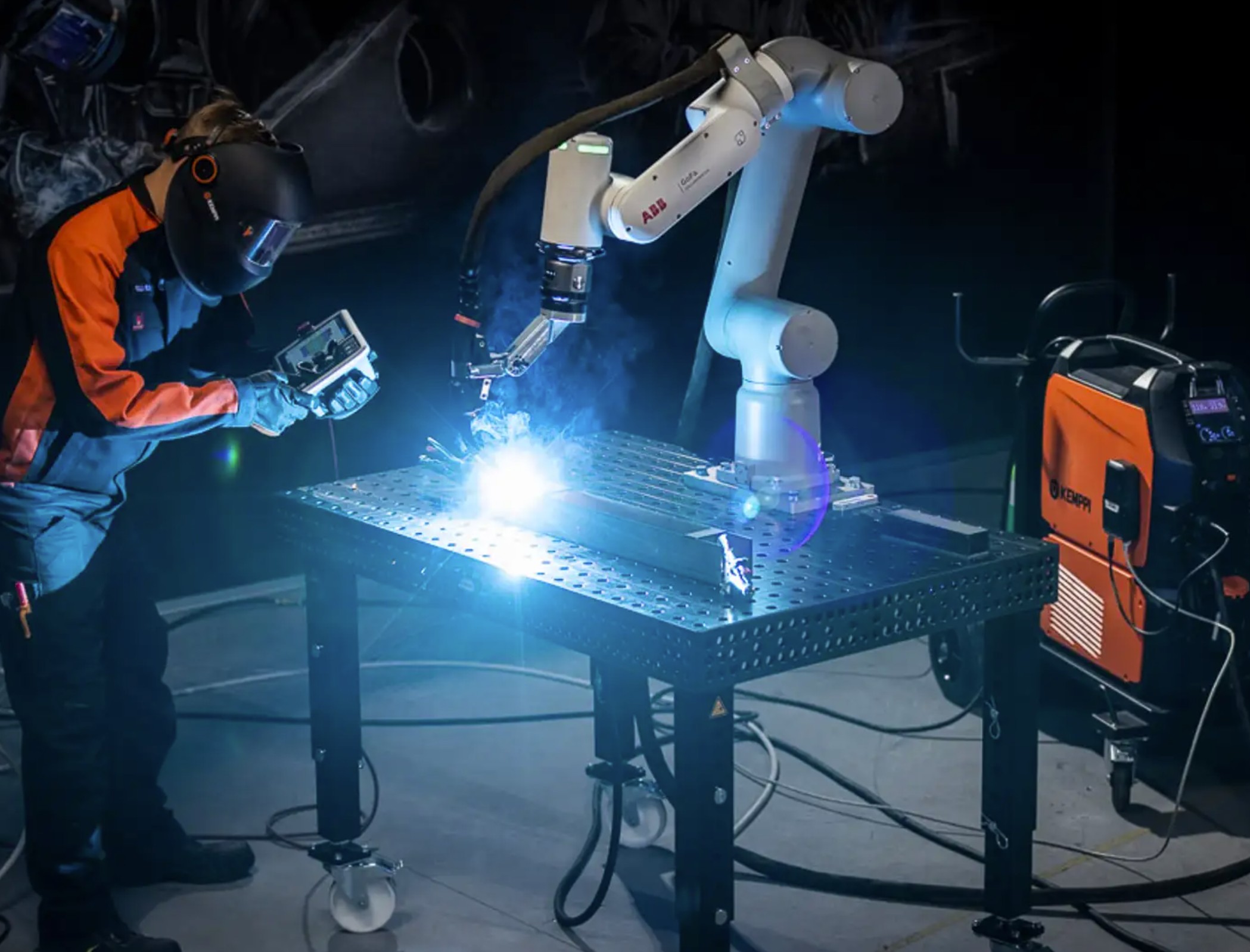
Why Cobots Matter in UK Manufacturing
The reason cobots matter to UK manufacturers right now is access. A traditional robotic welding cell or palletising system starts at £60,000 or more and is built around a specific process. Once it's in, changing it is a project in itself.
Cobots lower that barrier. They're generally quicker to deploy and easier to move between tasks. The don't always require a full safety enclosure (though a proper risk assessment is still required before you operate one without guarding, don't just assume that because it's marketed as a cobot that it is automatically fine to use without guarding). To see if a cobot palletiser is right for you or if you need a more traditional robotic palletising cell, give our guide a read.
For smaller manufacturers running high-mix, lower-volume production, cobots make automation commercially viable in a way that traditional cells don't. They're not always the right answer: if throughput is the priority and your process is highly repeatable, a conventional industrial cell will usually deliver better ROI. But for businesses that need flexibility first, cobots are worth a serious look.
How Does a Cobot Work?
Cobots are typically 6-axis robot arms, the same basic configuration as most industrial robots. What makes them different is the safety architecture. They contain torque sensors in each joint that measure the forces acting on the arm in real time. If the cobot contacts an unexpected object, including a person, it stops within milliseconds. This is what allows them to operate closer to people without a full safety cage in certain applications.
Programming a cobot is also usually simpler than programming a traditional industrial robot (not always and programming software is coming on massively for industrial robots) . Most modern cobots support lead-through teaching, this is where an operator will physically move the arm through the path it needs to follow and the robot controller records the movement. Some also support tablet-based or no-code programming interfaces.
In welding applications, the cobot holds a welding torch and follows a programmed path across a joint. A cell would include a wire feeder, power source, and shielding gas just as with a conventional robotic welding cell. The cobot welding robot replaces the industrial robot arm and controller; everything else in the cell is broadly the same.
For a full guide on UK cobot applications, including costs and lead times, check out our full cobot guide.
What Can You Use a Cobot For?
- Robotic welding — MIG welding of small batch or high-mix components
- Palletising — stacking mixed or varied products at the end of a line
- Machine tending — loading and unloading CNC machines during unmanned shifts
- Assembly — fastening, pressing, or placing components in mixed-product environments
- Quality inspection — holding vision cameras for repeatable part inspection
UK Integrators Offering This Solution

Automation and Robotics Ltd
Automaton and Robotics Integrator

Cobot Automation Ltd
Cobot Automation for UK manufacturers

Doosan Robotics
Next-generation cobots with the widest payload range in the market — safe, intuitive and AI-ready
Related Application Guides
![Machine Tending Robots UK: Costs, Systems & Integrators [2026]](https://automationworld.co/wp-content/uploads/cobot-machine-tending-300x184.jpg)
Machine Tending Robots UK: Costs, Systems & Integrators [2026]
A CNC machine's output depends on more than its programmed machining time. Every part also needs to be unloaded, replace…
View Guide
Cobot Palletising: End-of-Line Automation with Collaborative Robots
Cobot palletising is an increasingly popular way for UK manufacturers to automate the repetitive task of stacking boxes,…
View Guide![Collaborative Robots UK: Cobot Automation Guide for Manufacturing [2026]](https://automationworld.co/wp-content/uploads/cobot-300x200.png)
Collaborative Robots UK: Cobot Automation Guide for Manufacturing [2026]
Most UK manufacturers who've looked at collaborative robots and decided they aren't for them were looking at the wrong a…
View Guide![Cobot Welding Systems UK: Costs, ROI & Suppliers [2026]](https://automationworld.co/wp-content/uploads/cobot-welding-300x229.jpg)
Cobot Welding Systems UK: Costs, ROI & Suppliers [2026]
Cobot welding systems in the UK can typically cost between £30,000 and £150,000+, the exact figure is very dependent on…
View Guide
Robot Palletising UK: Automating End-of-Line Stacking
Most production lines in the UK still end the same way they did 30 years ago with a person or persons lifting boxes onto…
View Guide