
Industrial Robot
An industrial robot is a programmable, multi-axis machine used to automate manufacturing tasks such as welding, assembly, palletising, material handling and machine tending. The term covers several distinct arm designs, articulated, SCARA, delta and Cartesian/gantry among them, each suited to different combinations of speed, payload, reach and precision, but all sharing the ability to be reprogrammed for a new task rather than being built for one job only.
Why an industrial robot is important
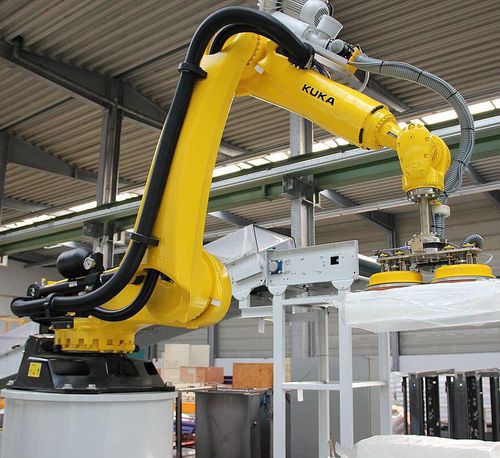
Choosing the right category of industrial robot is one of the first and most consequential decisions in any automation project, because it constrains almost everything that follows, the achievable cycle time, the payload the cell can handle, the footprint required, and the cost.
An oversized 6-axis arm bought for a light, high-speed pick-and-place job will underperform a SCARA or delta robot built for that speed range, while an undersized robot chosen to save on capital cost may simply be unable to handle the payload or reach a project actually needs. This is why a competent integrator will usually ask detailed questions about part weight, cycle time and reach envelope before recommending a specific robot family, rather than defaulting to whichever brand they distribute.
How an industrial robot works
Industrial robots are classified primarily by their mechanical structure. Articulated robots, the most common type, use a series of rotary joints, typically six, to move an arm through a wide, flexible working envelope, making them suited to tasks like welding, palletising and machine tending where reach and orientation flexibility matter.
SCARA robots move in a more constrained, largely horizontal plane and excel at fast vertical assembly and pick-and-place tasks. Delta robots, recognisable by their spider-like design with three arms hung from a fixed overhead base, are built for very high-speed, low-payload picking, common in food and pharmaceutical packing lines. Cartesian or gantry robots move along linear rails in straight X/Y/Z axes rather than rotary joints, offering a large working area and straightforward programming at the cost of some flexibility.
All types are driven by a robot controller running motion-control software, and are typically taught their paths either by manually guiding the arm or by programming coordinates directly in the controller’s software.
Where are industrial robots used?
- Welding and material joining
- Palletising and depalletising
- Machine tending
- Pick and place and assembly
UK Integrators Offering This Solution

ABB Robotics
Global leader in industrial robots, cobots and AMRs for smarter, more flexible manufacturing

Fanuc
The world's largest robot manufacturer — precision, reliability and zero downtime since 1972
Kawasaki Robotics
Over 50 years of industrial robot expertise — from precision assembly to heavy payload handling
Related Application Guides
![Machine Tending Robots UK: Costs, Systems & Integrators [2026]](https://automationworld.co/wp-content/uploads/cobot-machine-tending-300x184.jpg)
Machine Tending Robots UK: Costs, Systems & Integrators [2026]
A CNC machine's output depends on more than its programmed machining time. Every part also needs to be unloaded, replace…
View Guide
Robot Palletising UK: Automating End-of-Line Stacking
Most production lines in the UK still end the same way they did 30 years ago with a person or persons lifting boxes onto…
View Guide
Robotic Pick and Place UK: Automation Guide
Robotic pick and place automates the repetitive movement of products, components or parts from one location to another.…
View Guide![Robotic Welding Systems (UK Guide): Costs, ROI & Suppliers [2026]](https://automationworld.co/wp-content/uploads/robotic-welding-cell-1-300x200.png)
Robotic Welding Systems (UK Guide): Costs, ROI & Suppliers [2026]
Finding and retaining skilled welders is a growing challenge for many UK manufacturers. Robotic welding can help automat…
View Guide