
Machine Tending
Machine tending is the use of a robot to load raw material into a production machine, such as a CNC lathe, injection moulding machine or press, and unload the finished part once the cycle completes. Rather than performing the manufacturing process itself, the robot handles the repetitive loading and unloading around it, freeing an operator from standing at the machine for every cycle.
Why does machine tending matter?
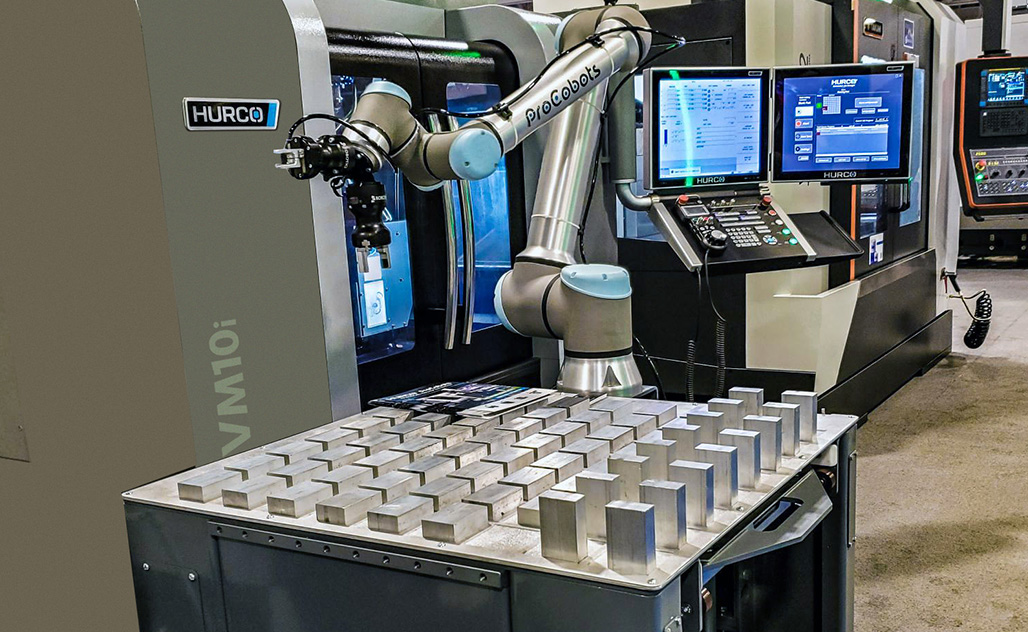
Machine tending is consistently one of the highest-ROI automation applications a manufacturer can look at because it targets idle time rather than adding new capacity. A CNC machine with a five-minute cycle time can lose a significant chunk of that time to manual loading and unloading between cycles, and that time is lost whether or not an operator is available to do it. Automating the tending step lets the machine run through breaks, shift changes and, with the right setup, lights-out overnight, without changing the machining process itself. For UK manufacturers facing persistent recruitment difficulty for repetitive machine-minding roles, it also addresses a real staffing problem, the same operator can often oversee several tended machines at once instead of dedicating a full shift to one.
How does a machine tending cell work?
A machine tending cell places a robot, typically an articulated arm, though cobots are common for lower-volume work, next to the production machine, with access to both the machine’s chuck or mould cavity and a parts store or input/output conveyor. On each cycle, the robot removes the finished part, places it into an output tray or onward conveyor, picks a new raw part or blank, and loads it into the machine before signalling for the machine to start.
This handshake between robot and machine controller is usually done over a simple I/O or industrial network connection, so the robot only proceeds once the machine confirms it is safe to open the guard. Where parts arrive in bins rather than a fixed magazine, a vision system is added to locate and orient each blank before pick-up. Safety guarding, light curtains, interlocked doors, or safety-rated cobot force limiting, is a core part of the design, since the robot works in close proximity to a machine with its own hazards, such as coolant, swarf and moving tooling.
Where are machine tending cells used?
- CNC lathe and milling machine loading
- Injection moulding part removal
- Press brake and stamping press tending
- Multi-machine tending by a single robot cell
UK Integrators Offering This Solution


Cobot Automation Ltd
Cobot Automation for UK manufacturers

Cobots Online
UK cobot automation experts supporting manufacturers with cobot solutions that boost productivity and improve quality
Related Application Guides
![Machine Tending Robots UK: Costs, Systems & Integrators [2026]](https://automationworld.co/wp-content/uploads/cobot-machine-tending-300x184.jpg)
Machine Tending Robots UK: Costs, Systems & Integrators [2026]
A CNC machine's output depends on more than its programmed machining time. Every part also needs to be unloaded, replace…
View Guide