
HMI
An HMI (Human-Machine Interface) is the screen, panel or touchscreen through which an operator monitors and controls an automated machine or robot cell. It displays real-time information such as machine status, cycle counts, fault alarms and sensor readings, and lets the operator start, stop, adjust or reset the process without needing to access the underlying PLC programming directly.
What makes an HMi important?
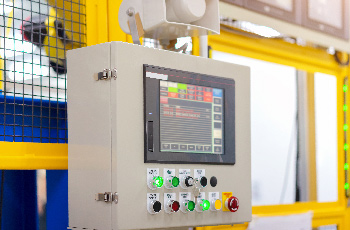
An HMI is often the single biggest factor in how quickly an operator can be trained on a new automated cell, and how quickly they can respond when something goes wrong. A well-designed HMI shows a clear fault message and a suggested next step; a poorly designed one shows a cryptic code that only the original integrator can interpret, which can mean a line sits stopped waiting for a support call rather than for an operator to fix a jam.
For manufacturers investing in automation, it is worth treating HMI design as a real requirement to specify up front, screen layout, alarm wording, and language options, rather than an afterthought left entirely to the integrator’s default templates.
How does an HMI work?
An HMI runs on a dedicated industrial touchscreen panel, or occasionally a standard PC, and connects to the cell’s PLC over an industrial network to read and write specific data points, known as tags. The HMI software is used to build screens, often organised as an overview screen, individual station or axis screens, an alarm history screen, and a settings or recipe screen, each pulling live values from the PLC and, where the operator has permission, writing values back, such as a changed setpoint or a manual jog command.
Alarms are usually configured with priority levels, so a critical safety fault is presented differently from a minor low-stock warning, and many systems log alarm history for maintenance review. On robot cells specifically, the HMI is often the only interface the day-to-day operator touches, with the robot’s own teach pendant reserved for programming and maintenance staff, this separation keeps routine operation simple while protecting the more technical robot programming from accidental changes.
Where would you use an HMI?
- Operator control panels for robot cells
- Machine status and alarm monitoring
- Recipe selection for multi-product lines
- Remote SCADA-linked dashboards for multi-cell monitoring
UK Integrators Offering This Solution

ADI Automation
Automated control solutions for process and machinery
Applied Integration (AIUK)
Deliver innovative digital and automation solutions that enhance efficiency, performance and measurable business value.

Beckhoff
PC-based control and automation technology for machines, production systems and intelligent manufacturing.
Related Application Guides
![Machine Tending Robots UK: Costs, Systems & Integrators [2026]](https://automationworld.co/wp-content/uploads/cobot-machine-tending-300x184.jpg)
Machine Tending Robots UK: Costs, Systems & Integrators [2026]
A CNC machine's output depends on more than its programmed machining time. Every part also needs to be unloaded, replace…
View Guide
Warehouse Robotics UK: A Buyer’s Guide to Automation Systems
UK warehouse operators continue to face recruitment and retention challenges. Robots don't fix the people problem entire…
View Guide