Application guide Machine tending · 2026
Machine Tending Robots UK Costs, systems and integrators
A CNC machine's output depends on more than its programmed machining time. Every part also needs to be unloaded, replaced with a new blank and secured before the next cycle can begin. Robotic machine tending can reduce handling delays, free operators for other work and, with the right cell design, allow machines to run for longer without direct attendance. The actual gain depends on handling time, machine interfaces, part presentation and how reliably the cell operates.
What Is Robotic Machine Tending?
Machine tending robots take over the load and unload cycle, cutting that 60-second manual dwell drastically and removing the dependency on an operator being present at the machine. This guide covers how robotic machine tending works on UK production lines, what a typical system costs, how long a project takes and what to look for when choosing an integrator.
A machine tending robot handles the load and unload cycle that a human operator would otherwise perform. It picks a raw blank from a presentation point, loads it into the machine, waits for the cycle to complete, removes the finished part and places it for inspection or onward transfer.
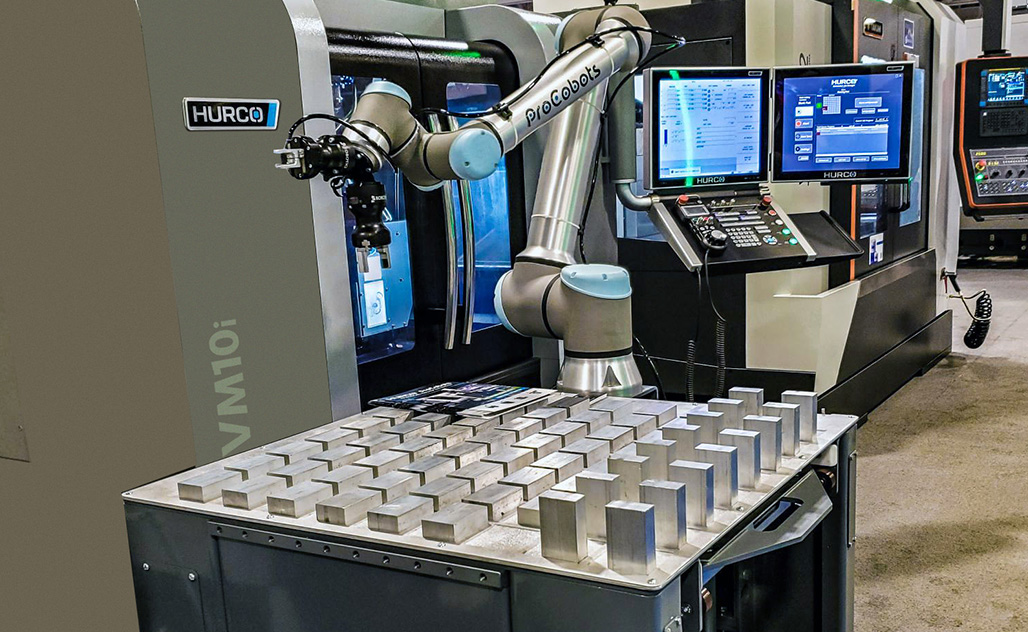
CNC machine tending is particularly common in automotive supply chain manufacturing, where high-volume repetitive turning and milling operations are well suited to robotic cells. The economics also shift significantly when a single robot tends two or more machines simultaneously. With the right cell layout and compatible cycle times, one robot can tend multiple CNC lathes or machining centres, potentially increasing machine utilisation and the return on the automation investment.
End effectors (the grippers at the end of the robot arm) are matched to part geometry and weight. A dual gripper allows the robot to remove a finished part and load a fresh blank in a single machine-open window, reducing the handling time compared with a single-gripper sequence. Collaborative robots can be used for tending lighter machines and smaller-batch operations where a conventional fenced cell may not be practical.
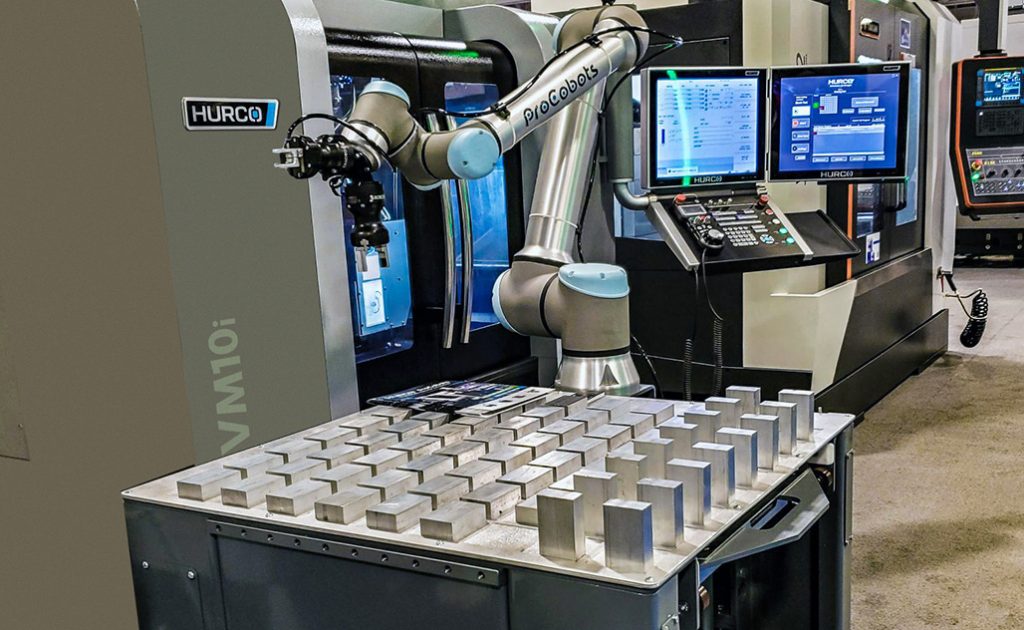
A cell that runs on its own can be scheduled across nights and weekends without extra headcount.
Cobot or industrial robot?
Cobots suit smaller machines, lighter parts and floors where a fenced cell won't fit. Industrial robots are generally faster and handle heavier payloads, but their applications often require more extensive safeguarding. Your integrator should say which fits your parts and cycle times.
Read the cobot guideRunning two or more machines? One robot can often tend both.
Find machine tending integratorsWhy UK Manufacturers Automate Machine Tending
Every machine has a designed cycle time. When manual loading is part of the process, the actual cycle time is longer. The difference sits in the operator: waiting for a part, repositioning, clearing swarf, working multiple machines, taking a break. On a high-volume line running tight takt times, that difference is not recoverable.
-
60 sec
Recover lost spindle time
Manual loading adds dwell to every cycle. A robot loads as soon as the door opens, so the machine runs much closer to its designed cycle time.
-
24/7
Run lights-out
A suitably designed cell can run nights and weekends with minimal direct operator attendance, potentially freeing a skilled machinist for work elsewhere on the floor.
-
Every part placed the same
The robot can place each part consistently in the chuck or fixture, helping reduce variation in the loading process.
Honest qualifier Payback depends on your shift pattern. A single-shift line replacing one operator takes longer to pay back than a cell running across nights and weekends.
How a CNC Machine Tending Cell Works
Five stages, and the question worth putting to your integrator at each one.
-
Feasibility and machine survey
The integrator surveys your machines, parts and cycle times, and confirms each CNC can talk to a robot. Many modern CNC machines can be interfaced with a robot, while older machines can often be assessed for retrofit.
Ask: Which machines can be tended, and what changes do they need?
-
Part presentation
Raw material reaches the robot by magazine feeder, conveyor or stacked pallets. Magazines can suit high-volume repeat parts; pallets can be useful where part variety is higher and trays can be prepared between runs.
Ask: How long can the cell run before someone refills it?
-
Machine interface
The robot and CNC exchange door, cycle-complete and other machine-status signals through discrete I/O or machine-specific interfaces, with standards such as MTConnect and OPC UA also available on some newer equipment.
Ask: Does my machine need an automatic door or a relay panel?
-
Gripper design
Grippers are matched to part geometry and weight. A dual gripper swaps a finished part for a fresh blank in one door-open window.
Ask: Single or dual gripper for my cycle time?
-
Output and inspection
Finished parts go to a conveyor, a fixture or an inspection station. Inline gauging or vision can check key dimensions before parts move on.
Ask: Can inline gauging be added later?
Key components

-
Robot arm
An articulated arm on a fixed pedestal in front of or between the machines. For a row of machines, a rail-mounted robot travels a linear track.
-
Gripper Sets the cycle
Matched to part geometry and weight. A dual gripper removes the dwell a single gripper needs.
-
Part presentation
Magazine feeder, conveyor or stacked pallet system, chosen by part geometry and batch size.
-
Machine interface
Door and cycle-complete signals over I/O or M-codes, or a standard interface on newer CNCs.
EUROMAP 67MTConnectOPC-UA
-
Inline inspection
Gauging or vision measures key dimensions before the part moves downstream.
Industries Using Machine Tending Automation
-
Automotive Well established
High-volume, repetitive turning and milling across the supply chain, where robotic cells are well established.
-
Aerospace & Defence
Tight-tolerance parts where consistent placement in the fixture can be important alongside machining accuracy and process control.
-
General Engineering
Subcontract and batch work, where a robot can keep machines running beyond staffed hours.
-
Agricultural Machinery
Larger components produced in steady batches can suit rail-mounted robots serving several machines.
-
Medical Device Manufacturing
Small, precise parts with inline gauging to check key dimensions before parts move on.
-
Oil & Gas Sub-Supply
Heavy components and longer machining cycles can create opportunities for a robot to tend more than one machine, where the payload and reach are suitable.
-
ROI calculator
Will machine tending pay back in your sector?
Put in your own wages, shifts and project cost to see a payback estimate in under a minute.
Work out your ROI
Sector guide: Automotive Automation in the UK | Robotics, Welding & Assembly Systems
How Much Does a Machine Tending Robot Cell Cost?
Investment range Indicative UK costs, excluding VAT
-
Simple system
A simple machine tending robot cell. One cobot or small industrial robot, a single CNC lathe, a basic gripper and standard safety setup.
-
Medium complexity
Dual grippers, magazine feeders or pallet systems, heavier parts, and often two machines sharing one robot.
-
High throughput
Multi-machine rail-mounted cells with inline gauging, vision-guided loading and MES integration. Costs can pass £300,000.
Project timeline 15–24 weeks, design to sign-off
-
3 – 5 weeks
Design
Design and feasibility typically runs three to five weeks.
-
10 – 16 weeks
Build
Build takes the majority of the project timeline.
-
1 week
Installation
On-site installation is usually two to five days depending on cell complexity.
-
1 – 2 weeks
Commissioning
Commissioning and operator training follows, typically one to two weeks, and covers final program…
Typical UK ranges from integrator quotes, for guidance only. Your cost depends on the parts, cycle time, safety and site.
UK integrators
-
 View profile
Cobots Online Claimed
UK cobot automation experts supporting manufacturers with cobot solutions that boost productivity and improve quality
Automotive, General Manufacturing
-
 View profile
Mills CNC
Giving UK and Irish component manufacturers everything they need to succeed
General Manufacturing
-
 View profile
SV Robot Solutions Claimed
UK robotics integrator delivering bespoke automation systems, robotic cells, and ongoing support for manufacturers.
Automotive, General Manufacturing
Project Matcher
Get a shortlist of UK integrators for this job
Answer four questions about your project. We match you with UK integrators who do this work.
Get matchedFrequently asked questions
How long does a machine tending robot take to pay back?
Payback can fall within the two-to-four-year range for some machine-tending projects, but the actual figure depends heavily on shift patterns, labour costs, utilisation and project cost. For example, a single-shift operation with one operator costing £35,000 per year on a fully loaded basis will take longer to pay back than a facility that uses the cell to run lights-out across nights and weekends, where the incremental output has no direct labour cost attached. The strongest payback cases combine operator redeployment with extended running hours rather than treating it as a straight labour replacement.
Can a machine tending robot work with my existing CNC machines?
In many cases, yes. Modern CNC lathes and machining centres can often be interfaced with a robot using discrete I/O, machine-specific interfaces or supported communication protocols. Older machines can sometimes be retrofitted, but the available machine signals, door/fixture access and control system need to be assessed. The integrator will survey your machines during the feasibility stage and confirm compatibility. Machines with very limited work envelope access or unusual fixture arrangements may require more engineering, but outright incompatibility is rare.
What is the difference between a cobot and an industrial robot for machine tending?
A collaborative robot (cobot) operates at lower speeds and with force-limiting safety features that allow it to work without a full safety fence in appropriate applications. For machine tending this makes cobots well suited to smaller machines, lighter parts and facilities where the floor space or budget does not support a fully fenced cell. Industrial robots are faster, handle heavier payloads and are better suited to high-volume production where cycle time matters. The trade-off is that industrial robot cells often require more extensive safeguarding and separation from people, which can add cost and floor space. Many UK integrators will recommend one or the other based on your part weight, required cycle rate and production environment.
Can one robot tend more than one machine?
Yes, and this is often where the economics of machine tending become most compelling. A single robot on a fixed pedestal can tend two machines positioned either side of it if the cycle times allow. For three or more machines, a rail-mounted robot travels along a linear track and tends each machine in sequence. The key constraint is cycle time arithmetic: the robot needs to complete its load and unload cycle on each machine before that machine finishes its own cycle. An integrator will model this during the feasibility stage to confirm how many machines a single robot can reliably tend given your actual cycle times.
Do I need to modify my CNC machines to accept a robot?
Some modification or additional interfacing may be required, depending on the machine. The most common change is fitting an automatic door opener to the machine, the robot can sometimes operate the door, but using the robot for this can add complexity to the end-of-arm tooling and robot sequence. Some machines also need a chuck guard interlock or a program modification to output the right M-code signals. These are standard integrator tasks and are typically included in the project scope. Machines that already have automatic doors and accessible interfaces require very little preparation.