
Automotive Automation in the UK | Robotics, Welding & Assembly Systems
Introduction: What Automotive Automation Covers
No other UK manufacturing sector runs at the cycle times automotive demands. A body-in-white line producing at takt times of under 60 seconds, sustained across three shifts, creates tolerance requirements that manual processes simply cannot hold.
Automotive automation spans robotic welding, paint application, vision-guided assembly and CNC machining at OEM level. Further down the supply chain, Tier 1 pressings and subassembly plants have followed a similar path, driven by OEM quality mandates and the economics of high-volume, low-margin components.
If you're researching automotive automation options for a production facility, this page covers the shape of UK automotive manufacturing, which processes are most heavily automated, how investment differs across the supply chain, and what the EV transition means for facilities weighing capital decisions now or in the next planning cycle.
Overview of the UK Automotive Automation Market
Automotive accounts for 28% of the UK factory automation market, a share that reflects both the volume demands of assembly line production and the quality standards that OEM supply contracts impose on every tier of the chain.
The geography of that investment is concentrated in a way that shapes how the supply chain operates. The West Midlands corridor, running through Coventry, Solihull and Birmingham, holds the highest density of Tier 1 and Tier 2 automotive suppliers in the country. The majority of automotive robotics integrators active in the UK are headquartered or regionally active within this corridor.
For buyers sourcing capability in this sector, that concentration means a denser pool of relevant integration expertise and systems knowledge here than anywhere else in the UK.
When a major OEM retools a line, the pressure transmits through that supply chain within months.
Automotive Manufacturing Automation Processes
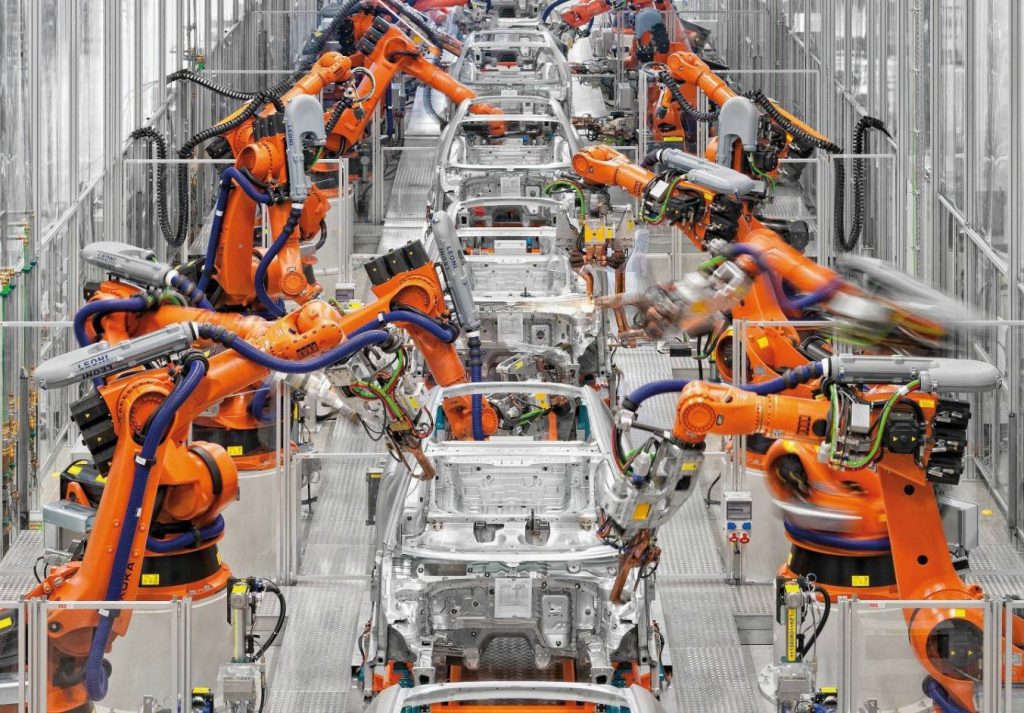
At OEM level, factory automation in the automotive sector is most intensive in body-in-white production.
Robotic spot welding and MIG welding cells handle the structural joins that define vehicle rigidity, with weld counts on a typical body running into the thousands.
Paint shop operations have been substantially automated for decades, with robotic application systems delivering the finish consistency and process control that manual spray cannot sustain at volume.
Final assembly remains the most labour-intensive stage, though guided assembly systems, torque traceability tools and collaborative robots are progressively taking on tasks where repeatability and audit trails are required.
Engine and drivetrain machining, where tolerance bands are measured in microns, has long been a stronghold for hard automation and dedicated CNC lines.
That investment profile is now shifting as powertrain mix changes, creating a capital reallocation challenge for facilities that built around combustion-era requirements.
Tier 1 and Tier 2 Automation in the Automotive Supply Chain
Tier 2 suppliers operate with a different automation profile. Batch sizes are often smaller, product variants more numerous and capital budgets tighter.
Flexible robotic cells that can be reprogrammed across part families are increasingly relevant here, as is the pressure from customers to demonstrate process capability data rather than inspect-and-ship quality control.
The gap between what OEMs expect in terms of traceability and what a smaller pressing or fabrication shop currently captures is one of the more consistent drivers of enquiries to automotive automation companies across the UK.
EV Transition and the Future of Automotive Automation
The EV transition is restructuring automation requirements rather than simply reducing them.
Battery module assembly, high-voltage harness routing and thermal management component production each carry different process demands to the combustion components they replace.
Facilities that built their automation infrastructure around engine block machining or exhaust system fabrication are assessing what transfers and what needs replacing.
The retooling decisions are live now for most Tier 1 suppliers with OEM contracts running to the end of the decade.
Why Automate Automotive Manufacturing?
The case for investing in automotive automation is built from the specific pressures of the sector, not from a general efficiency argument.
Takt time is the clearest pressure point. When an assembly plant is gated to a 55-second cycle, every upstream supplier is bound to feed it. Process inconsistency at a Tier 1 or Tier 2 level does not absorb quietly. It creates line stoppages, premium freight and the kind of conversations with customer quality teams that plant managers remember.
Automation that delivers cycle time consistency is not a productivity argument, it is a supply continuity argument.
Weld quality and traceability requirements have tightened as vehicle safety standards have evolved. OEM specifications on structural welds now routinely include process data retention, not just dimensional inspection. A robotic welding cell logging current, voltage and wire feed in real time satisfies that requirement in a way a manual process cannot.
Common Applications in This Industry
![Machine Tending Robots UK: Costs, Systems & Integrators [2026]](https://automationworld.co/wp-content/uploads/cobot-machine-tending-300x184.jpg)
Machine Tending Robots UK: Costs, Systems & Integrators [2026]
A CNC machine's output depends on more than its programmed machining time. Every part also needs to be unloaded, replace…
View Guide![Cobot Welding Systems UK: Costs, ROI & Suppliers [2026]](https://automationworld.co/wp-content/uploads/cobot-welding-300x229.jpg)
Cobot Welding Systems UK: Costs, ROI & Suppliers [2026]
Cobot welding systems in the UK can typically cost between £30,000 and £150,000+, the exact figure is very dependent on…
View Guide![Robotic Welding Systems (UK Guide): Costs, ROI & Suppliers [2026]](https://automationworld.co/wp-content/uploads/robotic-welding-cell-1-300x200.png)
Robotic Welding Systems (UK Guide): Costs, ROI & Suppliers [2026]
Finding and retaining skilled welders is a growing challenge for many UK manufacturers. Robotic welding can help automat…
View GuideUK Integrators in This Sector

Cobots Online
CLAIMED SUPPLIERUK cobot automation experts supporting manufacturers with cobot solutions that boost productivity and improve quality


SV Robot Solutions
CLAIMED SUPPLIERUK robotics integrator delivering bespoke automation systems, robotic cells, and ongoing support for manufacturers.
Ready to find an automation partner?
Find the right integrator for your industry