
Welding Fixture
Why Does a Welding Fixture Matter?
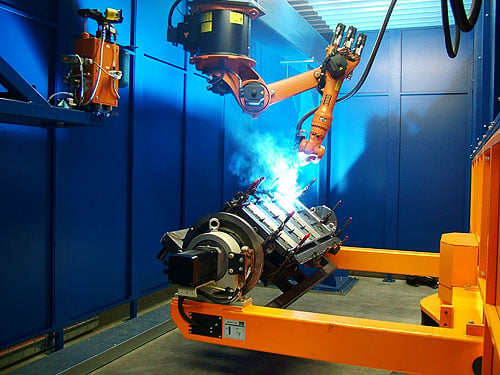
Holding the part in place is one of the most underestimated parts of any robotic welding project. When planning a welding cell it is easy to focus on the robot brand, how you will get power to the cell or the cell layout itself, but the welding fixture will determine whether you get good, consistent results out of the robot.
In practice, no two parts ever come in exactly the same. You might be working to tight drawings, but there’s always some natural variation from the upstream process. A properly built jig is there to take that out of the equation, it locates and holds each component where it needs to be, every time, and keeps everything within tolerance. If the jig isn’t right, that variation starts to show up in the weld, joints can creep, miss position, or become inconsistent, especially as the tooling wears or you start running slightly different batches.
Changeover is another area where the right fixture makes a big difference. If you’re running a mix of parts, a quick-change jig setup is a completely different proposition to a fixed, one-off fixture. Being able to swap over quickly and repeatably saves a lot of downtime, but it needs to be designed in from the start. It’s something we always recommend talking through properly at the design stage so the tooling matches how you actually plan to run production.
How a Welding Fixture Works
A welding fixture is typically fabricated from steel and designed specifically for one part type (or a family of closely related parts). It includes clamps, locating pins, and stops that position the part against a datum (a fixed reference point) so that every loaded part sits in exactly the same orientation for the robot.
For simple parts (in a cobot welding process for example), a fixed welding fixture bolted to the cell floor or a bench in the cell will be sufficient. For more complex parts, parts that need welding on multiple faces for example, a more complex welding fixture/jig will be needed. Rotary fixtures allow parts to be rotated to different positions for the robot without the need for an operator to enter the cell.
Designing a welding fixture, particularly for a complex welding process, is a specialist job and should not be taken lightly. A good integrator will take it on as part of their scope of supply, whether they make it themselves or engage a specialist in their supply chain who can make it.
Getting the fixture right at the design stage is considerably cheaper than modifying it once the cell is running.
Where Are Welding Jigs Used?
- Robotic MIG welding — holding structural components for precise, repeatable arc welding
- Twin-station welding cells — separate fixtures at each station allow continuous robot operation
- High-mix fabrication — quick-change fixturing enables multiple part types on a single cell
- TIG welding of precision components — tight tolerances in aerospace and defence applications
- Rotary positioner setups — multi-face welding of complex assemblies without manual repositioning
Related Application Guides
![Cobot Welding Systems UK: Costs, ROI & Suppliers [2026]](https://automationworld.co/wp-content/uploads/cobot-welding-300x229.jpg)
Cobot Welding Systems UK: Costs, ROI & Suppliers [2026]
Cobot welding systems in the UK can typically cost between £30,000 and £150,000+, the exact figure is very dependent on…
View Guide![Robotic Welding Systems (UK Guide): Costs, ROI & Suppliers [2026]](https://automationworld.co/wp-content/uploads/robotic-welding-cell-1-300x200.png)
Robotic Welding Systems (UK Guide): Costs, ROI & Suppliers [2026]
Finding and retaining skilled welders is a growing challenge for many UK manufacturers. Robotic welding can help automat…
View Guide