
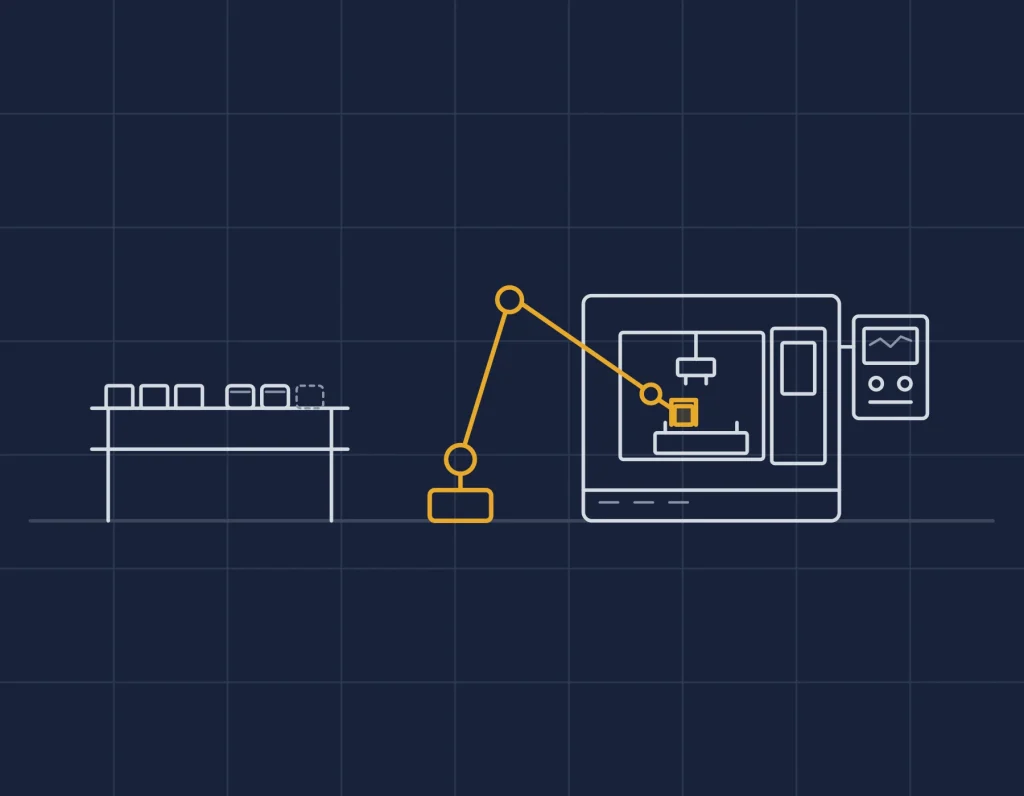







What is robotic machine tending?
Machine tending automates the loading and unloading of production machinery. A robot can place a raw component into a CNC lathe or machining centre, remove the finished part and transfer it to a tray, conveyor or inspection station.
The aim is to reduce the time machines spend waiting for an operator to handle parts. Depending on the application, a cell may serve one machine or several, potentially allowing equipment to run for longer periods outside normal staffed hours.
A typical system includes a robot, gripper or end-of-arm tooling, a way to present raw parts, a machine interface and suitable safety measures. More advanced systems may add automatic doors, part identification, vision, gauging or automated reject handling.
The critical factor is the complete cycle. Robot speed alone does not determine output. Part presentation, door operation, chuck or fixture access, machining time, gripper changes and finished-part handling all affect whether the system can meet your target.
For a deeper explanation of cell design, investment and delivery times, read our Machine Tending Robots UK guide.
Which machine tending system fits your production?
The right configuration depends on your parts, machine cycle times, production mix and how long you want the cell to run without intervention. These are typical approaches, not rigid categories.
| Best suited to | Main consideration | |
|---|---|---|
| Single-machine cell | One CNC machine with repeatable loading and unloading | A simpler scope, with benefits tied to that machine's utilisation |
| Multi-machine cell | Two or more machines with compatible cycle times and reachable layouts | The robot must service each machine without creating a new bottleneck |
| High-throughput cell | Several machines, rail-mounted robots or integrated inspection | Greater capacity potential, but more complex engineering and higher investment |
Is robotic machine tending right for your operation?
Machine tending is most attractive when manual handling interrupts productive machine time and the loading process can be made repeatable. A feasibility study should establish whether the robot can meet the available cycle time and, for multi-machine cells, account for travel time, and layout.
Good fit
- Machines sit idle while waiting for an operator to load or unload parts.
- Parts have repeatable dimensions, orientations and gripping points
- Production volumes and operating hours justify the investment.
- Machine cycle times leave enough time for the robot to complete loading
- You want to improve machine utilisation, extend operating hours etc.
Think twice
- Parts vary significantly and there is no reliable method of presenting them.
- Machine cycle times are so short that robot handling could become the bottleneck
- Production demand is too low or unpredictable to justify a dedicated cell.
- Machine interfaces, access or safeguarding would require substantial changes
Free planning tools
Size your project before you speak to suppliers
What to check before choosing an integrator
Ask shortlisted suppliers to demonstrate that their proposed system will work with your actual machines and parts. Check their application experience, cycle-time calculations, machine interfaces, safeguarding and support arrangements before comparing quotations.
| What to check | Evidence to ask for |
|---|---|
| Relevant machine experienceHas the integrator automated the same type of CNC, press or production machine? | Comparable installations, machine models and customer references. |
| Cycle-time validationCan the robot complete each load and unload sequence within the available machine cycle? | A cycle-time breakdown covering doors, gripping, transfers and machine waiting time. |
| Grippers and part presentationCan parts be gripped, located and presented consistently across the product range? | Tooling concepts and trial results using representative parts. |
| Machine interfaceCan the existing CNC machines communicate with the robot, and what modifications are needed? | A machine survey covering control interfaces, door operation, chuck or fixture access, required signals and retrofit work. |
| Safety and risk assessmentHow will people be protected during automatic operation, loading and fault recovery? | The proposed safeguarding concept, risk assessment and compliance responsibilities. |
| Unattended runningHow long can the cell run before it needs replenishment or intervention? | A run-time estimate, capacity calculation, fault-recovery plan and replenishment schedule. |
| Support and maintainabilityWhat happens when a fault stops the cell or a gripper needs attention? | Support response terms, spare-parts arrangements, training and maintenance documentation. |
Prepare for a machine tending quotation
You don't need a complete engineering specification to approach an integrator, but the more you can share about the machines, parts and required output, the more useful the initial assessment will be.
Use it in the Project Matcher- List the machines to automate, including make, model and control type.
- Record current machine cycle times and operator loading, unloading and handling time.
- Provide part dimensions, weights, materials, gripping points and product variations.
- Describe how raw parts arrive and where finished parts, rejects and swarf go.
- Specify required output, shift patterns, operating hours and desired unattended runtime.
- Share the factory layout, available space, access restrictions and safety requirements.
- Define your target outcomes, indicative budget and installation or shutdown constraints.
Machine tending robot costs in the UK
Machine tending costs depend on the robot, tooling, machine interfaces and the amount of automation required around the loading cycle. These indicative UK planning ranges exclude VAT and should be treated as starting points, not fixed prices. Actual quotations depend on the application/scope.
-
SIMPLE SYSTEM
£60,000–£120,000
One robot tending one machine, with relatively straightforward tooling, machine interfacing and safeguarding.
-
MEDIUM COMPLEXITY
£120,000–£200,000
More demanding tooling, automated part presentation, dual grippers or a robot serving two machines.
-
HIGH THROUGHPUT
£200,000–£300,000+
Complex cells with several machines, rail-mounted robots, inline inspection or advanced factory-system integration.
What moves the price:
- Robot and payload
- Gripper and tooling
- Automatic doors
- Part feeding
- Number of machines
- Safety equipment
- Vision and gauging
- Installation and commissioning
Indicative UK costs, excluding VAT. Actual project costs vary by application and specification.
Frequently asked questions
Robotic machine tending uses a robot to load raw components into a machine, remove finished parts and transfer them to the next stage. It is commonly used with CNC lathes, machining centres and other production equipment where manual loading interrupts productive machine time.
A straightforward machine tending cell may cost around £60,000–£120,000 excluding VAT. More complex systems serving multiple machines or incorporating advanced tooling and inspection can cost £200,000–£300,000 or more. Actual costs depend on the application and integration requirements.
Yes, if the machines are positioned within reach and their cycle times allow the robot to service them reliably. A feasibility assessment should account for robot travel, machine door operation, gripping, part transfers and the time each machine can wait without affecting output.
Cobots can suit lighter parts, smaller machines and applications where flexibility is important. Conventional industrial robots may be more appropriate for heavier payloads, higher speeds or demanding production rates. The right choice depends on the complete application, including the necessary safeguarding and risk assessment.
Often, yes. The integrator needs to assess the machine's control system, available signals, door operation, chuck or fixture controls and any required modifications. Some older machines are straightforward to retrofit, while others may require significant work or prove uneconomical to automate.
It can extend operating hours and reduce the need for continuous manual loading, provided the cell has sufficient part capacity and reliable fault recovery. Unattended running also requires suitable safeguards, monitoring, replenishment planning and a process for handling rejects or unexpected stops.
Provide the machine make and model, part dimensions and weights, cycle times, production volumes, shift patterns, part presentation method and desired unattended run time. A video of the current process and a basic factory layout can also help the integrator assess feasibility.