
Autonomous Mobile Robot (AMR)
Why do AMRs matter?
If your facility moves material by hand, i.e. operators pushing trolleys, carrying totes, walking parts to a workstation, then that's time not spent on anything that adds value. AMRs take on that internal transport job without requiring you to redesign your building or put down any new infrastructure.
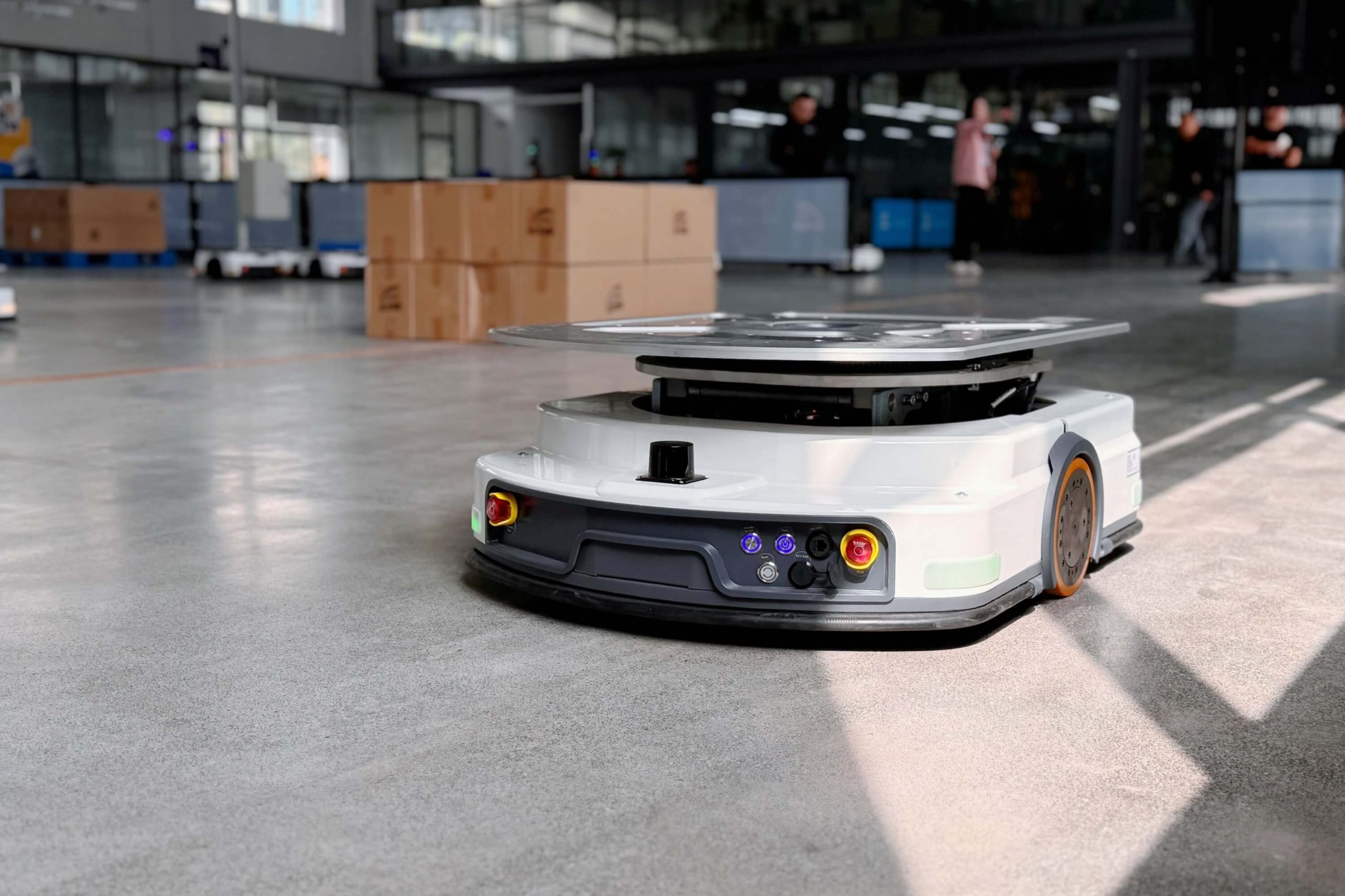
What makes AMRs particularly attractive right now is flexibility. They're not locked to a fixed route. If you add a new workstation or reconfigure a production line, the robot's map updates. You don't rip up flooring or rewire guidance systems.
They also work alongside people, which changes the risk calculation considerably. You don't need segregated zones or caged-off areas. That makes them viable in sites where a traditional AGV or conveyor-based system wouldn't be practical.
How do AMRs work?
AMRs navigate using a technique called SLAM, Simultaneous Localisation and Mapping. When you first deploy an AMR or a fleet of robots, they first map out their environment using sensors. These sensors are usually a combination of ultrasonic sensors, depth cameras and/or LiDAR (laser based distancing sensors).
As the AMR moves around the warehouse or factory it is constantly comparing what it sees (through its sensors) to the map it has stored, this allows it to plot the best route to get to its destination and re-route if something is in the way.
AMRs are controlled by fleet management software, usually from the manufacturer, though there are third-party platforms available too. The fleet management software will assign tasks to the AMR, handle charging cycles and can often integrate with warehouse management software.
For a full guide to deploying AMRs in a warehouse operation, including costs and timelines, see our warehouse AMR guide.
Where are AMRs used?
- Goods-to-person picking in e-commerce fulfilment
- Inter-department material transport in automotive manufacturing
- Tote delivery between workstations in assembly operations
- Kitting — delivering component sets to production cells
- Hospital logistics — moving supplies and samples between departments
- Returns processing in retail distribution centres
UK Integrators Offering This Solution


Geek+
Autonomous mobile robots for warehouse and fulfilment operations

Related Application Guides
![Warehouse AMR Guide: Autonomous Mobile Robots UK [2026]](https://automationworld.co/wp-content/uploads/warehouse-amr-300x225.jpg)
Warehouse AMR Guide: Autonomous Mobile Robots UK [2026]
UK warehouses are running out of people and running out of time. The transport and storage sector has recorded some of t…
View Guide
Warehouse Robotics UK: A Buyer’s Guide to Automation Systems
UK warehouse operators continue to face recruitment and retention challenges. Robots don't fix the people problem entire…
View Guide