Application guide Warehouse AMRs · 2026
Warehouse AMR Guide Autonomous mobile robots in UK warehouses
UK warehouses are running out of people and running out of time. The transport and storage sector has recorded some of the highest vacancy and turnover rates in the UK economy for several years running, and that gap doesn't show any sign of closing.
What are AMRs?
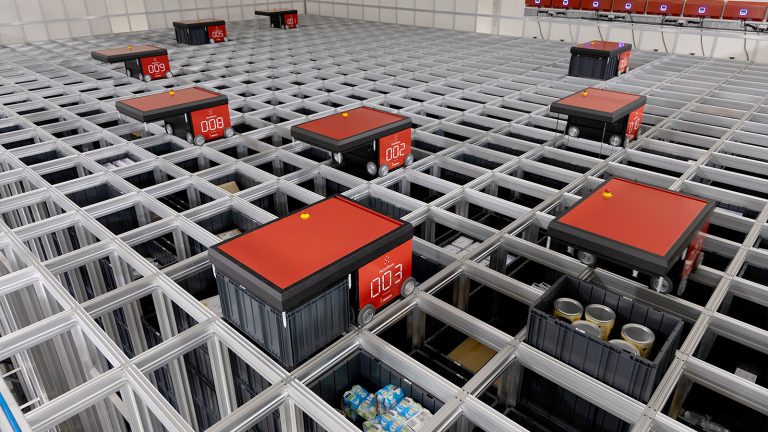
Warehouse AMRs, autonomous mobile robots, are the most common response to this problem. An AMR can move goods around a warehouse floor without the need for a human driver, bring shelving to pickers rather than sending pickers to shelving, and scale up by adding more robots rather than hiring more people.
This guide covers what AMR automation actually involves, what it costs in the UK, and what separates a good implementation from an expensive learning exercise. If you want a plain definition first, our AMR glossary page has it.
Warehouse AMRs navigate around your factory or warehouse using onboard sensors and mapping software (technology known as SLAM). They build a map of the warehouse floor and then can route themselves around obstacles, other robots, and people, without requiring a fixed guidance path such as tracks, magnetic tape or embedded wire. That's what separates them from an AGV, which is a similar technology but follows a predefined route and needs the route physically changed whenever the layout does.
The most common deployment format for warehouse AMRs is goods-to-person, where AMRs carry shelving units or tote bins to a stationary picker rather than sending the picker off to walk aisles looking for products. A manual picker walking to products might typically achieve around 60–80 picks per hour, while a well-designed goods-to-person station can exceed 300 picks per hour.
Payload capacity on most AMR platforms runs from around 100kg to 1,500kg depending on the system. Autonomous pallet-moving AMRs sit at the heavier end and start to overlap with traditional AGV territory, which is worth understanding if your operation moves pallets rather than totes.
AMR vs AGV - What's the Difference?
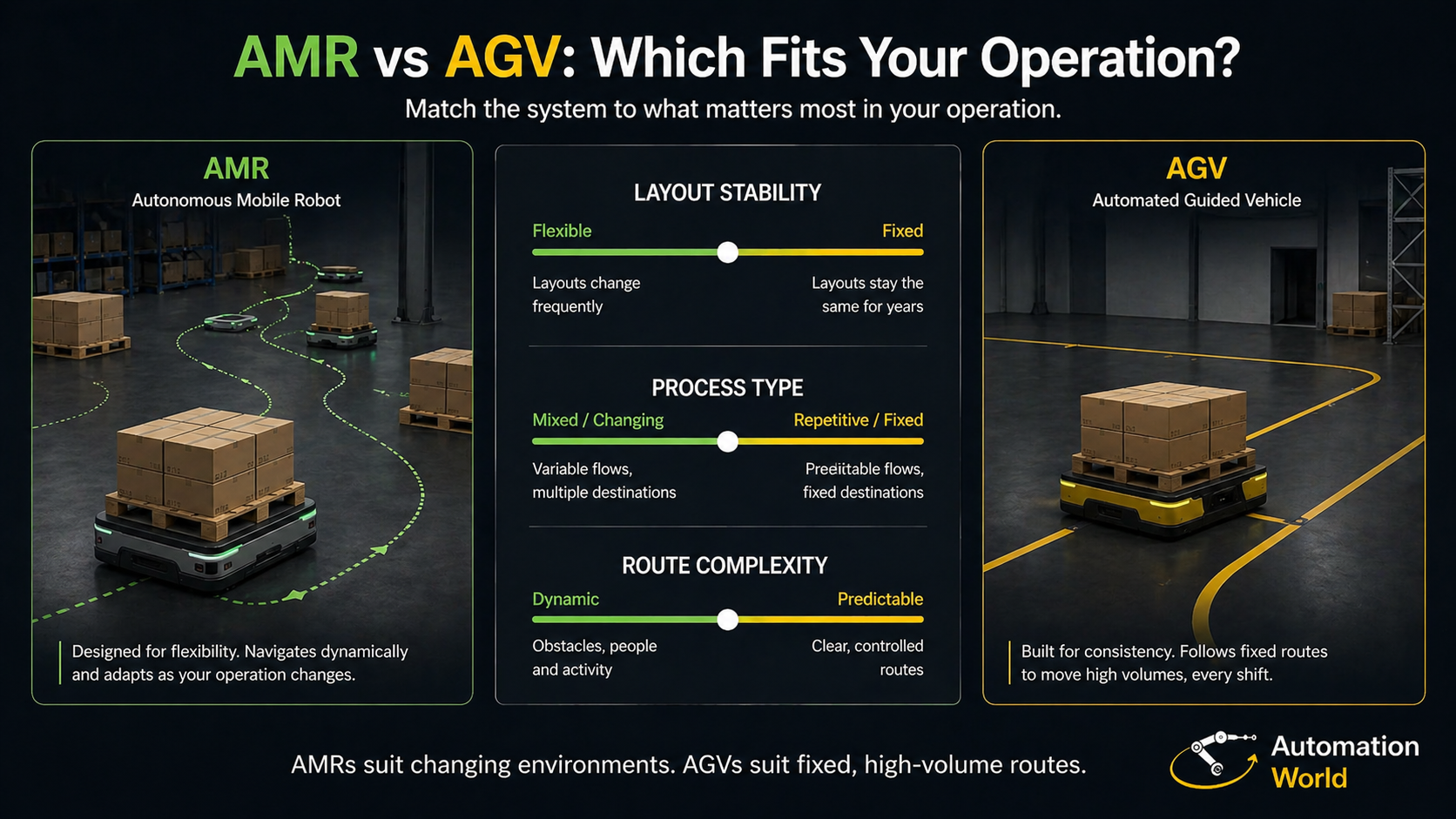
The short version: an AGV follows a fixed path. An AMR finds its own.
An AGV uses magnetic tape, reflective markers or wire embedded in the floor to navigate. It's reliable on a route that never changes. Change the layout and you've got a problem, because the route infrastructure has to change with it. An AMR builds a map of its environment using SLAM technology and routes itself dynamically, navigating around obstacles and adapting when zones are reconfigured without touching physical infrastructure.
If you're evaluating both technologies for a specific application, our AMR vs AGV comparison guide covers the full breakdown: where each technology wins, where they overlap at the pallet-moving end of the market, and how to make the decision for your operation.
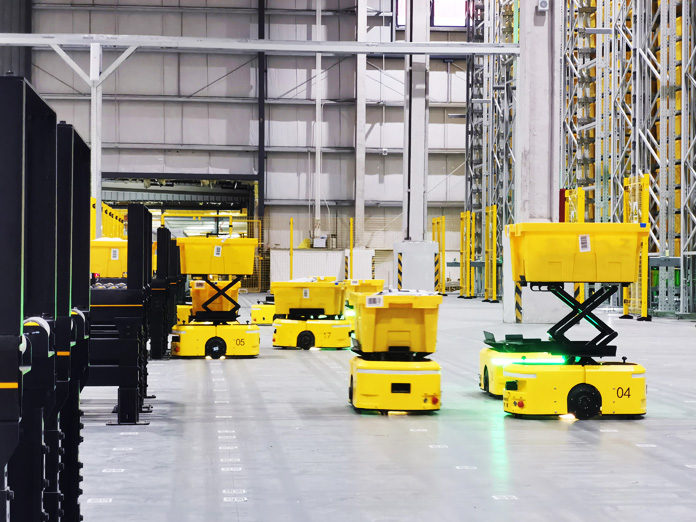
Expanding an established fleet can take weeks. Recruiting, training and retaining additional warehouse staff can take considerably longer.
AMR or AGV?
An AGV follows a fixed route set by tape, markers or floor wire, so the route has to change when the layout does. An AMR maps the space itself and routes around obstacles with no floor infrastructure. The pallet-moving end of the market is where the two overlap.
Planning a fleet? Talk to an integrator who has connected your WMS before.
Find AMR integratorsWhy Automate Using AMRs
For warehouse operations, labour is the obvious driver for taking up AMR's. The transport and storage sector has chronic vacancy and turnover figures that make the investment case easier to build every year. When you're advertising the same picker role every 3 months, the payback period on a robot fleet starts to look very different.
-
300+
Picks per hour, per picker
Goods-to-person stations reach 300+ picks an hour, against 60–80 for a picker walking the aisles.
-
4am
No slowdown overnight
AMRs don't call in sick on a bank holiday, and can support extended operating hours when the rest of the operation is designed to keep up.
-
Weeks
Scale by adding robots
Adding robots to a fleet takes weeks. Hiring, training and keeping people takes longer, with no guarantee they stay.
Honest qualifier WMS integration is often a bigger project risk than the robots themselves. If your WMS is older or heavily customised, plan for it to take longer.
How Does an AMR System Installation Work?
Five stages, and the question worth putting to your integrator at each one.
-
Site survey and order profile
The integrator maps your floor, analyses your order profile and SKU count, and decides which zones to automate first. Skip this and you get a well-specified robot doing the wrong job.
Ask: Which zones should go first, and why?
-
Navigation and mapping
Robots use onboard sensors and mapping/localisation technology to build a representation of the operating area and navigate around obstacles. Depending on the platform, this may include LiDAR, cameras and other sensors.
Ask: What happens when we change the layout?
-
Fleet management software
Coordinates routing, charging, task allocation and traffic across the whole fleet. How it copes under pressure tells you more than any spec sheet.
Ask: How does it handle peak demand, charging conflicts and congestion?
-
WMS integration Biggest risk
Where most AMR projects hit delays. The fleet must talk to your WMS in real time, and older or customised systems take much longer to connect. In larger or more automated warehouses, a Warehouse Execution System (WES) may sit between the WMS and automation layer.
Ask: How many live WMS integrations do you support, and on which platforms?
-
Phased go-live
One zone at a time rather than the whole floor at once. It adds time, but the warehouse keeps running throughout.
Ask: What does each phase need from my team?
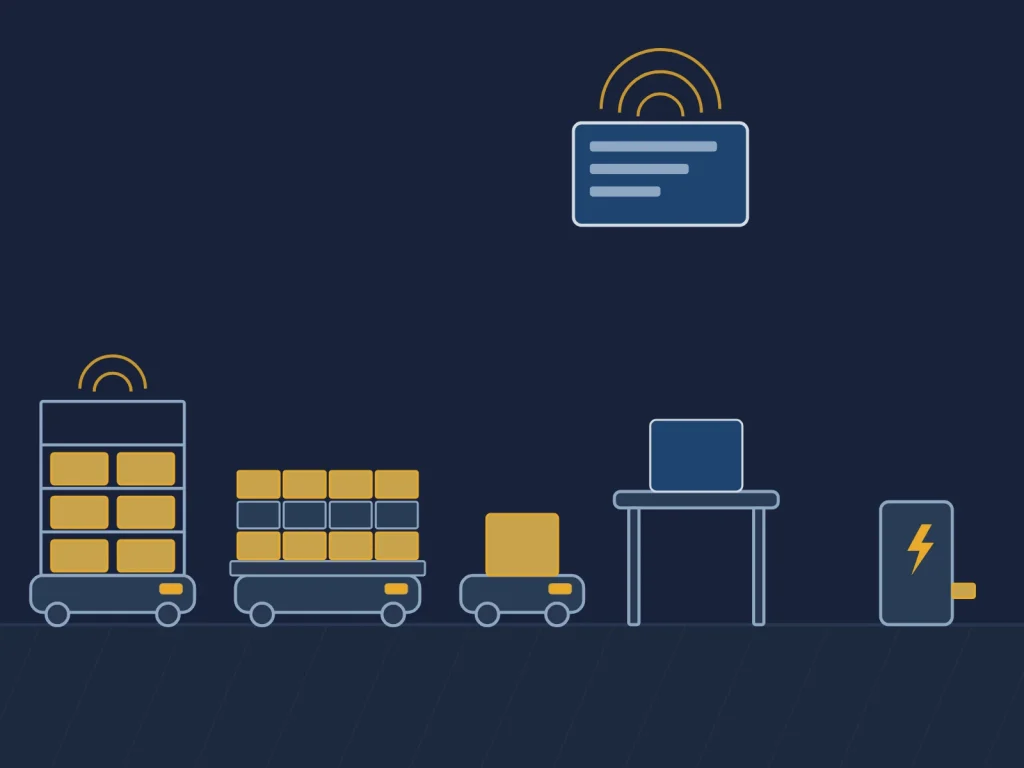
Key components
-
AMR fleet
Shelf-carrying or tote-carrying robots that navigate the floor on their own.
-
Fleet management software The control layer
Coordinates routing, charging schedules and task allocation across the whole fleet.
-
Autonomous pallet movers
Heavier-duty platforms for pallet transport rather than goods-to-person picking.
-
Goods-to-person stations
Fixed workstations where a picker receives stock from the robots.
-
Charging infrastructure
Robots typically recharge automatically using charging stations or other automated charging arrangements, but charging capacity and location need to be planned into the system.
Industries
-
E-commerce and 3PL fulfilment Most investment
One of the strongest UK use cases, particularly where SKU counts and order profiles change frequently.
-
Grocery and food retail
Tight margins and high throughput, with chilled and ambient areas needing different approaches.
-
Pharmaceutical and healthcare logistics
Slower to adopt historically, partly because of the validation and traceability requirements.
-
Manufacturing intralogistics
In manufacturing, AMRs aren't picking orders: they move materials around the site.
-
Retail distribution
Case-level picking for stores rather than unit-level, with rigid pallet build requirements.
-
Temperature-controlled logistics
A potentially strong use case where manual handling in chilled or frozen environments is difficult.
-
ROI calculator
Will warehouse amrs pay back in your sector?
Put in your own wages, shifts and project cost to see a payback estimate in under a minute.
Work out your ROI
Is AMR Right for Your Operation?
Not every warehouse needs an AMR fleet, and the business case looks very different depending on what you're actually trying to solve.
These are the indicators that a deployment is likely to make sense:
- You're running more than one picking shift and struggling to keep positions filled
- Your order profile involves a high SKU count rather than a small number of fast-moving lines
- Manual pick rates are the constraint on throughput, not packing capacity or dispatch
- You're dealing with high picker turnover or frequent agency use to plug gaps
- Your floor layout changes seasonally or by product range
- You're operating in an environment where manual handling risks are significant (cold stores, high-volume repetitive picking)
- Your operation is growing and your current model won't scale without a proportional headcount increase
AMRs aren't the right answer everywhere. If you're moving full pallets on fixed routes, a traditional AGV or a well-run manual operation may be more cost-effective. If your SKU count is very low and volumes are predictable, fixed automation such as conveyor-based systems might give you higher throughput at lower overall cost.
Budget Costs and timescales for Warehouse AMR Deployment
Investment range Indicative UK costs, excluding VAT
-
Simple system
Small fleet (5–15 robots). Varies by vendor, WMS complexity, and whether physical environment changes are needed.
-
Medium complexity
Mid-scale (15–50 robots). Larger WMS integration scope and multi-zone deployment are the main cost drivers.
-
High throughput
Large-scale programme (50+ robots). Enterprise-level deployments including full system orchestration, multiple workflows, and often phased rollouts.
Project timeline 29–64 weeks, design to sign-off
-
10–20 weeks
Design
Site survey, operational analysis, simulation, and system design.
-
12–24 weeks
Build
Robot procurement, fleet software configuration, and WMS/WCS integration.
-
4–12 weeks
Installation
Phased rollout by zone, with the warehouse remaining operational throughout.
-
3–8 weeks
Commissioning
System tuning, performance optimisation, and operator training.
Typical UK ranges from integrator quotes, for guidance only. Your cost depends on the parts, cycle time, safety and site.
UK integrators



Project Matcher
Get a shortlist of UK integrators for this job
Answer four questions about your project. We match you with UK integrators who do this work.
Get matchedFrequently asked questions
What's the difference between an AMR and an AGV?
An AGV follows a fixed route defined by physical infrastructure on the floor: magnetic tape, wire or reflective markers. Change the layout and the route has to change with it. An AMR maps its own environment using SLAM technology and navigates dynamically, routing around obstacles without any floor infrastructure. The core distinction is that an AGV is told where to go, while an AMR figures it out.
How much does a warehouse AMR fleet cost in the UK?
A small fleet of 5 to 15 robots typically lands between £200,000 and £500,000 including integration and commissioning. That figure moves around quite a bit depending on the vendor, WMS integration complexity, and whether you need changes to the physical environment. At larger scale, say 50+ robots with full fulfilment-centre-level deployment, you're looking at £3 million to £12 million or more. Smaller operations can sometimes start with a relatively small fleet or a RaaS model, but the economics still depend on sufficient volume, utilisation and labour savings.
Can AMRs work with my existing WMS?
Many modern AMR platforms can integrate with existing warehouse management systems using APIs or other standard interfaces. Older or more heavily customised WMS platforms can be more complicated and can add significant time and cost to the project. Before committing to any AMR fleet, make sure to ask your integrator specifically which WMS platforms they've connected to and how many live integrations they currently support. Don't assume compatibility, get it confirmed and down in writing in the scoping phase, not after you've signed a contract.
Are warehouse AMRs safe to use around people?
Warehouse AMRs are designed to operate in environments where people and mobile robots may share the same working area, but the required safeguards depend on the robot, application and site layout. Systems can use safety laser scanners, protective fields, speed reduction, warning systems and emergency stops to manage interactions with pedestrians and other vehicles.
A suitable risk assessment should be completed as part of the project, covering pedestrian routes, forklifts, loading and unloading areas, charging stations and other workplace hazards. Your integrator should define the required safeguarding and operating controls before the system is commissioned.