
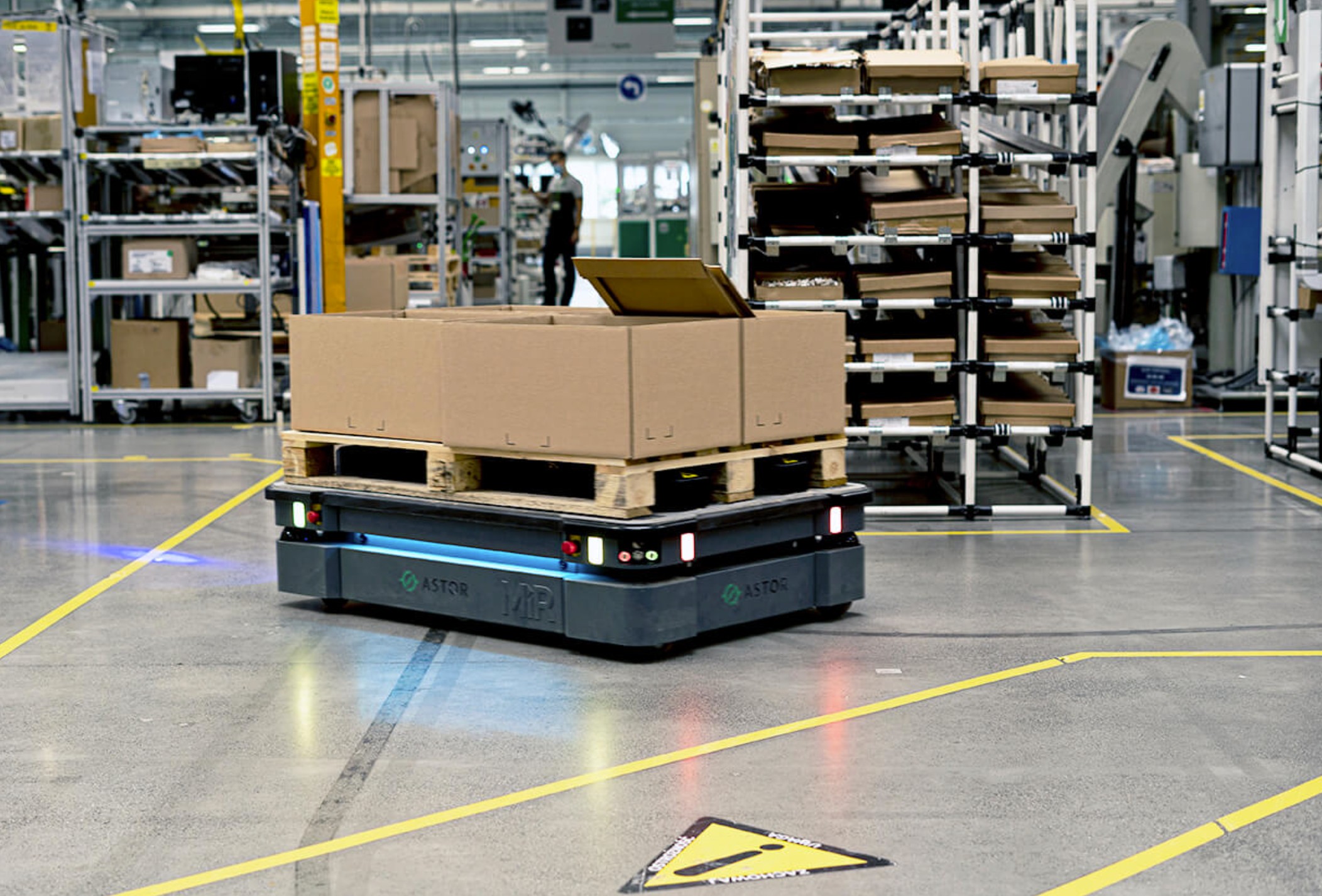
Both an AMR and an AGV will move goods around your warehouse without a human driver. That’s genuinely where the similarity ends. The technology underneath, the infrastructure required, the cost model and how each system behaves when your operation changes are all meaningfully different. This post gives you a clear, honest comparison so you can make a decision that fits your site.
What each technology actually does
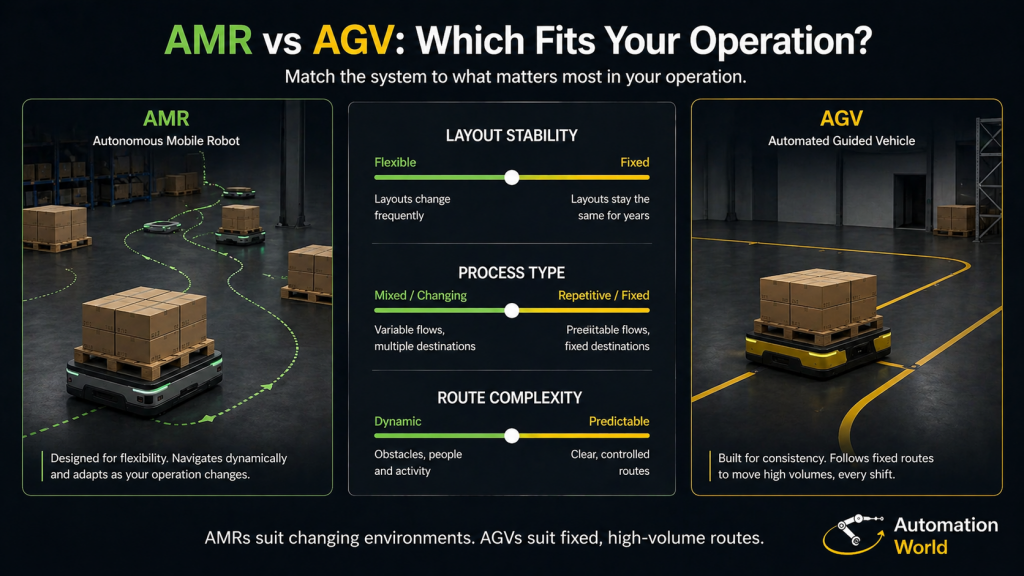
An AGV, or automated guided vehicle, follows a fixed route in your factory. That route is defined by physical infrastructure embedded in or applied to the floor, usually in the form of magnetic tape, wire buried in the ground or painted markers. The vehicle reads that signal and follows it. It doesn’t think, adapt or choose a different path when something’s in the way. It stops and waits for either the obstacle to move or human intervention.
That sounds like a limitation, and sometimes it is. But it’s also what makes AGVs genuinely reliable in the right environment. A vehicle with one job tends to do that job without variation.
AMRs work differently at a fundamental level. An autonomous mobile robot builds a map of its environment using SLAM technology (simultaneous localisation and mapping) and navigates dynamically within it. It knows where it is, where it needs to go and can recalculate its path in real time when a forklift, a pallet or a colleague is in the way.
A simple way to think about it: an AGV follows instructions. An AMR makes decisions.
The comparison: AGV vs AMR at a glance
| AGV | AMR | |
|---|---|---|
| Navigation method | Fixed path (tape, wire or markers) | SLAM-based self-mapping, dynamic routing |
| Layout flexibility | Very low — rerouting requires physical changes to infrastructure | High — remappable via software |
| Obstacle handling | Stops and waits | Navigates around obstacles in real time |
| Typical payload range | 500kg to 10,000kg+ | 100kg to 1,500kg (heavy-duty platforms reach the upper end) |
| Deployment time | 6–16 weeks including floor infrastructure | 1–4 weeks in most environments |
| Operational environment | Stable, high-volume, fixed-route manufacturing | Dynamic fulfilment, e-commerce, mixed-SKU warehousing |
| Entry cost | £30,000–£80,000 per unit (plus infrastructure) | £25,000–£70,000 per unit (lower site cost overall) |
These ranges are indicative. Real projects vary significantly based on integration, safety requirements and application complexity.
The table gives you the clean version. What it can’t show is the grey zone at the upper payload end, where a newer generation of heavy-duty AMR platforms has moved into territory that was entirely AGV territory five years ago. If you’re evaluating technology for pallet movement specifically, that grey zone matters more than the table suggests. There’s a section on it below.
Where AGVs still win
AGVs aren’t obsolete. They’re the right choice in specific circumstances and pretending otherwise would mislead anyone who actually runs a site that fits the profile.
The clearest case is high-volume, fixed-route transport in stable manufacturing. Take a large automotive stamping plant where press-to-assembly line movement follows the same path every shift, has done for a decade and won’t change when a new model year arrives. The floor infrastructure isn’t a constraint in that context; it’s an asset, because it makes every vehicle’s behaviour entirely deterministic. You know exactly what the system will do and when.
Very heavy payload movement is the other area where AGVs genuinely dominate. Custom-engineered guided platforms handle loads of 5,000kg to 10,000kg that no standard AMR platform approaches (yet, though there are some more bespoke units that will). If you’re moving raw steel coil, engine blocks or large press tooling, the AGV conversation usually ends quickly with “there’s nothing else that does this.”
For operations where the floor layout hasn’t changed in a decade and isn’t going to, AGVs will almost certainly deliver a lower total cost of ownership over a 7–10 year horizon. The infrastructure spend is front-loaded. The ongoing reliability is high.
Where AMRs win
E-commerce and 3PL fulfilment are the obvious starting point: high SKU counts, variable order profiles and layouts that shift seasonally or between clients. AMRs handle all of that without anyone touching the floor.
The strongest single argument for AMRs in a warehouse setting is goods-to-person picking. In a traditional operation, a picker walks to the product. In a goods-to-person AMR deployment, the robot brings the product to the picker. A manual picker walking a conventional warehouse typically manages 60–80 picks per hour. A well-configured goods-to-person system regularly delivers 300+ picks per hour per picking station. That’s a transformation in throughput that’s difficult to achieve any other way at comparable cost.
Deployment speed matters too, particularly for 3PLs building out new sites or retailers preparing for peak trading. An AMR fleet can be operational within weeks of delivery. An AGV system requiring floor infrastructure work typically takes 3–4 months before a vehicle turns a wheel. When the deadline is September and the peak is November, that timeline gap can make the technology decision for you.
Multi-product operations with constantly evolving inventory profiles also suit AMRs well. Adding a new pick station, reconfiguring a goods-in bay or expanding the fleet is a software and hardware question, not a building project.
The overlap zone: pallet-moving AMRs
This is the part most comparison articles skip, and it’s directly relevant if pallet transport is the application you’re evaluating.
A generation of heavy-duty AMR platforms, including units like the Omron HD series and equivalent platforms from MiR and others, are designed to move pallets at 1,000kg to 1,500kg using SLAM navigation rather than floor guidance. That puts them into territory previously occupied only by AGV pallet trucks and tugger trains.
For a pallet-moving application in that weight range, the choice between a traditional AGV and a heavy-duty AMR now genuinely comes down to route complexity and layout stability rather than raw capability. Fixed routes unlikely to change: a guided system is probably still cheaper over the life of the installation. Routes that might evolve, or a site where you want to expand without floor infrastructure work: the AMR platform makes a stronger case.
This isn’t a clean technology divide anymore at the upper payload end. It’s a genuinely situational decision.
How to make the decision for your operation
The question that cuts through most of this is layout stability. If you’ve reconfigured racking, moved pick stations or changed flow paths more than once in the last 3 years, you’ll probably do it again. Every time you do, AGV infrastructure costs you money. AMR navigation is a software change.
Throughput profile matters too, consistent, high-volume movement along predictable routes is AGV territory. Variable demand, seasonal peaks or a wide SKU range pulls the decision toward AMRs.
Deployment speed is its own variable, especially if you’re building toward a peak trading period. A 12-week infrastructure project and a 3-week AMR deployment aren’t the same decision even when the per-unit cost is similar. And don’t stop at year one costs. AGVs carry higher upfront infrastructure spend; AMRs typically cost more per unit but less in site modifications over time. Both need maintenance budgets that proposals tend to underestimate.
Complexity around the integration of AMR technology and your current systems is often underestimated. A standalone AMR demo can look very simple but connecting the fleet management software to your existing WMS/WCS, handling exceptions and aligning with real operational workflows is where projects often succeed or fail. The same applies to AGVs, but the effort shows up in different places.
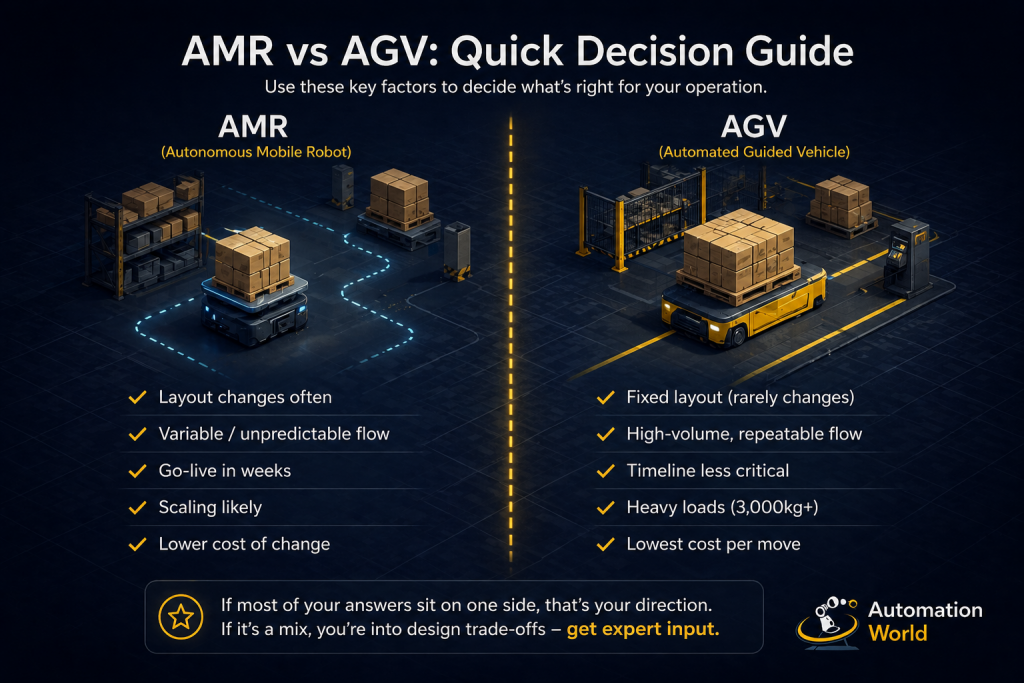
Quick decision check: AMR or AGV?
If you want a fast way to sanity-check the direction, this cuts through most of the noise:
- Has your layout changed in the last 3 years?
Yes → AMR is the safer bet
No → AGV becomes more viable - Is your material flow fixed and repeatable every shift?
Yes → AGV will likely be more efficient long-term
No → AMR handles variability better - Do you need to be live in weeks rather than months?
Yes → AMR
No → Both are still on the table - Are you moving very heavy loads (3,000kg+)?
Yes → AGV (in most cases)
No → Either, depending on layout and flow - Do you expect to scale or reconfigure within the next 2–3 years?
Yes → AMR avoids future rework costs
No → AGV economics improve
If you’re landing in the same column most of the time, that’s your direction. If you’re split, you’re into design trade-offs, and that’s where getting input from someone who’s deployed both starts to matter.
If you’d rather work through those specifics with a specialist who knows both technologies, the Project Matcher connects you with UK integrators who work with both AMRs and AGVs, so you’re not getting a one-sided recommendation.
Frequently Asked Questions
Can an operation use both AMRs and AGVs?
Yes, and it’s more common than people expect. A food manufacturer running 2 shifts might use AGVs for heavy raw material movement from goods-in to production (fixed, high-volume, predictable) while running AMRs in the finished goods area where packing line configurations change by product. The technologies don’t conflict; they serve different parts of the operation. The integration question is the real one: making sure your WMS communicates cleanly with both systems adds complexity that’s worth scoping before you commit to either.
How long does an AMR take to deploy compared to an AGV?
AMRs typically go live in weeks, not months from delivery. The robot maps the environment itself; there’s no floor work and minimal site prep beyond ensuring Wi-Fi infrastructure is adequate. An AGV system typically takes months once full system integration is included when you factor in site survey, floor installation and commissioning. That gap narrows slightly for simpler AGV deployments, but even a basic 2-vehicle system needs floor work that an AMR simply doesn’t. If time to live matters, that difference is hard to argue around.
Which is cheaper to run long term?
AMRs tend to have lower maintenance costs over a 5–7 year period, mostly because there’s no floor infrastructure to repair or modify. That said, AGVs in stable, high-volume environments often deliver a lower cost per movement simply because the system is less complex. The cases where AGVs look expensive long-term are almost always sites that changed their layout post-installation and paid the floor modification costs repeatedly. If your layout is stable, AGV economics hold up well. If it isn’t, AMRs usually win on total cost.
Do AMRs need special flooring?
Not special flooring, but consistent flooring. Significant floor irregularities, wide expansion joints or surfaces with heavy debris can affect navigation and sensor accuracy. Most warehouse floors are fine, and a proper site survey will flag anything that isn’t. Where AMR deployments have run into flooring problems, it’s usually been older distribution centres with damaged concrete. It’s not usually a deal-breaker, but often an overlooked cost (resurfacing a patch, filling joints) that doesn’t appear in the initial proposal. Ask your supplier to be explicit about it during scoping.