
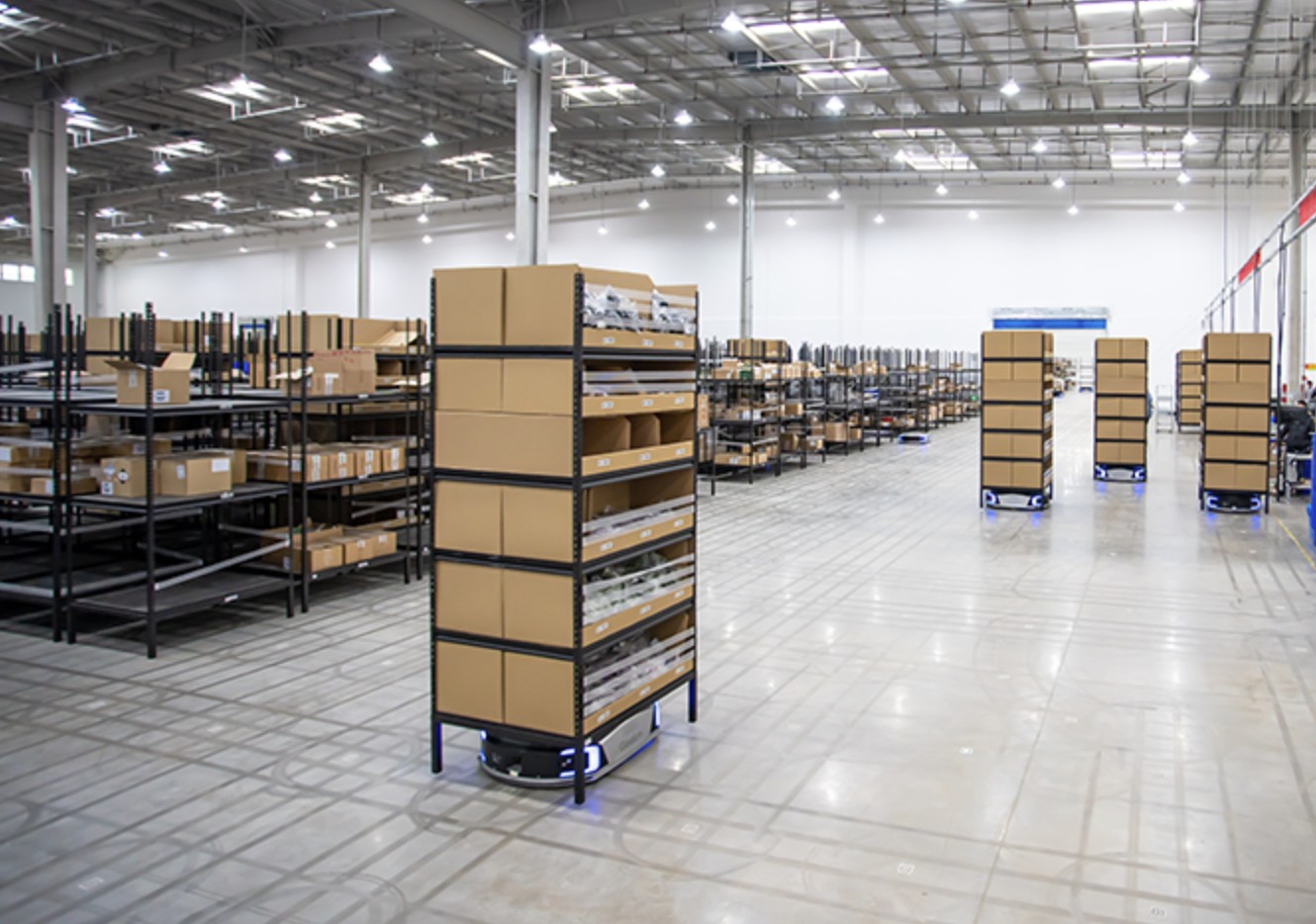
In a goods-to-person system, robots bring inventory to a stationary picker rather than the picker walking to it — and that single change is why manual pick rates of 60–80 picks per hour jump to 300 or more. It’s the most widely deployed solution to throughput problems in UK fulfilment, and the gap in those numbers is why more warehouse managers are seriously pricing it up.
How a goods-to-person (GTP) system works
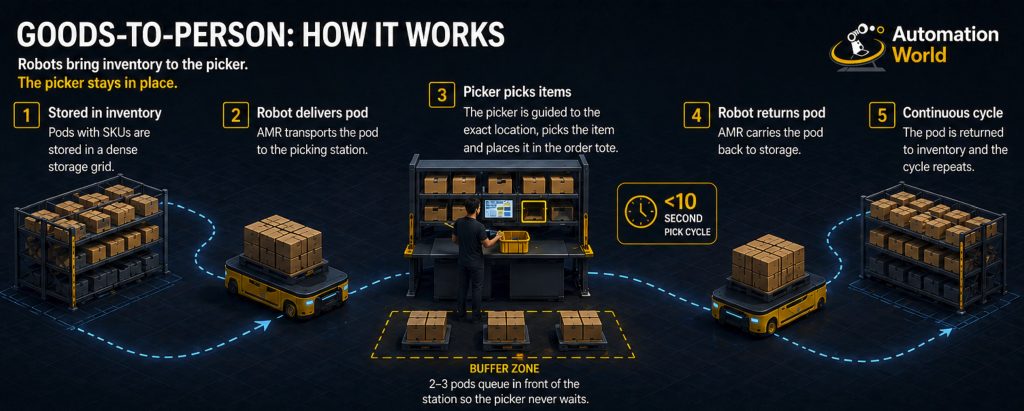
The principle is simple, instead of pickers walking to the product, the product comes to them. Autonomous Mobile Robots (AMRs) carry mobile shelving pods or tote bins from storage to a fixed workstation (Not sure how AMRs differ from traditional guided vehicles? See our guide to AMR vs AGV.). The picker stands still. The robot travels.
At the workstation, the sequence is fast and tightly controlled. A pod arrives, a screen or put-to-light system directs the picker to the exact shelf position, they pull the item into an order tote and the robot carries the pod back to storage. A well-tuned station can process that cycle in under 10 seconds.
A fleet management system assigns robots to tasks, sequences pod movement and keeps the floor clear of bottlenecks. Your WMS needs to plug into it and that integration is where most of the complexity lives. The workstations themselves need power and data infrastructure and the robots need charging docks distributed across the floor, typically at the edges of the automated zone.
One thing a lot of write-ups skip, what happens when the picker is faster than the robots? The answer is buffer zones in front of workstations, where two or three pods queue up so the picker is never idle waiting for the next one to arrive. Get the buffer sizing wrong and you’ve put a fast picker back to standing around, which defeats the point.
Goods-to-person vs person-to-goods
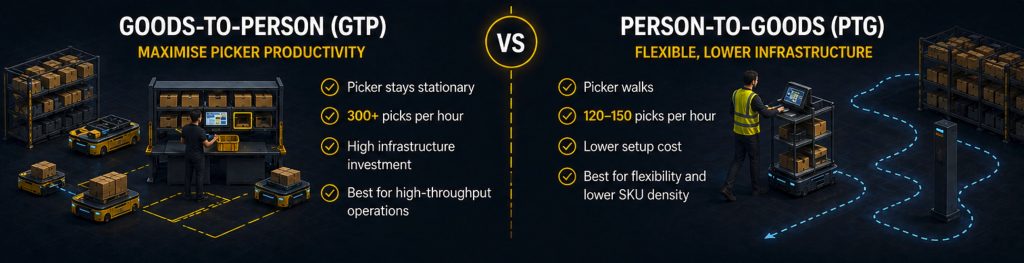
Person-to-goods systems, where an AMR or smart cart follows a picker around the warehouse, are the lower-cost entry point into mobile robotics. They reduce walking time and can push manual pick rates up to around 120–150 picks per hour, but the picker is still moving. The infrastructure requirement is much lighter too: no fixed workstations, no pod-based storage reconfiguration, often requiring lighter integration, sometimes via API or middleware rather than full WCS-level control.
Goods-to-person automation requires more of everything, capital, integration work, floor space planning, but it delivers a step-change in throughput that person-to-goods can’t match. At 300+ picks per hour per station, a two- or three-station deployment can often replace a much larger manual picking team, depending on order profile and SKU distribution.
Compared to shuttle-based systems or crane AS/RS, goods-to-person AMR systems are generally faster to deploy and easier to scale incrementally, you scale by adding robots (and, if needed, additional pods and stations) rather than rebuilding fixed infrastructure. The trade-off is that AS/RS typically offers higher storage density, which matters if floor space is the primary constraint rather than throughput.
The operations where person-to-goods makes more sense are those with very high SKU counts with low pick frequency per SKU, where pod-based storage becomes inefficient, or lower-volume operations where the fixed costs of a goods-to-person setup are hard to justify. At serious scale, 5,000 or more daily order lines, goods-to-person often becomes the stronger economic case.
What a goods-to-person system costs in the UK
UK vendors rarely publish pricing, so getting a reliable number usually means going through a formal quote process. That said, UK buyers should typically plan in the region of £400,000–£800,000 for a small goods-to-person deployment covering a single zone with around 10–20 robots, depending on integration complexity and site readiness. Mid-scale operations, 30–50 robots with multiple workstations, will often land in the £1.2 million to £2 million+ range.
The components buyers most often underestimate are WMS integration, workstation infrastructure and floor preparation. A robot fleet that looks affordable at roughly £30,000–£35,000 per unit is only one part of the picture, once you add workstation build-out, pods or shelving, network infrastructure, software licensing and the cost of involving your WMS vendor, the total project cost increases quickly.
Commissioning time is also a real cost. Getting from delivery to stable operation typically takes 4–8 weeks, with further optimisation often required before the system consistently hits target throughput.
On ROI, well-scoped deployments commonly achieve payback in the 2–4 year range, though this is highly sensitive to utilisation and shift patterns. The core logic is labour replacement: in a like-for-like throughput scenario, a two-station goods-to-person system running two shifts might replace the equivalent output of 8–10 manual pickers, while also improving consistency and accuracy.
At typical UK warehouse labour costs, around £28,000–£32,000 per picker per year fully loaded, that equates to roughly £250,000–£320,000 in annual labour savings, before factoring in reduced errors, lower reliance on agency labour during peak and the ability to scale throughput without a linear increase in headcount. Operations with high labour costs or persistent recruitment challenges tend to see payback at the shorter end of the range.
It’s also worth noting the downside scenario: systems that are underutilised, for example, sized for peak but run at low average volumes, can struggle to achieve these payback periods.
Some vendors offer robotics-as-a-service models, rolling hardware, software and maintenance into a monthly contract. These reduce upfront capital requirements, although total cost of ownership over five years is typically comparable to, and sometimes slightly higher than, an outright purchase, depending on contract structure.
Ready to test these numbers against your operation? Use the ROI calculator →
How long does a goods-to-person project take?
From site assessment to go-live, a well-scoped goods-to-person deployment with a modern WMS can take around 6 months, although 6–12 months is more typical in UK warehouse environments. If your WMS is older or heavily customised, 12–18 months is more realistic, WMS integration is consistently the phase that slips, and the more bespoke your system, the more testing it requires before anyone’s happy to go live.
Most UK deployments don’t require you to take the warehouse down. Vendors bring one zone live at a time, running the automated area alongside your existing manual operation. For most operations that’s not a nice-to-have, it’s a hard requirement. The warehouse has to keep shipping out product.
That phased approach also gives you a real-world performance baseline before you commit to expanding the footprint, which is useful if the original business case had optimistic assumptions baked in.
Which UK operations suit goods-to-person best
The key driver in goods-to-person suitability is not SKU count alone, but the combination of SKU profile, pick density and travel time. Systems work best where pickers would otherwise be walking long distances across a wide and relatively fragmented product range.
As a general guide, goods-to-person systems are typically worth modelling in operations with low-thousands of active SKUs, although the real constraint is how those SKUs are distributed in terms of pick frequency. Below this, throughput gains may still be significant, but the capital cost becomes harder to justify.
Order volume is equally important. A system generally needs sufficient daily order lines to keep workstations consistently utilised. As a rough benchmark, goods-to-person is often worth modelling from around 2,000 daily order lines, although this depends heavily on shift pattern, order complexity and growth expectations. At lower volumes, payback periods can extend unless there are strong offsetting factors such as labour shortages or space constraints.
Seasonality is another key design consideration. Operations with strong peaks must decide whether to size the system for peak demand or average throughput, which can leave capacity underutilised for large parts of the year. Some operations address this with hybrid models, combining a core AMR fleet with flexible manual or assisted picking during peak periods.
Floor space is often underestimated. Goods-to-person systems trade storage density for speed, and the automated zone plus workstation footprint can be significantly larger than conventional racking depending on design. This makes early spatial modelling critical, particularly for sites already operating at capacity.
Shift pattern also has a major impact on ROI. Systems operating across two shifts achieve materially faster payback than single-shift operations due to higher utilisation of fixed infrastructure and software costs.
Not sure if your operation fits the profile? Run your numbers through the ROI calculator →
Where goods-to-person projects go wrong
Most goods-to-person failures aren’t robot failures. The system itself usually works as intended, the problems tend to sit in process design, integration and day-to-day operation.
Poor slotting strategy is one of the most common culprits. Pod-based storage only delivers its throughput potential if fast-moving SKUs are positioned close to workstations and slower movers are stored further away. Operations that carry over their existing slotting logic without rethinking it for a goods-to-person environment often see pick rates fall materially below projections in the early months.
SKU volatility can also catch businesses out. Systems designed around a relatively stable product mix need active management when SKU profiles shift, new lines launching, others going dormant or demand concentrating unexpectedly. The system can support this, but it requires ongoing ownership of slotting decisions. In many operations, this is not a formalised role prior to automation and is often underestimated during planning.
WMS integration scope creep is where timelines and budgets most commonly drift. What begins as a defined API connection often expands once testing starts and edge cases emerge, order types that weren’t accounted for, reporting fields that don’t map cleanly or custom workflows that need to be rebuilt. The operations that manage this best enter the project with a clearly defined integration scope agreed in detail before contracts are signed.
Underutilisation in the early stages is more common than vendors tend to highlight. Systems frequently go live at 40–60% of design capacity while teams adapt to new processes. This can make early ROI performance look weak. The fastest recoveries tend to come from operations that invest properly in training and change management for both pickers and supervisors.
Two additional risks are worth highlighting. First, systems sized around projected growth that doesn’t materialise can remain underutilised for extended periods, stretching payback timelines. Second, over-customising the system to match legacy processes rather than adapting workflows to the new model can introduce unnecessary complexity and slow down both deployment and performance optimisation.
Questions to ask a goods-to-person AMR vendor
WMS integration is where projects most often get complicated during delivery, so press vendors hard on their experience with your specific platform. Ask how many live integrations they’ve completed with it, whether those were in similar operational environments, and whether they own the integration work or rely on your WMS provider. Clarify what testing, exception handling and final sign-off actually look like, not just the happy path.
Ask how many goods-to-person sites they’re actively running in the UK today, particularly in operations comparable to yours. A vendor with a handful of local deployments is a very different proposition from one with a larger UK install base when something goes wrong at 11pm on a Monday.
Get the SLA in writing before you enter procurement. Uptime guarantees, response time commitments and minimum operating capacity should be clearly defined in the contract, not left in a sales deck. A common red flag is vendors who can’t commit to specific response or resolution times, or who are vague about parts availability and on-site support. Robot failures are inevitable, what matters is how quickly the system recovers and how well it degrades when part of the fleet is offline.
Push vendors on how system performance is defined and measured. What throughput is contractually guaranteed, under what conditions, and how is it validated during acceptance testing? Without this clarity, it’s difficult to hold anyone accountable once the system is live.
Finally, understand how the system scales and who owns ongoing optimisation. Ask how easy it is to add robots, workstations or storage capacity over time, and whether performance tuning, such as slotting strategy and workflow optimisation, sits with your team or the vendor post go-live.
Ready to speak to suppliers? Use the Project Matcher to find vetted vendors in your region → or browse the directory filtered for AMR/AGV capability →
Frequently Asked Questions
How many robots do you need per picking station?
A common rule of thumb is 3–5 robots per workstation, but the real answer depends on how quickly you need to keep the station fed with work. The goal is to ensure the picker is never waiting for the next pod, so the required robot count is driven by travel distance, pick cycle time and overall system layout.
In practice, factors such as pod travel distance, SKU velocity distribution and workstation throughput targets all influence the ratio. More compact layouts with short travel paths may need fewer robots per station, while larger or more dispersed systems require more to maintain continuous flow.
A vendor who quotes a fixed ratio without asking these questions is worth being cautious about. Any serious proposal should include a simulation model that shows how the system performs under your expected order profile, including peak conditions, before hardware quantities are finalised.
Can goods-to-person work with an existing WMS?
Yes, and most deployments do exactly that. The integration is usually via API or middleware, and the main risk is with older or heavily customised WMS platforms where testing takes longer and costs more than expected. Worth asking your WMS vendor upfront what their involvement and fees look like, it’s not always included in the robotics vendor’s scope, and finding out late is expensive.
Can you start small and scale up?
This is one of the genuine advantages of AMR-based goods-to-person systems over fixed automation such as shuttle systems or crane AS/RS. Deployments can be phased, often starting with a single zone and a relatively small robot fleet, validating performance, and then expanding over time.
Scaling is typically achieved by adding robots and, where needed, additional workstations and storage capacity. However, it’s not completely frictionless, expansion may also require more floor space, charging infrastructure and layout adjustments to maintain performance.
The most important consideration is that early design decisions shape how easily the system can scale later. The initial layout, workstation positions and storage grid should all be planned with the eventual footprint in mind, not just phase one. The same applies to WMS integration and infrastructure, which are far easier to size correctly upfront than to retrofit later.
What’s the minimum order volume that justifies a goods-to-person system?
There’s no universal floor, but goods-to-person systems rely on keeping workstations consistently utilised, so order volume is a key driver of the business case.
As a general guide, operations processing fewer than 1,500–2,000 order lines per day often find it harder to achieve payback below around 4–5 years, particularly on a single shift. At these volumes, the fixed cost of the system can outweigh the labour savings unless there are strong offsetting factors.
Those factors can shift the threshold significantly. Running multiple shifts, operating in high labour cost areas, or dealing with long walking distances can all improve the economics and bring payback forward. Conversely, systems sized for higher volumes but run below capacity tend to struggle to justify the investment.
The most reliable way to assess this is to model your actual operation, including shift pattern, labour cost and growth expectations, before going to market.
What happens during a robot breakdown?
A single robot failure doesn’t stop a goods-to-person system. AMR fleets are designed with redundancy, so fleet management software redistributes tasks across the remaining robots, usually with only a small reduction in throughput.
The impact depends on how tightly the system is sized. In a well-buffered fleet, losing one or two robots has minimal effect. In more tightly optimised systems, or where multiple robots are offline at once, throughput can drop more noticeably as the remaining fleet works harder to keep stations supplied.
Most systems are designed to degrade gracefully rather than fail outright. Workstations continue operating, but at reduced efficiency. Some installations allow for limited manual access to storage as a fallback, although this is typically slower and not intended for sustained operation.
The more important question is not whether failures happen, they will, but how quickly the system recovers. That’s why SLA terms matter: response times, parts availability and on-site support determine whether a fault is a minor disruption or a prolonged loss of throughput.