
Fleet Management Software for AMRs
Why Do You Need Fleet Management Software?
A single AMR is manageable. A fleet of twenty or fifty robots working the same floor simultaneously though? Without proper coordination robots end up queuing at the same locations, creating traffic bottlenecks in narrow aisles and miss charging windows.
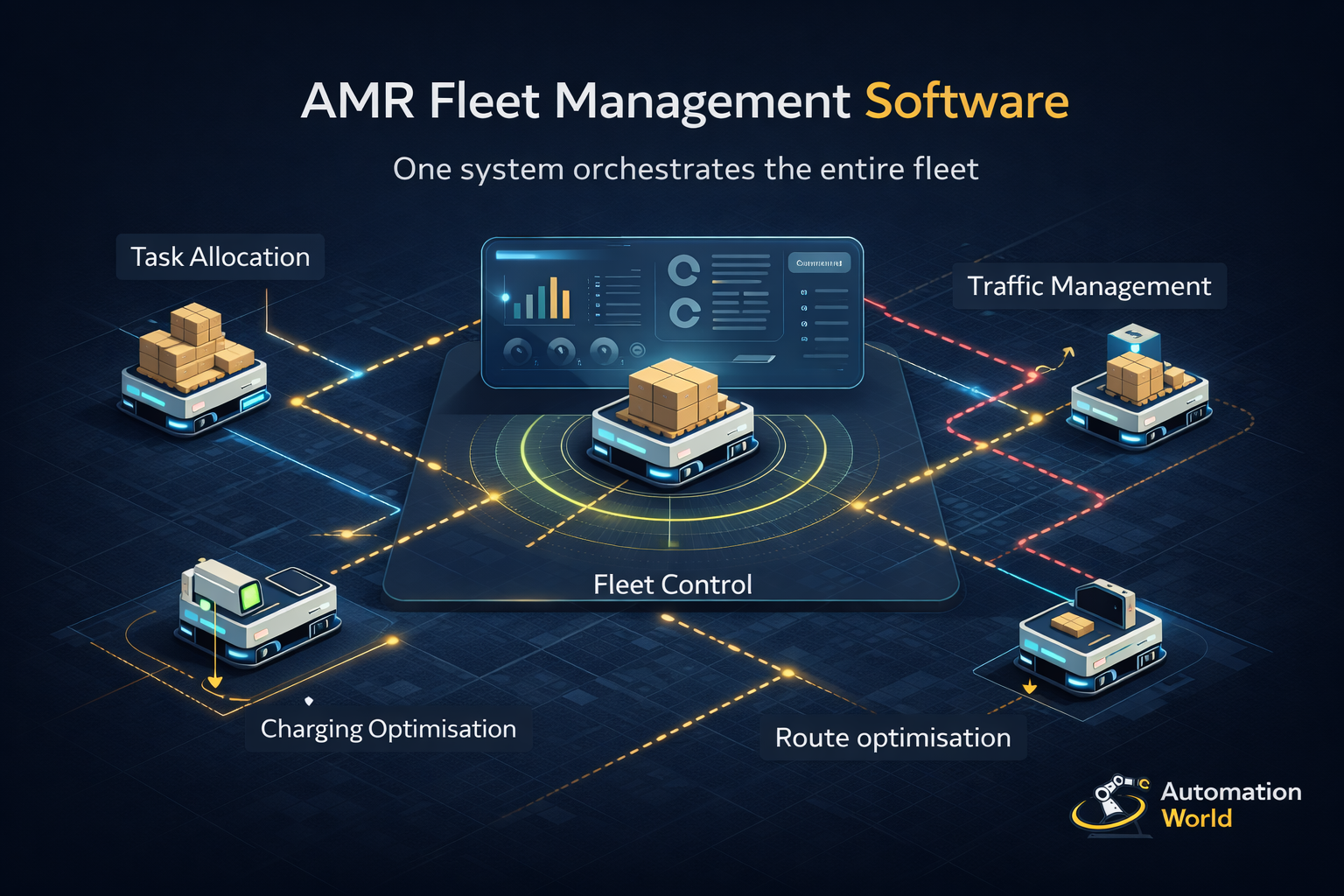
Good fleet management software distributes tasks intelligently, routes robots to avoid conflicts, and keeps operations moving without constant human intervention. Operators deal with exceptions, the FMS handles the day-to-day routine.
For buyers, the FMS layer is also where multi-vendor interoperability becomes relevant. If you eventually want robots from different manufacturers working together on the same floor, something that is increasingly common in large distribution centres, you need a fleet manager that handles mixed fleets. VDA5050, for example, is an open protocol designed to make this possible. Ask prospective vendors whether their FMS supports it before you're locked in.
How Does Fleet Management Software Work?
Fleet management software sits between the WMS and the individual robots. The WMS calls the FMS when a task needs doing. The FMS selects the right robot, calculates the most efficient route, sends the instructions and receives continuous status reports back from the robot, position, battery level, task completion etc.
Traffic management runs through a combination of dynamic path planning and zone control. Robots negotiate right-of-way, hold at designated waiting points and get routed away from congested areas. The system recalculates continuously as conditions change.
Battery management is handled automatically. The FMS monitors charge levels and routes robots to charging stations during quieter periods or when the battery drops to a defined threshold, without stopping operations if the fleet has enough capacity to keep running.
Example Applications
- Fleet management software is relevant to any AMR deployment with more than a handful of robots. It's critical in large e-commerce fulfilment centres, multi-zone distribution operations, and facilities running mixed automation and AMRs alongside conveyor systems or ASRS.
- Smaller deployments sometimes use the vendor's own basic FMS. As fleet size grows, the sophistication of the traffic management and battery scheduling becomes a real operational differentiator. Check the FMS capability before the fleet, not after.
Related Application Guides
![Warehouse AMR Guide: Autonomous Mobile Robots UK [2026]](https://automationworld.co/wp-content/uploads/warehouse-amr-300x225.jpg)
Warehouse AMR Guide: Autonomous Mobile Robots UK [2026]
UK warehouses are running out of people and running out of time. The transport and storage sector has recorded some of t…
View Guide
Warehouse Robotics UK: A Buyer’s Guide to Automation Systems
UK warehouse operators continue to face recruitment and retention challenges. Robots don't fix the people problem entire…
View Guide