
You’ve reached the point where palletising automation looks like the right move. You’ve spoken to a couple of integrators, maybe had site visits or early proposals, and already the picture isn’t lining up. One is pushing a cobot, another is specifying a full industrial robot, and the pricing gap is wide enough to raise questions.
If you are not sure what type of palletiser you need, or if you are even ready to automate, try our Palletising System Selector tool.
That doesn’t usually mean anything’s wrong. But it does mean you’re comparing very different approaches and without a clear way to assess them, it’s easy to default to the cheapest option or the most persuasive salesperson. Neither is a reliable way to choose a system that will actually perform on your line.
If you haven’t started building a shortlist yet, our guide to finding a palletising integrator in the UK is a good starting point, or if you just want to see a list of companies to choose from we have you covered with our list of 10 UK robotic palletising integrators.
This guide gives you a practical framework for evaluating integrators properly, what matters, what to challenge and where the real risks tend to sit.
If you want to understand the systems themselves first, how palletising cells work and what they typically cost, start with the robot palletising guide. This piece focuses on the companies behind the proposals.
What if you just want to see what is out there? Take a look at our list of 10 robotic palletising companies operating in the UK that you should consider for your next project.
What makes palletising integrators different from each other?
Palletising is one of the most common first automation projects in UK manufacturing. That’s good news for buyers in some ways, the technology is mature and a well-specified project shouldn’t carry much risk. The market is crowded, though, and the quality gap between the best and the merely adequate is wider than you’d expect.
Some palletising automation suppliers specialise almost entirely in end-of-line stacking. They’ll have built dozens of cells, have a library of end-of-arm tooling already developed for common product types and can usually move through design and commissioning faster because they’ve solved the same problems many times. A food manufacturer installing a bag palletiser will get a different level of assurance from a supplier who’s done 40 bag palletising projects than from one for whom it’s a fifth of their workload.
Generalist integrators aren’t automatically a worse choice though. If you’re planning a broader automation programme across multiple applications, having 1 supplier who can handle palletising, machine tending, and end-of-line inspection might make more commercial sense than managing 3 separate relationships. The question is whether the scope of this project alone justifies a specialist, or whether continuity across a wider programme matters more.
One thing worth understanding upfront: many integrators are aligned to a specific robot brand. A KUKA partner will almost always recommend KUKA hardware. A Universal Robots integrator will default to cobots, if you’re trying to work out which approach suits your line before you even speak to suppliers, our guide to cobot palletisers vs robotic palletisers covers the key differences. Neither recommendation is wrong on its face, deep expertise in 1 platform is usually better than shallow knowledge of 4, but it means the recommendation you get is shaped partly by what they’re certified to sell. Ask directly which brands they work with and why.
Once you know roughly what you’re looking for, you can compare palletising integrators in our directory directly.

What to look for in a robotic palletising integrator before you get to a quote
Most buyers jump to quotes too fast. Before you ask anyone to price a system, a few checks will tell you quickly whether a supplier is worth pursuing seriously.
Start with their experience of your specific product format. Palletising a 25kg sack of animal feed is a different engineering problem from palletising shrink-wrapped packs of bottled water or stacked trays of fresh produce. The gripper design, the layer pattern logic, the infeed speed, all of it changes with the product. An integrator who can talk specifically about the challenges of your product type has solved them before. One who talks in generalities probably hasn’t.
Ask for references you can actually call, not a logo on their website and a sentence in a case study. The integrators who’ve done good work will give you 2 or 3 customer contacts in a comparable sector and let you ring them. A 15-minute call with a production manager who’s had the cell running for 18 months will tell you more than any brochure.
Find out who owns your support after handover. Some UK robotics palletising integrators have their own engineers on their books. Others rely on the robot manufacturer’s support network or have service agreements with third parties. There’s nothing wrong with either model, but you need to know what happens when something goes wrong mid-shift. Get the response time commitment in writing, not just in conversation.
Commissioning approach matters too. A Factory Acceptance Test (FAT) runs the system at the integrator’s facility before it ships, you travel to them, run it through its paces and sign off before it’s taken apart and transported. A Site Acceptance Test (SAT) happens after installation at your site. Both should be standard. If a quote doesn’t mention either, ask why.
The brief you give them matters as much as choosing a palletising integrator wisely
A vague project brief produces a vague quote. It also produces quotes that look completely different from each other because every supplier has filled in the blanks differently and you end up comparing assumptions rather than proposals.
A solid palletising brief includes your current throughput in cases or bags per minute (not just per shift — per minute is what determines whether a cobot can keep up), product dimensions and weight range, your target pallet configuration including height, the number of SKUs the cell needs to handle and how often they change, the shift pattern the robot needs to cover and available floor space including ceiling height.
Those are the basics. The things people forget to include are often the ones that cause problems later on down the line. The height and condition of your existing infeed conveyor, whether your floor is a suitable concrete specification for anchoring the cell, how far the end of the line is from your loading bay and whether you have a safe area for empty pallet staging.
A good integrator will ask most of these questions during a site survey anyway. But if you can answer them upfront, you’ll get more accurate quotes faster, and you’ll be able to spot quickly if someone is guessing rather than engineering.
How to compare quotes when they don’t look alike
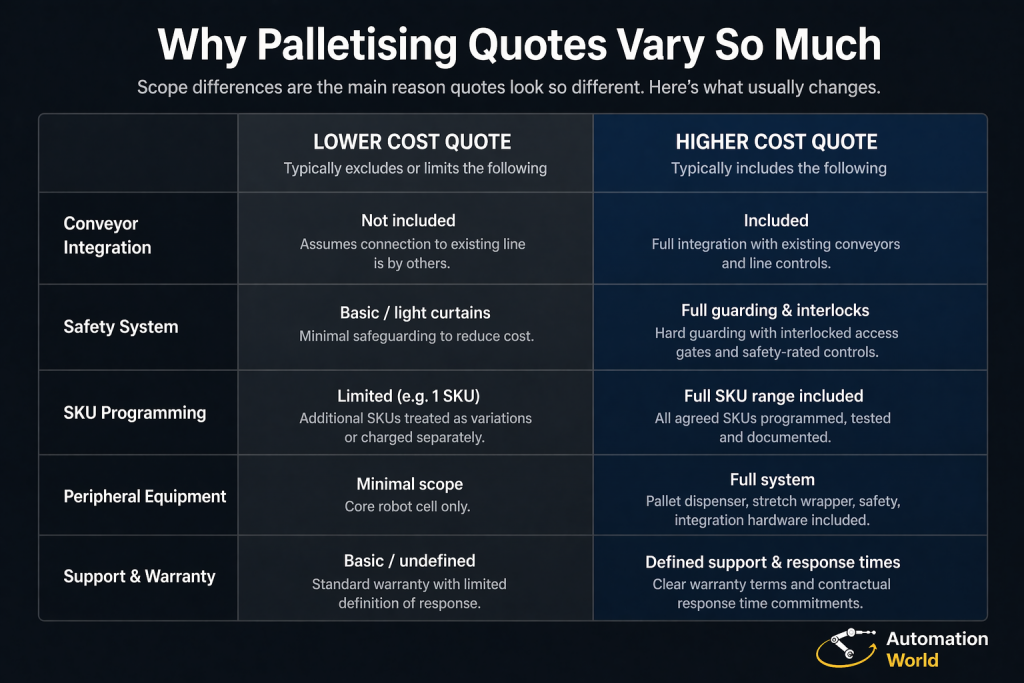
2 quotes for the same palletising cell spec can easily differ by £50,000 or more, a traditional robot palletising cell can look very different to the cost of a cobot palletising cell. That gap isn’t always explained by one supplier being cheaper, it’s often explained by what’s included in the quote and what isn’t. Find out how to calculate the ROI on a palletising cell.
Check whether conveyor integration is included. If the cell needs to connect to your existing line, who’s responsible for the modification is sometimes a line item and sometimes assumed away. Same for stretch wrapper integration, pallet dispensers and safety guarding specification. One supplier might include full hard guarding with interlocked access gates. Another might be quoting light curtains and area scanners. Neither is necessarily wrong, but you need to know you’re comparing the same scope.
Programming time is a common place where quotes diverge quietly. Some include time to programme and test all your SKUs. Others include 1 SKU and treat the rest as variation orders. If you’re running 12 products through the same cell, the difference is significant, ask explicitly how many SKU programmes are covered.
For a standard palletising cell with clear scope, expect a fixed-price quote. A supplier who wants to work on day-rate for a straightforward project is either uncertain about the scope or uncertain about their own costs. Neither is your problem to absorb.
Warranty: 12 months is standard, 24 is available from some suppliers, but the length matters less than what’s actually covered and what the response time commitment looks like in writing.
Questions to ask before you sign anything
Questions to ask before you sign anything
With a shortlist in front of you and detailed proposals on the table, these are worth getting answered before anything is signed.
- What’s your experience with my product format specifically? Not palletising generally, your product type. Ask them to describe a comparable project in detail.
- Can you give me references I can actually call? 2 or 3 contacts in a comparable sector, phone numbers included.
- Who owns the robot programme after handover? Your operators should be able to manage standard SKU programme additions after training, without calling the integrator back.
- What’s the FAT process and can I attend? What are the acceptance criteria, and what happens if the cell fails to meet them before it ships?
- What does post-go-live support look like in year 1? Named contact, location, contractual response time.
- What’s your process if the cell underperforms against the agreed spec after installation? Get this in writing.
- What are the warranty exclusions? Wear items like gripper pads are usually excluded, ask what else.
A few things that should make you slow down: a supplier who won’t give a fixed price for a standard cell, no FAT offered as standard, references they’ll name but won’t let you contact, a quote produced after a phone call with no site visit and any pressure to sign before a deadline. None of these are automatic disqualifiers, but each one deserves a direct question.
What good looks like on the day the cell goes live
Handover is not the end of the project, it’s the beginning of the system being yours to run. By the time you sign off, your operators should be able to load new SKU programmes from the HMI themselves, without calling the integrator. That’s a reasonable expectation and if the training hasn’t got them there, push back before you sign.
The documentation pack should be complete: electrical schematics, mechanical drawings, programme backups, a maintenance schedule with intervals and consumables list. If any of it is missing at handover, it gets harder to obtain later.
Some snagging after go-live is normal. What matters is how fast the integrator responds to close it out. A supplier who goes quiet after sign-off is a supplier you’ll be frustrated with inside 6 months.
For everything covering how the cell itself is designed and specified, robot types, costs, industries, EOAT, the robot palletising guide has the detail. This piece covers who builds it. That one covers what they should be building.