
Palletising Cell
A palletising cell is the complete automated workstation built around a palletising robot, including the robot itself, the infeed conveyor, pallet dispenser, safety guarding and any layer-sheet or wrapping equipment needed to produce a finished, ready-to-ship pallet. It is the full system a manufacturer buys and installs, rather than just the robot arm on its own.
Why does a palletising cell matter?
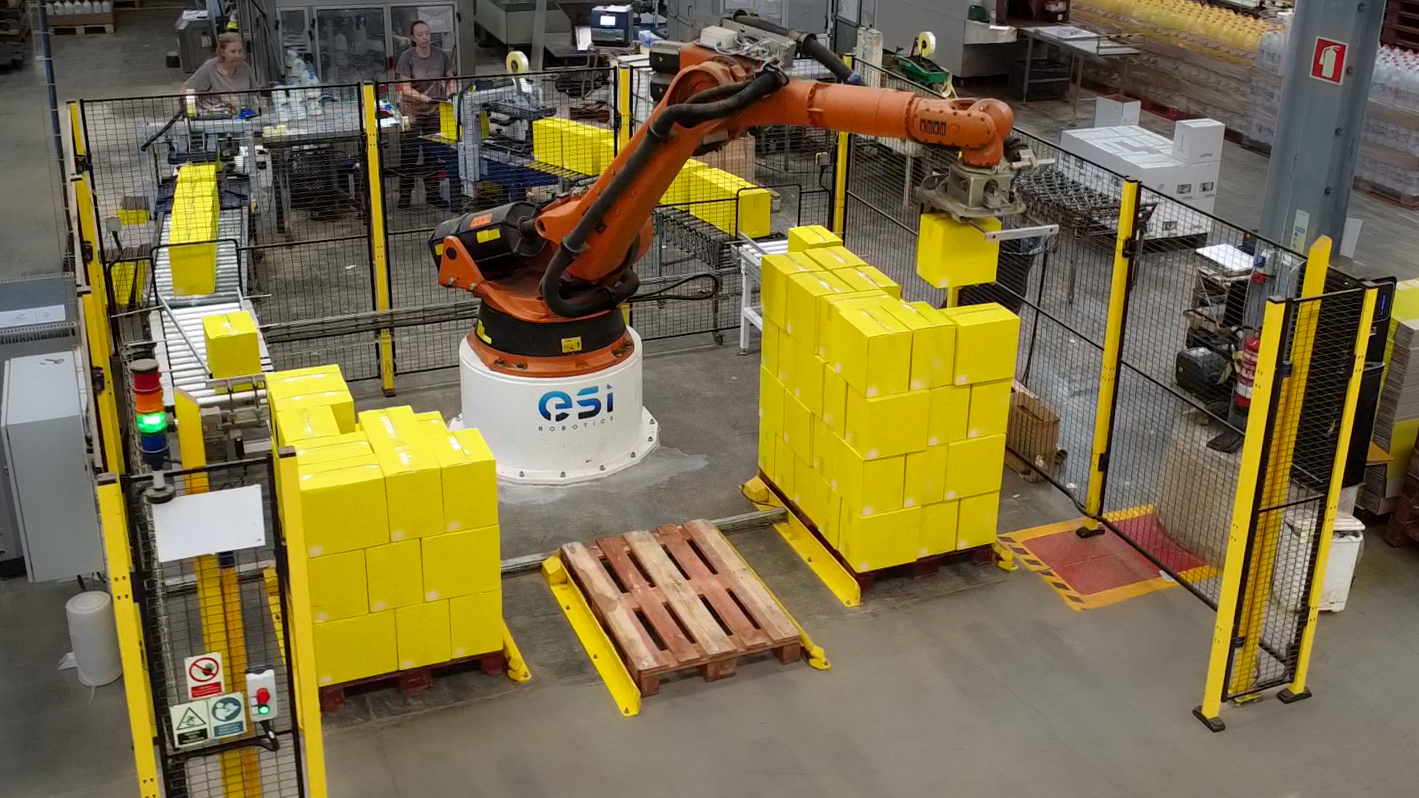
When manufacturers price out palletising automation, the robot itself is often only a fraction of the total project cost, the surrounding cell, including conveyors, safety guarding, pallet and layer-sheet dispensers, and controls integration, typically makes up the larger share. Understanding this early avoids the common mistake of comparing robot list prices between suppliers without accounting for what a fully working cell actually costs to install.
It also affects timeline: a straightforward robot purchase can be quick, but a full cell involves site surveys, guarding design, and integration with existing conveyor and warehouse systems, which is why palletising projects typically take longer from order to go-live than the robot’s own lead time would suggest.
How does a palletising cell work?
A palletising cell typically begins with an infeed conveyor bringing cases or bags from upstream packaging into the robot’s reach, often with a vision system or photo-eye sensor confirming each item’s position and orientation before the robot picks it. The robot, running a pre-programmed pallet pattern, places each item onto an empty pallet supplied by a pallet dispenser or magazine, building the load layer by layer, sometimes with automatic layer-sheet insertion between layers for stability or hygiene reasons.
Once a pallet reaches its target height, a full-pallet conveyor or roller system moves it out of the cell, often toward a stretch-wrapper, while an empty pallet is brought into position for the next load, allowing continuous operation. Safety guarding, whether fixed fencing with interlocked access gates or, for cobot-based cells, force-limited operation without full fencing, is a core design element throughout, since the cell handles heavy, moving loads. Cell layout is usually customised to the specific factory’s floor space and existing conveyor routing rather than sold as an identical standard package.
Where will you find a palletising cell?
- End-of-line case and carton palletising
- Bag palletising for powders and granular products
- Mixed-pallet building for retail distribution
- Multi-line palletising fed by several packaging lines
UK Integrators Offering This Solution

ABB Robotics
Global leader in industrial robots, cobots and AMRs for smarter, more flexible manufacturing

Fanuc
The world's largest robot manufacturer — precision, reliability and zero downtime since 1972

Kawasaki Robotics
Over 50 years of industrial robot expertise — from precision assembly to heavy payload handling
Related Application Guides
Cobot Palletising: End-of-Line Automation with Collaborative Robots
Cobot palletising is an increasingly popular way for UK manufacturers to automate the repetitive task of stacking boxes,…
View Guide
Robot Palletising UK: Automating End-of-Line Stacking
Most production lines in the UK still end the same way they did 30 years ago with a person or persons lifting boxes onto…
View Guide