
Layer Palletiser
Why Would You Use a Layer Palletiser?
Layer palletisers exist because on very high-speed lines, a robot arm picking individual cases can't always keep pace. A 6-axis arm might handle 15 to 18 picks per minute comfortably and with clever designs of the EOAT to allow for multi-case pickups this can drastically improve throughput, there are scenarios where a single robot will struggle to keep up. A layer palletiser moves a whole layer at once, which is how it achieves higher throughput on the right application.
The trade-off is flexibility, and this can be a big trade-off for some manufacturers. Layer palletisers handle a narrower range of product types and pallet configurations than robotic arms. Changing the pallet pattern generally takes more setup time, and some product shapes don't suit layer formation well at all.
If your line runs one product at very high volume, that's rarely a problem. If you're running 20 SKUs with varying case sizes and different pallet requirements for each retailer, a robotic arm is almost certainly the better fit, and most integrators will tell you so early in the conversation.
How Does a Layer Palletiser Work?
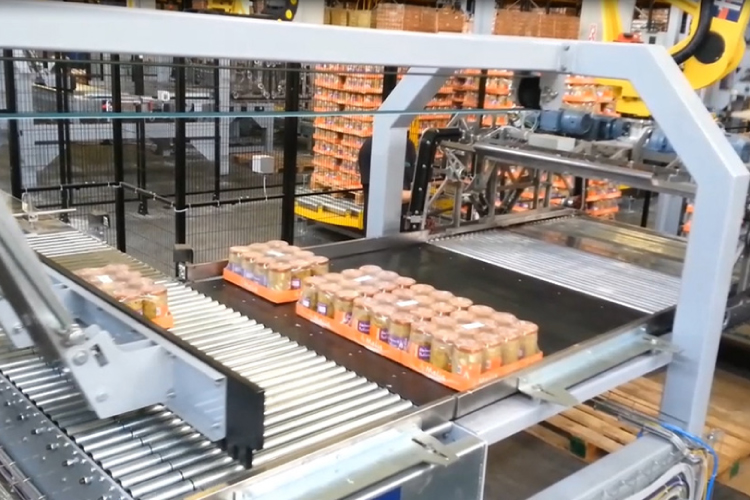
Products arrive from the production line on infeed conveyors and are accumulated in a layer-forming area. Depending on the machine design, a turning station reorients individual products to build the correct pattern, and a sweep or pusher mechanism gathers the full layer into position. Once the layer is formed it transfers onto a layer plate or fork positioned above the pallet. The layer is then lowered onto the stack, or the pallet indexes down slightly, and the plate or fork retracts cleanly so the layer stays in place. The cycle repeats until the pallet is full.
The whole sequence is controlled by a PLC, with operators selecting programmes and monitoring throughput at the HMI (Human Machine Interface). Changeovers between products involve selecting a different "recipe" on the HMI and adjusting the guide rails for the new case dimensions, which takes longer than on a robotic arm cell.
One practical advantage that doesn't always get mentioned: because the process is largely mechanical rather than software-driven, day-to-day maintenance is generally more accessible. The components that wear are physical and replaceable without specialist programming knowledge, which matters on sites without an in-house automation engineer.
Examples of Where Using a Layer Palletiser is Beneficial
- High-speed case palletising in brewery and soft drinks production
- Single-SKU carton palletising in ambient food warehousing
- Tin and can palletising for canned food manufacturers
- High-throughput bag palletising on flour and sugar production lines
UK Integrators Offering This Solution

ABB Robotics
Global leader in industrial robots, cobots and AMRs for smarter, more flexible manufacturing

Fanuc
The world's largest robot manufacturer — precision, reliability and zero downtime since 1972

Kawasaki Robotics
Over 50 years of industrial robot expertise — from precision assembly to heavy payload handling
Related Application Guides
Robot Palletising UK: Automating End-of-Line Stacking
Most production lines in the UK still end the same way they did 30 years ago with a person or persons lifting boxes onto…
View Guide