
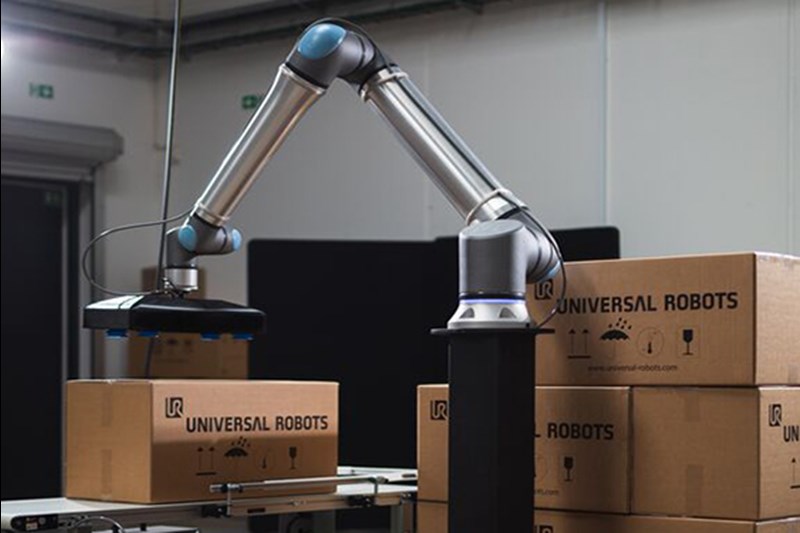
The assumption that robot palletising is for large manufacturers was reasonable a decade ago. The entry cost of a traditional industrial robot cell, even a modest one, put automation out of reach for most businesses under, say, £20m turnover. That’s changed.
Cobot palletising cells start at around £50,000–£60,000. That’s within reach for a lot of SMEs, and for a 2-shift operation, payback in under 2 years is genuinely achievable. Not guaranteed, but achievable with honest assumptions. Here’s what the numbers actually look like for smaller operations, what makes the business case work and, more importantly, where the business case tends to fall apart under scrutiny.
Not sure if you need to be looking for a cobot palletising system or a traditional robot palletiser? Try our palletising suitability calculator.
Want more information on what robotic palletising actually entails? Read our full guide to palletising automation.
What’s changed in the past decade
The price drop is real and has been driven by 3 things. Collaborative robots (cobots) brought capable, safe palletising systems to market at a fraction of the cost of traditional industrial robot cells, the cobot market didn’t exist at meaningful scale before around 2014. The growth of SME-focused integrators in the UK means there are now companies who know how to do a clean, cost-effective installation without over-engineering it for a manufacturer with a 5,000 sq ft factory. And competition in the integrator market has pushed down pricing generally.
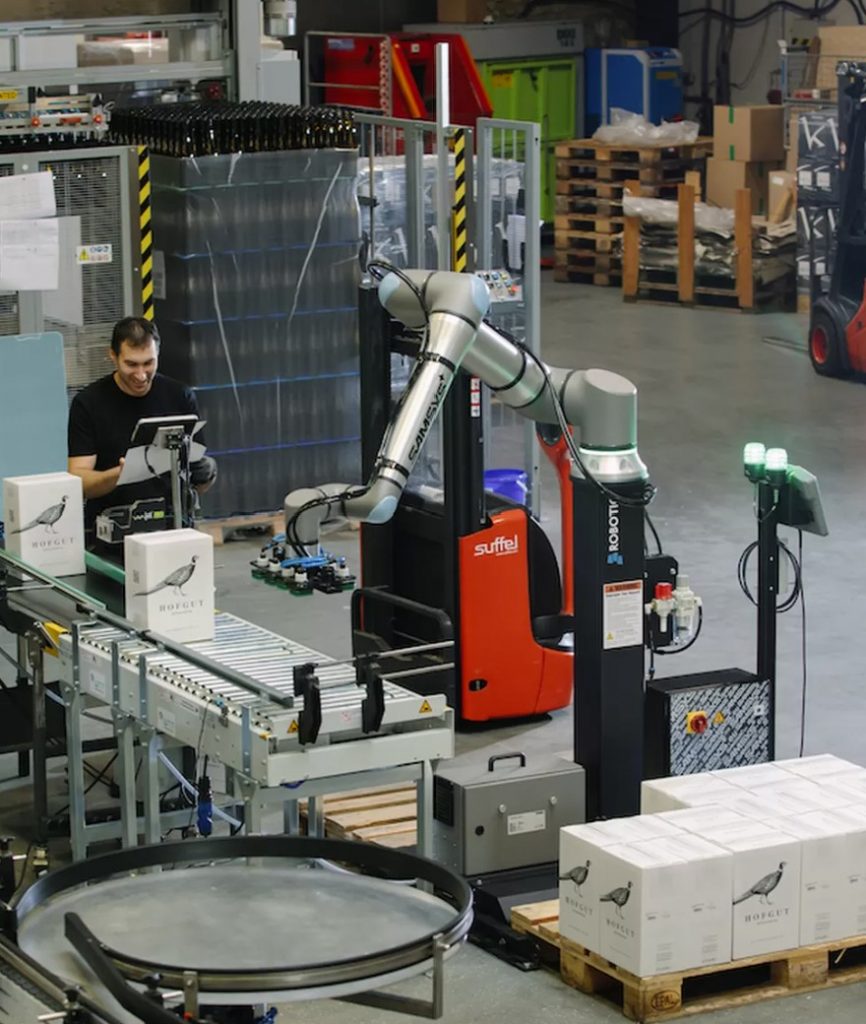
A cobot cell doesn’t need full safety fencing in most applications (subject to risk assessment), which cuts down on both the equipment cost and the floor space required. In a smaller factory where floor space is genuinely scarce, that matters. The cells are also faster to install, typically 2–6 weeks on site rather than the 6–16 weeks a traditional system might take, which limits disruption for businesses that can’t afford to stop production for long.
The honest payback case
Take a contract food packer with 15 employees running 2 palletising shifts, 1 operator per shift. All-in labour cost per operator, taking into account wages, employer NI, pension, around £30,000–£33,000 per year. That’s £60,000–£66,000 of annual cost directly attributable to the palletising process.
A cobot palletising cell for that application, installed and commissioned, might cost £70,000. You’ll still need someone managing pallet changeovers and monitoring the cell, so model the net annual saving at roughly £50,000–£55,000 after a service contract of around £4,000/year. Payback: roughly 12-18 months. If you want more detail on costs, have a look at our guide to cobot palletising costs.
That’s the right end of the spectrum for an SME application. A single-shift operation with one operator saving £25,000/year from a £50,000 system takes around 2.5 years to pay back, less compelling, but still a reasonable return on equipment that should run for a decade. The key is running the numbers before you talk to anyone rather than after.
The automation ROI calculator is built for exactly this, enter your labour costs, shift patterns, and a rough system cost, and it produces a realistic payback estimate. Most people find it takes about 5 minutes and either confirms their instinct or resets their expectations, both of which are useful before the first integrator conversation.
What makes SME projects work
A robot performs best on regular, predictable products, same case dimensions (or close to it), same weight, arriving in a consistent orientation and layered onto a pallet in a consistent pattern. If your palletising involves highly variable products, mixed layers built from 10+ different SKUs, or irregular formats that change week to week, the system gets more complex and the cost starts to rise.
Stable throughput over the working day is the other factor. A palletising robot justifies its cost most clearly when it’s running for the majority of the shift. If you genuinely only need it for 2–3 hours a day because production is intermittent, the economics get harder to justify. That said, even lower-throughput operations sometimes find the ROI works when you include the injury risk reduction, the agency spend and the cost of high turnover in the palletsing role. It’s worth doing the full calculation rather than dismissing it on throughput alone.
We have a handy tool that looks at your throughput and product mix and tells you if your process is ready for automation and, if it is, whether a cobot palletiser will do the job or if you need a more traditional system.
Starting with a clearly scoped, well-understood application helps enormously. SME projects that go well tend to begin with ‘we palletise this one product on this one line and we want to automate that’ rather than ‘we’d like to automate our entire end of line.’ The second brief produces a bigger, slower, more expensive project. The first one produces a working cell in 3 months that the business can learn from.
What causes SME projects to stall
Underestimating installation costs is the most common issue. The robot cell itself is only part of the spend. Conveyor integration (connecting the new cell to your existing packing line), electrical supply upgrades, compressed air installation, and civil preparation (floor levelling, drainage considerations near the cell) can add 15–25% to the quoted system price. A good integrator will scope this upfront, but some don’t volunteer it unprompted. Ask to see a full project cost breakdown that includes everything.
Going to a single integrator is the other one. The UK market has dozens of palletising integrators now, and pricing for similar solutions can vary by 30–40%. Two businesses with nearly identical applications have ended up with quotes of £52,000 and £89,000 for what was essentially the same cobot cell with different integrators. That’s an unusual gap but not an unheard of one. Getting 3 quotes is basic due diligence.
Overspecifying the system is a subtler issue. Some integrators will design a system for the 95th percentile of your operation, maximum possible throughput, every possible SKU and full flexibility for any future product. That’s a more expensive system than most SMEs need, and it takes longer to install and commission. Being clear about what you actually need to automate (rather than everything you might ever want to automate) keeps the project cost and timeline realistic. If there are products that add to the complexity but they only account for a very small amount of your overall production, consider removing them from the spec and dealing with them separately.
How to evaluate integrator quotes
Price is the obvious comparison point, but it’s not the most important one. What matters is, what exactly is included (full civil scope, conveyors, all electrical, commissioning, training), what the service contract covers and what the response time commitment is, and whether the integrator has done comparable projects for businesses of your size in your sector.
Ask for references from SME customers specifically. A large integrator whose core business is £500k+ industrial robot lines for automotive manufacturers may technically be able to install a £60k cobot cell, but their commercial model and support structure may not be calibrated for a business your size.
The supplier directory lists verified UK palletising integrators, with information on their capabilities and sectors served. If you want to be matched to the ones best suited to your application, budget, and sector specifically, the project matcher does that in a couple of minutes. It’s a better starting point than cold-searching for whoever ranks first in Google, and more targeted than the full directory if you know broadly what you need.
Before any of those conversations, read through the signals that suggest an operation is actually ready to automate. Going into a site survey having already checked those boxes puts you in a much stronger position than finding out halfway through the process that the business case doesn’t hold.