Application guide Pick and place · 2026
Robotic Pick and Place UK An automation guide for UK manufacturers
Robotic pick and place automates the repetitive movement of products, components or parts from one location to another. Robots can transfer products between conveyors, machines, fixtures, packaging stations and inspection points, using different grippers and vision systems depending on the application. For UK manufacturers, pick and place is particularly useful where repetitive handling is labour-intensive, difficult to staff, physically demanding or needs to operate at a consistent rate.
What Is a Pick and Place Robot?
Ever watch someone pack boxes or sort items all day? There's a reason we now let robots handle that. A pick and place robot performs a repetitive transfer: picking a product or component from one location and placing it in another. The robot repeats the movement consistently according to the programmed process.
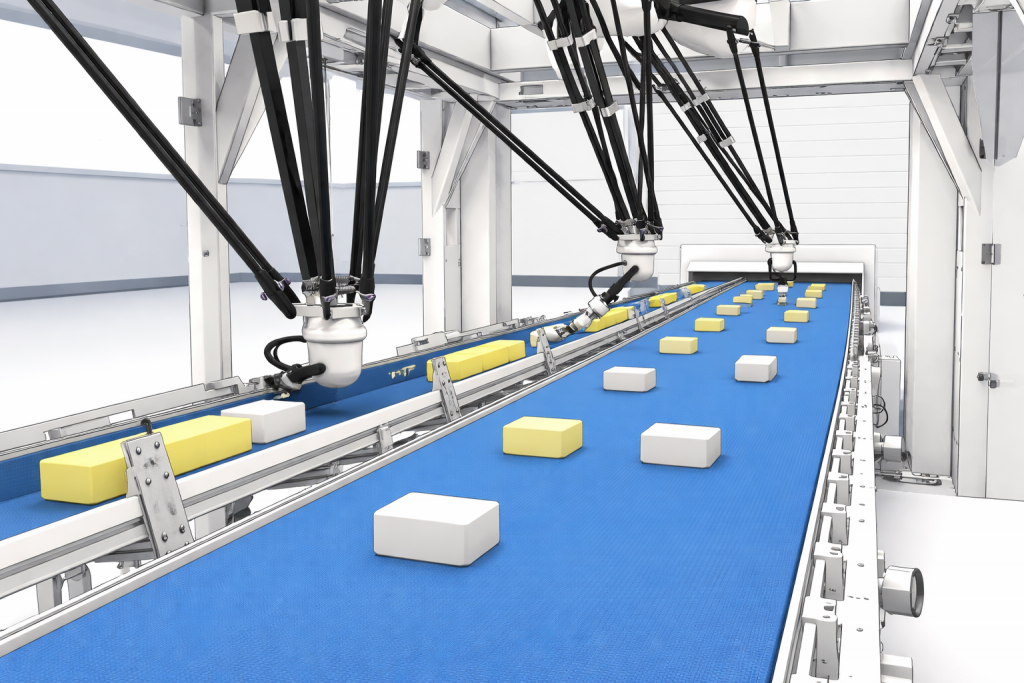
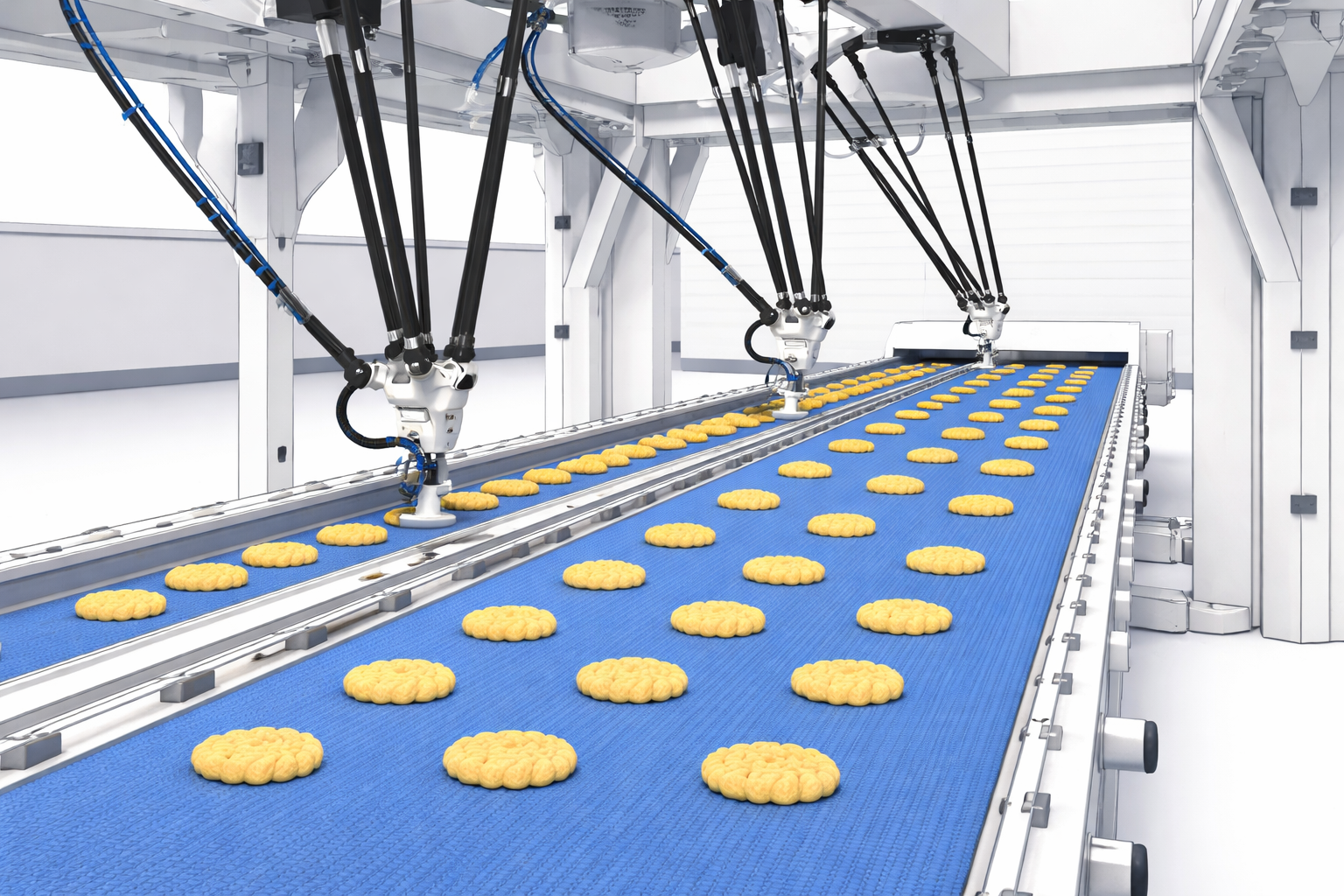
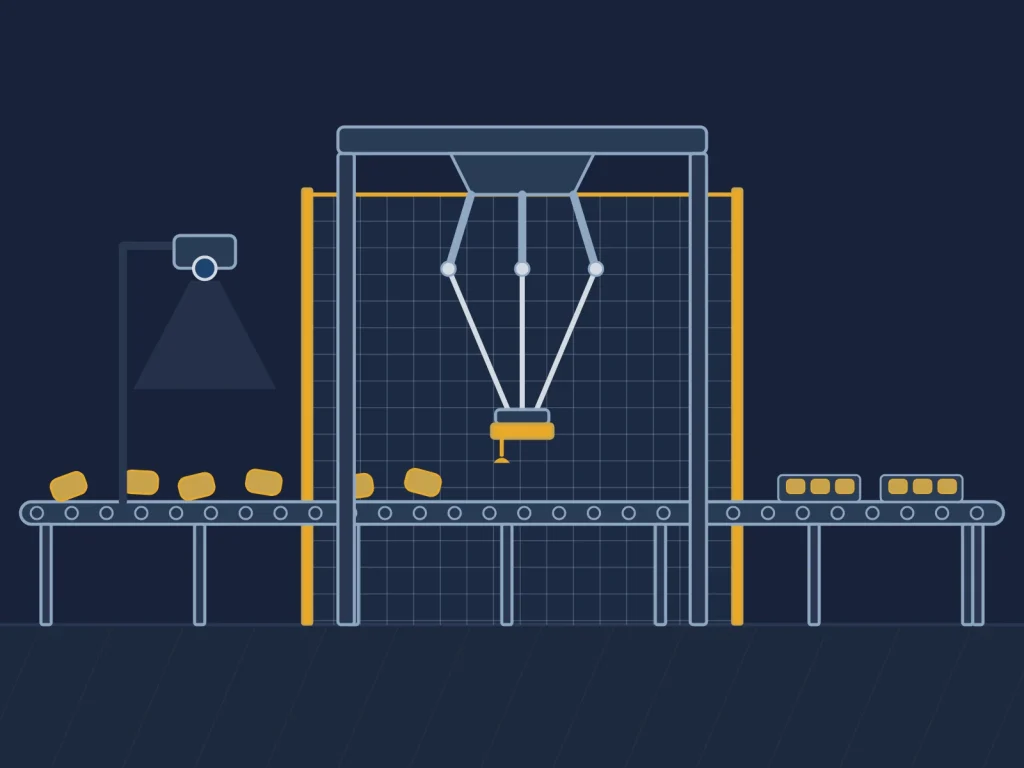
You'll see these robots in all sorts of shapes. Some just slide back and forth on rails, perfect for simple "grab from here, put over there" jobs. Others look like human arms with joints everywhere, great when things need to be twisted and turned mid-move. Then there are those spider-looking ones dangling above conveyor belts. Those delta robots are insanely fast at grabbing lightweight stuff like cookies or tiny electronics parts.
Most robotic pick and place systems come with vision now too in the form of cameras and sensors. Even basic setups can tell if something's actually there to grab. The smarter ones can spot randomly scattered items in a bin or figure out exactly when to snatch something zooming past on a conveyor.
Delta robots
Spider-like delta robots mounted above conveyor belts. Extremely fast, ideal for lightweight products like confectionery, pharmaceuticals or small electronics. High-speed delta systems can achieve 100–200+ picks per minute in suitable lightweight applications.
SCARA robots
Excel at flat, horizontal movements with very high levels of repeatability. SCARA robots are well suited to precise horizontal handling, assembly and packaging applications.
6-axis articulated arms
The most versatile option out of the 3. 6-axis articulated robot arms offer the greatest flexibility of these three options, particularly where products need to be reoriented, approached from different angles or handled through multiple stages.
The gripper is arguably just as important as selecting the right robot.
Delta, SCARA or 6-axis?
Delta robots are typically fastest for lightweight, high-speed picking. SCARA robots suit precise, flat placement in assembly and packaging. 6-axis arms handle awkward shapes, heavier payloads and multi-step tasks.
New to automation? An integrator will size the robot, gripper and vision to your product.
Find pick and place integratorsWhy Automate Pick and Place Tasks?
Pick and place is often repetitive, labour-intensive work, making it one of the more straightforward manufacturing tasks to assess for automation.
Throughput depends on the application
Pick-and-place throughput varies enormously between applications. High-speed delta systems can exceed 100 picks per minute on lightweight products, while SCARA, articulated and collaborative robots are normally selected for different combinations of speed, payload, reach and flexibility.
The achievable rate depends on the robot, product weight and geometry, pick distance, gripper, vision, product presentation and whether one or multiple products are picked at each cycle.
Reduce repetitive manual handling
Pick and place automation can reduce the amount of repetitive handling required from operators, particularly on processes running for long periods or across multiple shifts. The business case depends on labour requirements, operating hours, throughput and the level of automation required.
Cleaner, Safer, Compliant
Reduced manual handling can be beneficial in hygienic applications, particularly where product contact needs to be controlled. The robot cell itself still has to be designed and operated to meet the applicable hygiene, safety and regulatory requirements.
Extend production without adding another repetitive manual task
A suitably designed robotic cell can operate for extended periods and across multiple shifts without fatigue. This can create additional production capacity where the rest of the line can support it, although maintenance, changeovers, material supply and downstream constraints still determine actual availability.
Robotics Integrators in the UK
If you are new to automation then you might want to read our guide on robotics integrators, it will give you a better idea on what they do, how to choose one and what to look for in a project.
-
100+ /min
High-speed delta systems
High-speed delta systems can achieve this range on suitable lightweight products.
-
24/7
Across multiple shifts
A robotic cell can repeat its task without the fatigue associated with manual handling.
-
Cleaner and more consistent
Reducing manual product handling can reduce some contamination risks in suitable applications, while consistent robot motion can improve repeatability.
Honest qualifier Treat cost guides here as loose. Payload, speed, product shape, space and integration complexity all move the price.
How Pick and Place Systems Work
Five stages, and the question worth putting to your integrator at each one.
-
Choose the robot
Selection depends on speed (your throughput), payload (your product's weight) and reach from the mounting position to the pick and place points.
Ask: Delta, SCARA or 6-axis for my product?
-
End-of-arm tooling Critical
The part that touches your product. It must pick accurately and repeatably without damaging or marking it: vacuum cups, fingers, magnetic or soft grippers, or a tool changer for several products.
Ask: Has the gripper been tested on our products?
-
Vision
Some cells use simple sensors to confirm product presence, while 2D or 3D vision can locate products whose position or orientation varies.
Ask: Do our products arrive in a fixed position?
-
Infeed and outfeed
Conveyors, feeders or hoppers bring product in, and an outfeed carries it on. Synchronising the two keeps the robot running smoothly.
Ask: What sets the pace, the robot or the line?
-
Safety and guarding Mandatory
Guarding and safety devices are set by the cell's risk assessment, so access for loading and maintenance is designed in from the start.
Ask: What guarding will the cell need?
Key components
-
Robot
Chosen by speed, payload and reach.
DeltaSCARA6-axis
-
End-of-arm tooling Make or break
Vacuum cups, fingers, magnetic or soft grippers, or a tool changer for several products.
-
Vision system
Sensors and, where required, 2D or 3D cameras detect and locate products.
-
Infeed
Conveyor, feeder or hopper that delivers product to the pick area.
-
Outfeed
Carries completed picks on to packing or further processing.
-
Guarding
Set by the risk assessment, with safe access for loading and maintenance.
Industries Using Pick and Place Robots
-
Food and Beverage
Pick and place is widely used in food and beverage, particularly for tray loading, product transfer and secondary packaging.
-
Pharmaceutical and Medical
In pharmaceutical and medical applications, controlled and repeatable handling can be important for product quality, traceability and process control.
-
Electronics and Assembly
Pick and place is widely used for handling electronic components and assemblies where repeatable positioning and controlled handling are important.
-
General Manufacturing and Fabrication
Out on the shop floor of a typical UK fab shop or manufacturing plant, pick and place robots are less about raw speed and more about keeping things moving.
-
Logistics and Warehousing
Pick and place systems are also used in logistics and fulfilment for sorting, transferring and presenting products for packing or further processing.
-
Automotive and Engineering
Automotive and engineering often involve heavier or more complex components, where articulated robots may be more appropriate than high-speed delta systems.
-
ROI calculator
Will pick and place pay back in your sector?
Put in your own wages, shifts and project cost to see a payback estimate in under a minute.
Work out your ROI
How Much Does a Pick and Place Robot Cost in the UK?
Investment range Indicative UK costs, excluding VAT
-
Simple system
Simple 2–3 axis cell with a basic gripper.
-
Medium complexity
Integrated cell with vision and/or more complex tooling, controls and line integration.
-
High throughput
Multi-robot systems, high-speed handling, advanced vision, bespoke feeding and extensive line integration.
Project timeline 20–29 weeks, design to sign-off
-
8-10 weeks
Design
Depending on the complexity of the cell
-
8–12 weeks
Build
Depending on the complexity of the cell
-
2-3 weeks
Installation
Depending on the complexity of the cell
-
2-4 weeks
Commissioning
Depending on cell, level of training required etc.
Typical UK ranges from integrator quotes, for guidance only. Your cost depends on the parts, cycle time, safety and site.
UK integrators
-
 View profile
AdaptTech Manufacturing Solutions Ltd Claimed
Manufacturing Solutions
Automotive, General Manufacturing
-
 View profile
-
 View profile
Project Matcher
Get a shortlist of UK integrators for this job
Answer four questions about your project. We match you with UK integrators who do this work.
Get matchedFrequently asked questions
What industries use robotic pick and place systems in the UK?
Robotic pick and place systems are widely used across UK manufacturing and logistics industries, including food and beverage, pharmaceuticals, automotive, electronics, and e-commerce fulfilment. These systems are ideal for high-speed, repetitive tasks such as packaging, sorting, assembly, and inspection.
What are the main benefits of robotic pick and place automation?
The main benefits include increased speed, improved accuracy, reduced labour costs, and a consistent product quality. Pick and place robots can handle repetitive tasks with high precision and operate continuously, significantly boosting productivity and throughput.
What types of robots are used for pick and place applications?
Common types include SCARA robots, delta robots, Cartesian (gantry) systems, and collaborative robots (cobots). The choice depends on factors such as payload, speed requirements, workspace, and the complexity of the application.
How do I choose the right pick and place system?
Your focus should be on the payload that the robot will need to pick, the speed/throughput, product type and shape, what space constraints you need to work within and integration complexity in your factory. Most UK manufacturers work with a robotics integrator to assess requirements and design a tailored system to ensure all of these points are met. If that is your next step then have a look around our directory to see who might fit the bill.
How fast can a pick and place robot work?
There is no single pick rate for robotic pick and place. High-speed delta systems can exceed 100 picks per minute on suitable lightweight products, while SCARA, articulated and collaborative robots are normally used at lower rates where precision, payload or flexibility is more important. Actual throughput depends on the robot, product, gripper, vision, travel distance and whether multiple products can be picked per cycle.