
Pick and Place
Pick and place is the general term for any automated process where a robot picks up an item from one location and places it in another, usually as part of packing, assembly, sorting or machine loading. It is one of the oldest and most common robotic applications, ranging from simple fixed-position transfers to vision-guided systems that can handle randomly oriented parts on a moving conveyor.
Why is Pick and Place important?
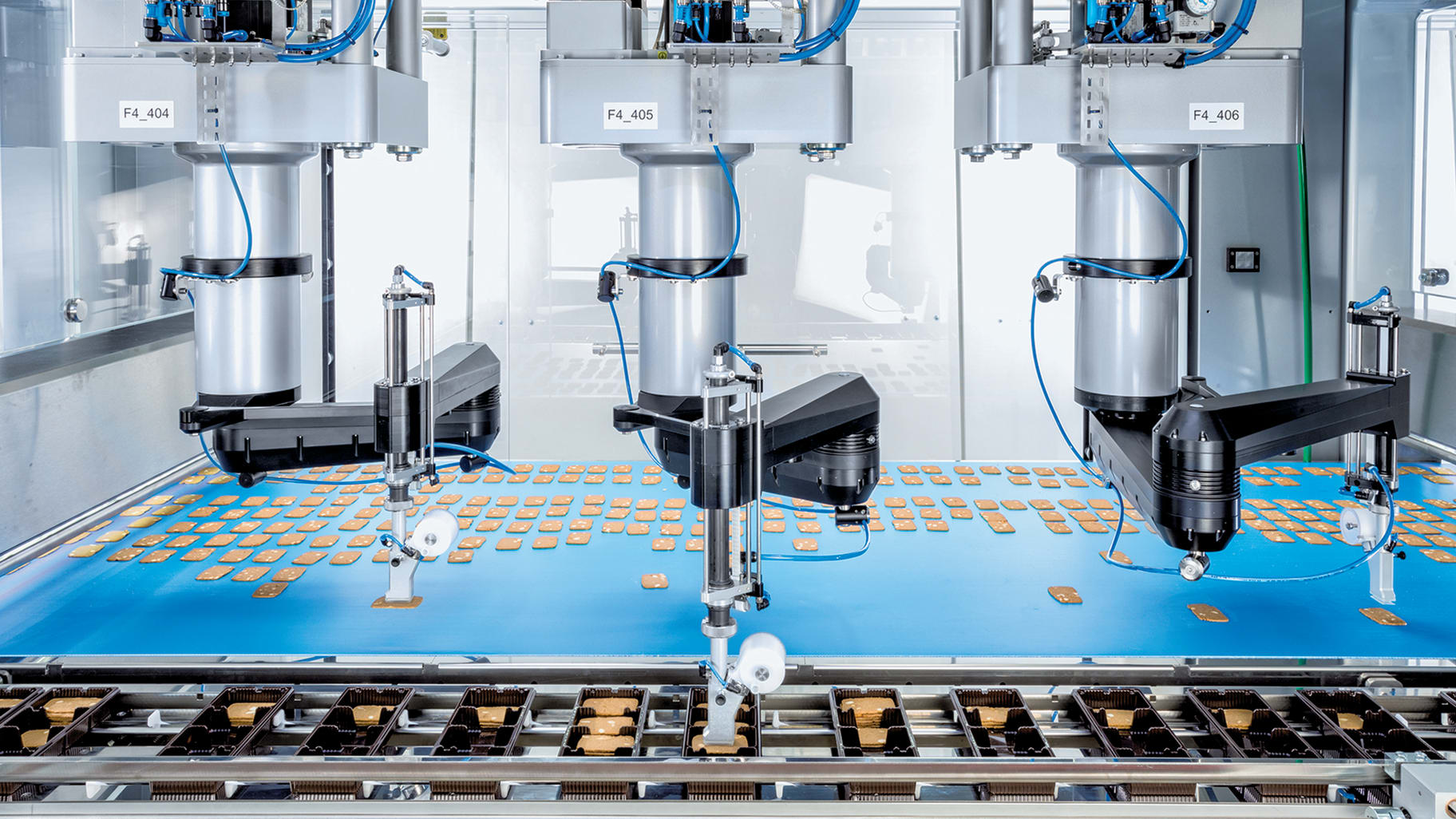
Pick and place tasks are among the most repetitive, and therefore among the most automatable, jobs on a production line. For manufacturers, that repetition is exactly the problem: the same motion performed thousands of times a shift causes fatigue, RSI-type injuries and inconsistent output as workers tire.
A well-specified pick and place cell removes that risk entirely and typically runs at a steadier rate than a manual station, which improves downstream planning. It is also usually the first automation project a factory considers, because the business case is straightforward to build, labour hours saved, throughput gained and injury risk reduced can all be measured against a relatively modest capital cost, especially where a cobot is a viable option.
How does a pick and place system work?
A pick and place system combines a robot arm, articulated, SCARA or delta, depending on speed and reach needs, with an end effector suited to the part, commonly a vacuum gripper, mechanical gripper, or a combination of both on a multi-tool head.
In its simplest form, parts arrive in a fixed, known position, such as a tray or fixture, so the robot can execute a pre-programmed pick-and-move path without needing to sense anything. Where parts arrive randomly oriented, tipped into a bin or spread on a conveyor, the robot is paired with a machine vision system that locates each part in real time and adjusts the robot’s path accordingly. Cycle time, positional accuracy and payload are the three specifications that usually decide which robot type and gripper suit a given job. High-speed, light-part applications typically favour delta or SCARA robots, while heavier or more varied parts usually call for a 6-axis articulated arm.
Where would you find pick and place systems?
- • Packaging line loading and unloading
- • Assembly line part transfer
- • Sorting items by size, type or destination
- • Kitting components for downstream assembly
UK Integrators Offering This Solution

AdaptTech Manufacturing Solutions Ltd
Manufacturing Solutions


Related Application Guides
Robotic Pick and Place UK: Automation Guide
Robotic pick and place automates the repetitive movement of products, components or parts from one location to another.…
View Guide