
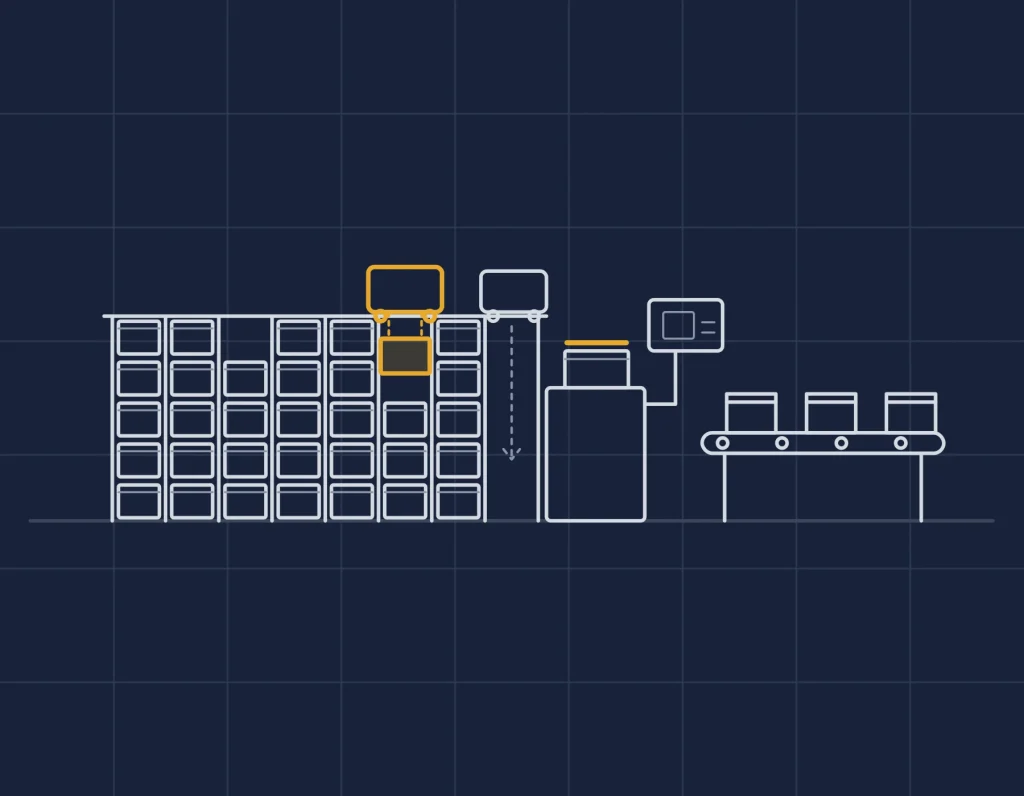








What is an ASRS?
It's a storage system where machines do the fetching. Stock lives in dense racking or a grid, and cranes, shuttles or robots bring each item to a person at a pick station (or onto a conveyor) when it's needed.
The payoff usually comes from 3 places at once. You fit more stock into the same building, pickers stop walking, and picking errors drop because the system presents exactly the right tote.
Most ASRS projects are warehouse-scale and take a year or more. Factories often start much smaller, with a vertical lift module for spares, tools or kitting parts beside the line.
Which type of ASRS?
Load size and throughput rule most options out quickly. Your building's height and floor usually settle the rest.
| Vertical lift module | Cube storage | Shuttle system | Pallet crane | |
|---|---|---|---|---|
| Stores | Trays of parts and tools | Totes stacked in a grid | Totes or cartons in racking | Full pallets |
| Best for | Spares, tooling and kitting | Many small SKUs, e-commerce | High throughput and fast replenishment | Bulk storage and cold stores |
| Throughput | Tens of picks an hour per unit | Grows with robot numbers | Highest per aisle | Tens of pallets an hour per crane |
| Building | Fits inside most factories | Level floor, flexible footprint | Height and a level floor | High-bay, sometimes a new build |
| Indicative cost | £60k–£150k per unit | £1m+ | £750k+ | £1m+ |
Is an ASRS right for your operation?
If you're about to extend the building or rent more space, run through this first. An ASRS can work out cheaper than more square metres.
Good fit
- Short of space, but with height to spare
- Lots of SKUs picked in small quantities
- Pickers spend most of their time walking
- Picking errors cost you returns or credits
- Steady or growing volumes for 5+ years
- 2 shifts or more, or plans to add them
Think twice
- A lease ending in the next few years
- Mostly bulky, odd-shaped or very heavy items
- Sharp seasonal peaks with quiet months between
- A floor that's uneven or can't take the load
- A WMS that can't talk to automation
- A small range picked in full pallets
What's in an ASRS project
-
Storage structure
Racking, grid or trays that hold the stock. Sized for your SKUs and 5 years of growth.
-
Robots, shuttles or cranes
The machines that fetch and return stock. Their number sets your throughput.
-
Pick stations
Where people meet the stock. Ergonomics here decide how fast your team can pick.
-
Conveyors
Link the ASRS to packing, despatch or production. Often a big share of the cost.
-
Control software (WCS)
Runs the machines and decides which tote goes where, second by second.
-
WMS integration
Connects orders and stock records to the ASRS. Projects stall here more than anywhere.
Common ASRS mistakes, and the fix
-
Mistake: Designing for today's order profile
Fix Give suppliers 3 to 5 years of growth forecasts, including SKU count and order lines.
-
Mistake: Leaving the WMS conversation until late
Fix Get your WMS provider and ASRS integrator in the same meeting before you sign.
-
Mistake: Assuming the system never stops
Fix Agree how you'll pick if it's down for a shift, and test that plan before go-live.
-
Mistake: Underestimating the move-in
Fix Build stock migration and several weeks of ramp-up into the timeline.
Free planning tools
Put numbers on it before you talk to suppliers
Choosing an ASRS integrator
An ASRS can run for 15 to 20 years, so you're choosing a long-term partner as much as a system.
| What to check | Evidence to ask for |
|---|---|
| Data analysisBuilt on your real order data | A throughput model using a year of your order lines |
| System choiceWhy this type of ASRS | A comparison with at least 1 other option they considered |
| SoftwareWCS and WMS integration | Named interfaces, who builds them and who supports them |
| Reference sitesSimilar size and sector | 2 live sites you can visit, ideally 3+ years old |
| ResilienceWhat happens in a breakdown | Redundancy design, manual fallback and recovery times |
| Lifetime supportService for 15 years or more | On-site engineer options, spares strategy and upgrade path |
Before you ask for quotes
ASRS design starts with data. Bring these 5 things and integrators can tell you quickly which systems are worth modelling.
Use it in the Project Matcher- A year of order lines, by SKU
- SKU dimensions, weights and stock levels
- Building drawings, including clear height
- Peak day volumes and growth forecasts
- Your WMS and who supports it
What does an ASRS cost?
The range is huge, so separate the 2 kinds of project. A VLM is a piece of equipment. A warehouse ASRS is a building-scale programme with software, conveyors and a lot of change.
-
Vertical lift module
£60k–£150k
1 unit, installed, with basic inventory software
-
Mid-size system
£750k–£3m
Cube or shuttle system, pick stations and WMS integration
-
Large warehouse system
£3m+
High-bay cranes, several systems or a new building
What moves the price:
- System type
- Storage positions
- Throughput
- Pick stations
- Software and WMS
- Building work
- Cold store
Indicative UK costs, excluding VAT. Actual project costs vary by application and specification.
Frequently asked questions
A vertical lift module can be in and working within a few weeks. A warehouse system usually takes 9 to 18 months from contract to full operation, and the design and data work at the start is the last place to save time.
Most modern systems can grow. Cube and shuttle systems can add storage, robots or pick stations, provided the original design left room. Ask for the expansion plan in writing at quote stage.
Good designs avoid single points of failure, so one fault slows picking down while the rest keeps going. Ask how you'd pick if the whole system stopped for a shift, because one day it will.
Often you can keep yours. Many current WMS platforms connect through the integrator's control software. Older or heavily customised systems are where projects stall, so bring your WMS provider in early.
Often, yes. Leasing is common for VLMs and increasingly offered on larger systems. On a big system, check what happens at the end of the term, because taking it out is a project in itself.
For spares, tools or kitting parts, often yes. A VLM or two can free up floor space and stop people hunting for parts. Full warehouse systems rarely make sense on a factory site unless it runs its own distribution too.