









What is robotic welding?
A robot holds the torch and follows a programmed path along each seam, at the same speed, angle and distance every time. Many UK installations use MIG/MAG on steel, with TIG, spot and laser welding used for more specialist applications.
Fixtures and part fit-up decide whether most projects succeed. A robot can't tell that today's batch was cut 2 mm long unless you give it sensors to find out.
Fabrication covers the jobs around the weld too, like cutting, bending and grinding. This page concentrates on welding, and the application tiles above link to the rest.
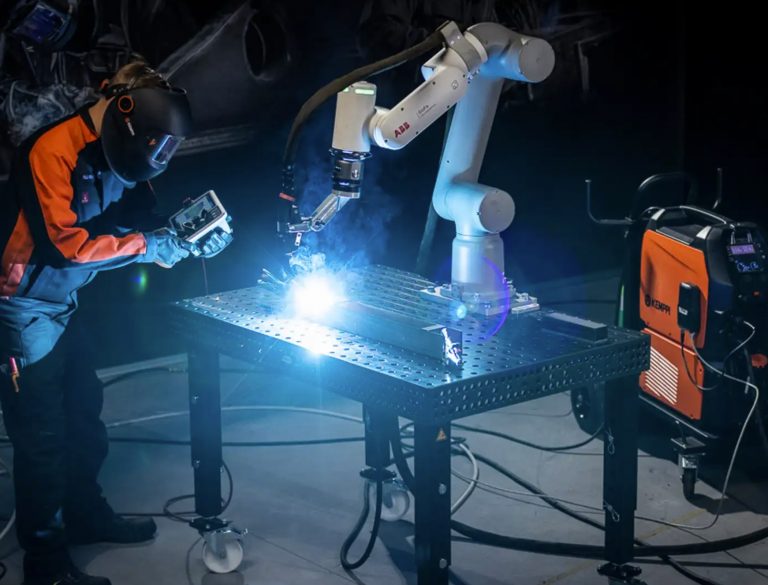
Cobot welding or a robot welding cell?
Batch size and part size usually settle it. If you change jobs several times a week, a cobot is one option worth considering.
| Cobot welding | Robot welding cell | |
|---|---|---|
| Batch sizes | Short runs, high mix, repeat 1-offs | Repeat parts in larger batches |
| Programming | Hand-guide the torch and save points | Pendant or offline software, usually specialist |
| Throughput | Slower moves, operator loads between welds | Faster travel, loading happens while it welds |
| Guarding | Welding screens, set by the risk assessment | Fully guarded cell with interlocked doors |
| Part size | Small to medium parts on a table | Heavy or large parts on positioners |
| Indicative cost | £35k–£100k | £90k–£250k+ |
Is robotic welding right for your parts?
A quick check before you ring anyone. Consistent parts matter more than volume, which surprises a lot of fabricators.
Good fit
- Parts cut and formed to consistent tolerances
- Repeat jobs, even in small batches
- Long seams or several welds per part
- Fixtures you can load the same way every time
- Trouble hiring or keeping welders
- Customers asking for consistent weld quality
Think twice
- Gaps that vary from part to part
- Genuine 1-offs that won't come back
- Joints the torch physically can't reach
- Very large structures without a gantry or track
- Materials your team can't yet weld reliably by hand
- No one on site to own programming
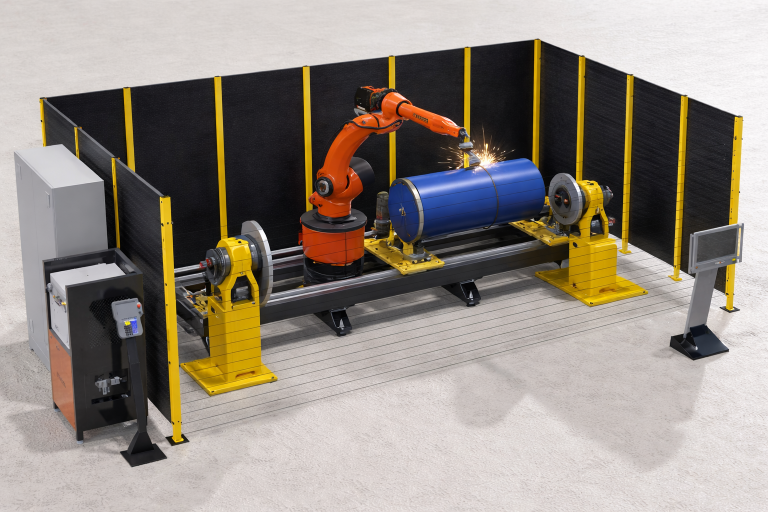
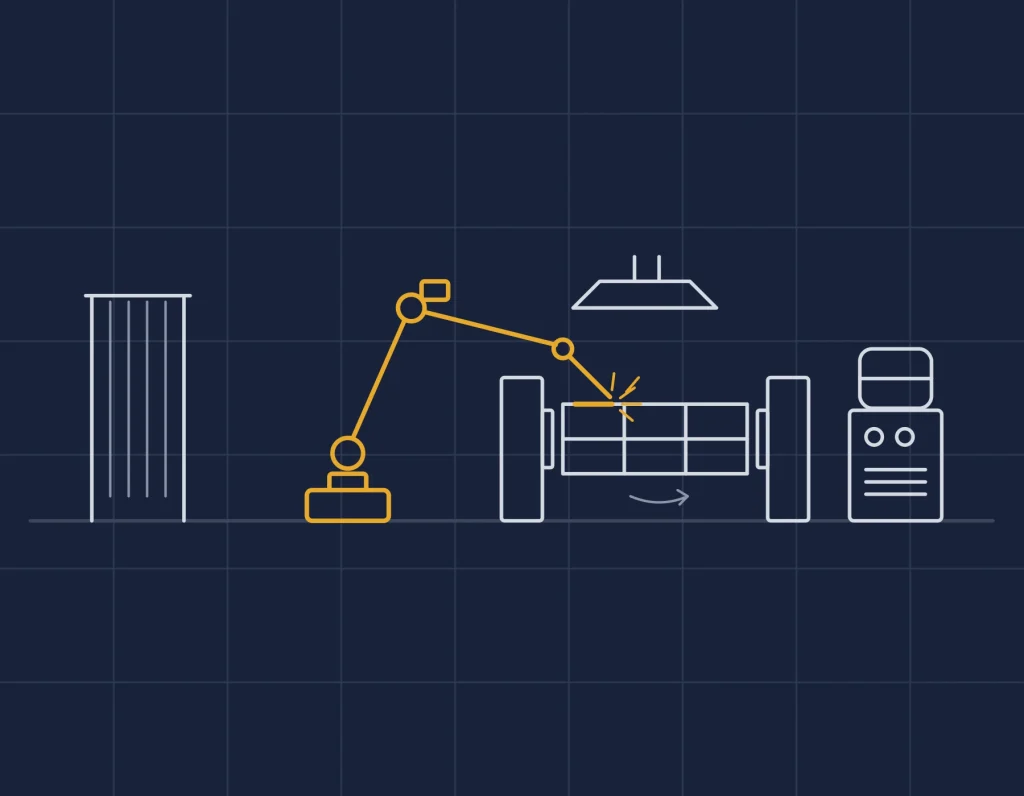
What's in a welding cell
-
Robot or cobot arm
Holds the torch. Its reach and number of axes decide which seams it can get to.
-
Welding power source
A robot-ready MIG or TIG set that takes its settings from the controller for each weld.
-
Fixtures and clamps
Hold parts in the same place every time. Many weld problems start here.
-
Positioner
Turns the part to keep more welds in the down-hand position.
-
Fume extraction
On-torch or hood extraction. HSE expects suitable controls for all welding fume.
-
Seam finding
Touch sensing or laser tracking that corrects for small variations between parts.
Welding robot myths, and the reality
-
Myth Robots only pay off on huge batches
Reality Cobots and quick-change fixtures can make some small batches worth automating.
-
Myth The robot will fix our weld quality
Reality A robot repeats exactly what it's given. Poor fit-up goes in, poor welds come out, just faster.
-
Myth We'll lose our skilled welders
Reality Some shops move welders onto programming, fit-up and the hard jobs. Their know-how makes the robot better.
-
Myth Programming takes weeks per part
Reality Simple parts can sometimes be taught on a cobot in an hour or two. More complex parts need longer setup and testing; offline programming can help.
Free planning tools
Check the numbers before you talk to suppliers
Choosing a welding integrator
Ask to see a weld on your own part. It tells you more than any brochure, and the good integrators offer before you ask.
| What to check | Evidence to ask for |
|---|---|
| Weld trialsOn your parts and material | Sample welds, plus a macro section if strength matters |
| Fixture designWho designs and builds the jigs | Fixture drawings and a loading sequence for your parts |
| Welding know-howProcess experience beyond robotics | A welding engineer on the team and weld procedure support |
| ProgrammingHow new parts get added | A demo of teaching or offline programming a new part |
| Fume and safetyExtraction, screens and guarding | An extraction proposal and their risk assessment approach |
| AftercareConsumables and breakdowns | Response times, a spares list and torch service intervals |
Before you ask for quotes
Welding quotes swing on part detail. Bring these 5 things and integrators can price properly first time.
Use it in the Project Matcher- Drawings and photos of your top 5 parts
- Batch sizes and how often each part repeats
- Materials, thicknesses and welding process used
- Current weld times and number of welders
- Your cutting and fit-up tolerances
What does a welding robot cost?
Budget for the cell, the fixtures and training. Fixtures can run into thousands per part family, so ask for them priced separately.
-
Cobot welding cell
£35k–£100k
Cobot, torch, welding table, screens and training
-
Robot welding cell
£90k–£250k
Industrial robot, 2-station positioner, guarding and extraction
-
Advanced line
£250k+
Gantry systems, multiple robots or extensive automated handling
What moves the price:
- Welding process
- Positioners
- Fixtures
- Seam tracking
- Fume extraction
- Offline programming
- Part size
Indicative UK costs, excluding VAT. Actual project costs vary by application and specification.
Frequently asked questions
Often, yes, especially with a cobot. If a part comes back every month, even in 20s, it's usually worth teaching once. Genuine 1-off work is still quicker by hand.
Yes, and the robot works better with them. Someone has to judge weld quality, set parameters and handle the awkward parts. Shops that put a good welder in charge of the robot tend to get the best results.
A simple part can sometimes be taught on a cobot in an hour or two. Complex parts take longer, and offline programming can reduce the time the cell is taken out of production.
Plan extraction from day 1. HSE treats all welding fume, mild steel included, as a cause of cancer, and a robot welding more hours per shift makes more of it. On-torch extraction, suitable LEV or an appropriately designed extraction system may be required depending on the cell and process.
Yes, with the right power source, wire feed and torch. Aluminium is fussier, so insist on trial welds in your actual material and thickness.
Payback varies widely. A well-utilised cell may achieve payback in around 1–3 years, but the actual figure depends heavily on utilisation, labour savings, cell cost and the parts you put through it. An idle robot pays nothing back, so line up the next 3 parts before the first one's finished.