
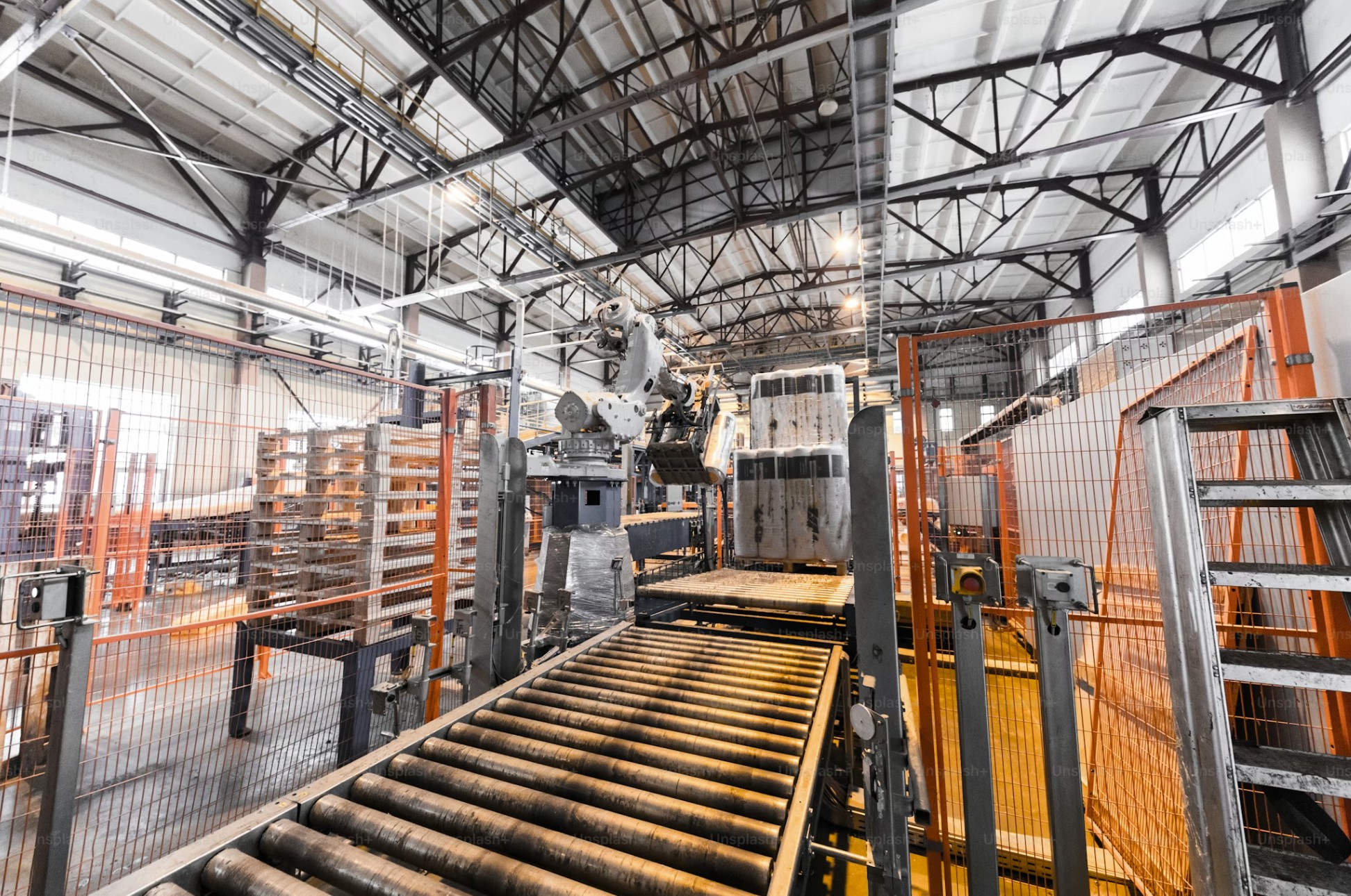
Three months running, the night shift palletising line has been short-staffed. The agency rate’s gone up again. And the last round of job ads got 2 replies.
That’s usually where the robotics conversation starts. Someone does the maths on what agency cover is costing, or a long-serving operator announces retirement and everyone quietly wonders how they replace them. The capital case for automation stops looking like a future project and starts looking like an urgent one.
Then comes the first question nobody prepares you for: you can find robot manufacturers easily enough, but who actually makes it work in your factory? Who designs the cell, writes the programmes, installs it, tests it against your actual product, and trains your operators to run it?
That’s the conversation that leads most UK manufacturers to their first call with a robotics integration company.
That’s what a robotics integrator does. This guide covers both questions you’re probably sitting with: whether you actually need one, and if you do, how to find the right one.
What does an industrial robotics integrator actually do?
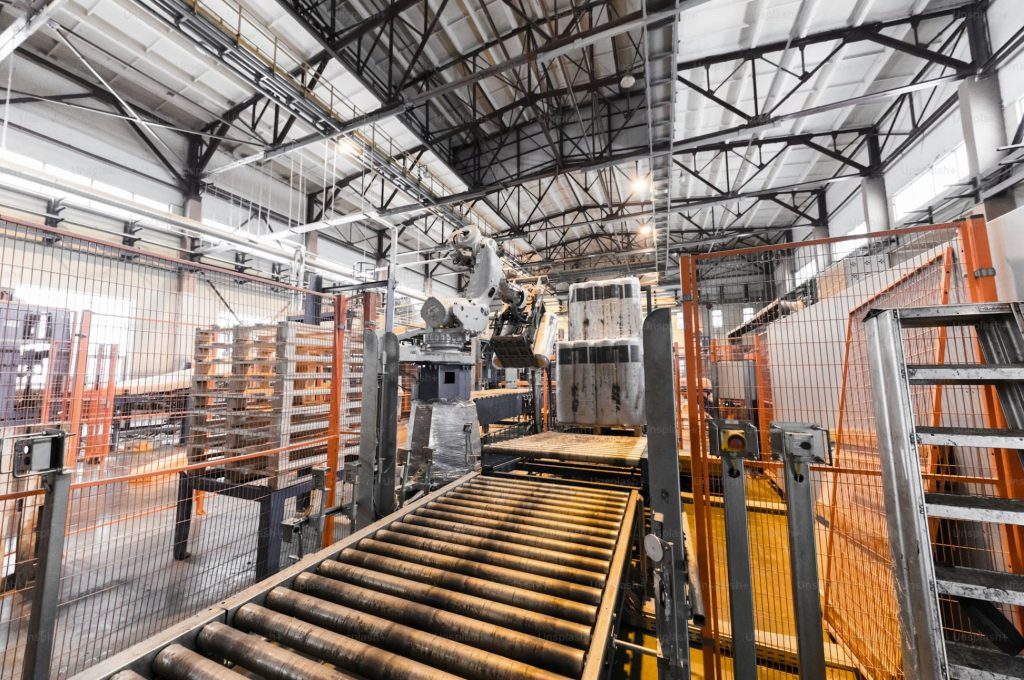
A robot manufacturer can sell you the robot and controller but very few of them will show up at your factory, figure out how to fit it into your production line, programme it around your specific product, design and specify the end of arm tooling (or gripper), build the safety guarding, commission the system, and show your operators how to run it.
That’s the integrator’s job.
Think of it like buying a commercial kitchen. The equipment manufacturer makes the oven. The installer fits it, connects it to your gas supply, tests it at temperature, and walks the chef through it. With robotics, the “fitting” is significantly more involved. It might include custom end-of-arm tooling built around the geometry of your product, vision systems that teach the robot to handle variants, conveyor interfaces, safety fencing, and a control system that talks to your existing line.
A good integrator has done this before, in your sector, with your type of application. They can tell you what usually goes wrong. That experience is worth paying for.
Which industries use robotics integrators?
Automotive is where UK robotics integration grew up and includes both tier 1 manufacturers and tier 2 suppliers, like press shops. Most people’s mental image of an industrial robot (the big orange arm doing a balletic weld) comes from car manufacturing. Tier 1 suppliers and their component manufacturers have been running highly automated lines for decades. The automotive robotics integrators who built their reputations there tend to be very capable, and often fully booked.
Food and beverage is where the volume is right now. End-of-line automation (palletising, case packing, shrink wrapping) is being retrofitted into facilities that were never designed around robots. The challenge is the environment: temperature variation, moisture, products that change shape slightly from batch to batch. Some of the larger UK snack food manufacturers now run fully automated palletising lines, and the integrators specialising in the food industry who made those projects work are in serious demand. In food manufacturing, sector experience is essential.
Logistics and warehousing committed in a rush after the labour crunch of 2021 and 2022. Distribution centres that had been considering automation, such as goods-to-person, AMR’s, Parcel Sortation and ASRS systems, for years suddenly had the business case forced on them. The integrators in the logistics and warehousing industry who do this work tend to come from a different background than traditional manufacturing robot integrators: more systems and software, less welding and fixturing.
Pharmaceutical and medical device manufacturers have their own requirements around cleanrooms, traceability, and validation documentation. Slower to adopt, but when a project is properly scoped, the budget is usually there. There are now a number of integrators who specialise in the pharmaceutical industry and are aware of the specific challenges that comes along in that industry.
What’s changed is who’s asking. Robotics integration used to be the preserve of large manufacturers, but cobot technology and the growth of SME-focused integrators have shifted that. A company running 2 or 3 shifts a day can often make a palletising or machine tending project work commercially.
Robot Applications Commonly Automated by UK Integrators
Palletising is probably the most common first automation project in the UK right now. The robot stacks finished product onto pallets at the end of the line, consistently, through the night shift, without anyone putting their back out. If your product is regular and reasonably consistent in weight, a palletising cell tends to pay back faster than almost any other first automation project. If your application is end-of-line palletising, this comparison between cobots and traditional robots is worth reading first.
Welding and fabrication is where a lot of robot integrators first built their reputations. MIG, TIG, spot welding: automotive and heavy fabrication operations have relied on it for years, because the precision and repeatability at volume is hard to match by hand. For higher-mix work, collaborative welding robots have changed the economics considerably.
Machine tending means loading and unloading CNC machines, injection moulding presses, or stamping equipment. It’s the work operators hate most after hour six of a shift, and the work they do least well. Cobots handle it particularly cleanly, since the guarding requirements are less demanding and operator and robot can work in the same space.
Pick and place is a broad category. Chocolates into a tray, components between assembly stages, products off a conveyor and into a case. What they have in common is repetition and consistency. The less your product varies, the easier this is to automate reliably.
Assembly is harder. Robots assembling complex multi-component products need precise fixturing, vision systems, and careful programming. It requires an integrator with specific experience in your product type, and the scoping takes longer than most buyers expect.
Vision and quality inspection sits slightly differently from the others. Camera systems that check for defects, read labels, and verify component presence are frequently retrofitted onto existing lines rather than built into a new cell from scratch. It’s often the first automation project that doesn’t involve a robot arm at all.
How does a robotics integration project actually work?
Nobody tells you what an integration project actually involves until you’re already in one. Here’s the rough shape of it.
Site Visit and Initial Consultation
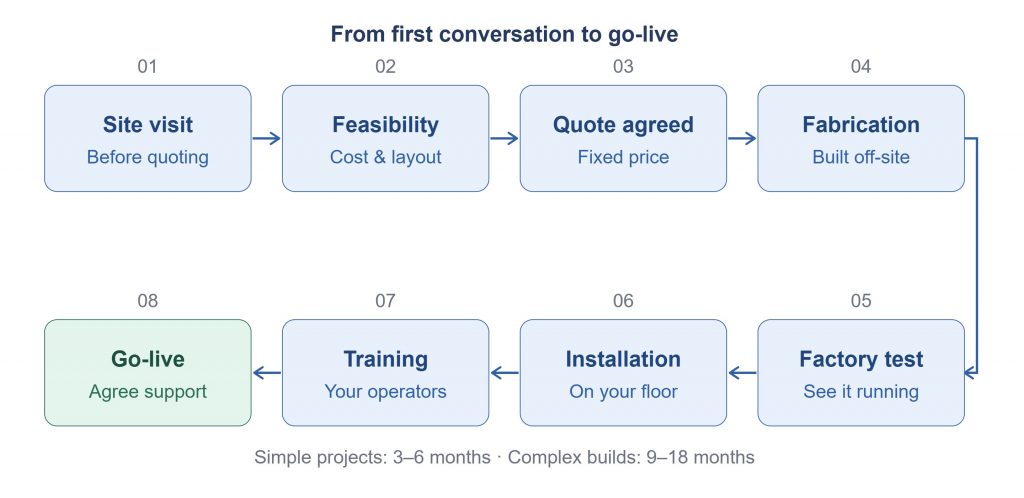
It starts with a site visit. A good integrator will come to your factory before quoting anything. They’re looking at your product, your line layout, the available footprint, the loading and unloading points, and the constraints you haven’t thought to mention yet (the column in the corner of the building that rules out the obvious cell location, for instance). Quoting off a spec sheet without a site visit is a shortcut that tends to cause pain later.
Feasibility and Concept Design
From there, feasibility and concept design. The integrator works out which robot, what tooling, how the cell lays out, what guarding it needs. You get a rough cost and timeline. Plenty of projects stall here when the number comes back higher than expected. Better to find that out now.
Detailed Design and Fixed-Price Quotation
If the numbers work, you move into detailed design and quotation. Proper drawings, a costed bill of materials, a fixed-price quote.
Before requesting quotes, it’s worth running the numbers through our robotics ROI calculator to test your payback assumptions.
Build and Fabrication
Then build and fabrication, usually at the integrator’s own facility. There’ll be a period where nothing seems to be happening from your side. That’s expected. The cell is being built and tested before it comes anywhere near your site.
Factory Acceptance Testing (FAT)
Factory acceptance testing (FAT) is the moment the integrator invites you to see the system running in their workshop. You check it does what was specified, ideally with samples of your own product. Issues are far cheaper to fix at this stage than after installation. Don’t skip it, and make sure it’s in your original contract.
Installation and Commissioning
Installation and commissioning is where it gets real. The engineers are on your floor, bolting the cell down, connecting services, running it up. Things that worked cleanly in the workshop will need tweaking in a live factory. Every integrator knows this. Build it into your timeline.
Operator Training
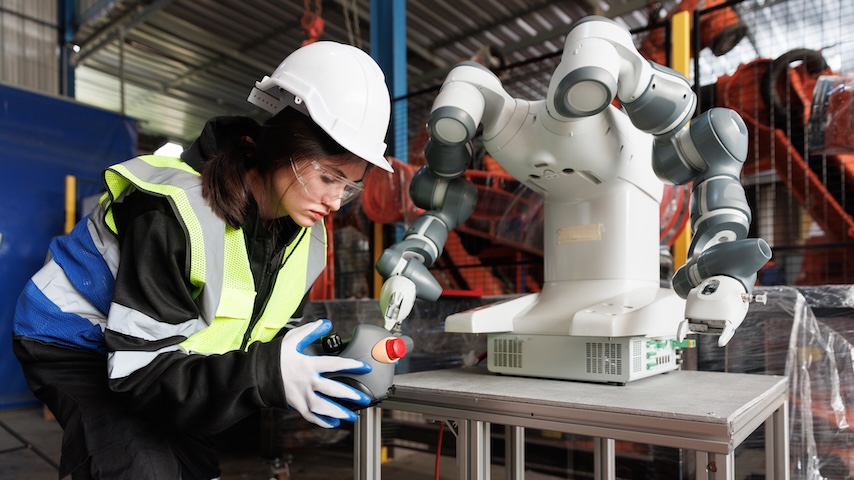
Then operator training. Your team needs to know how to run the system, respond to faults, and handle basic maintenance. Make sure it’s in the contract before you sign.
Go-Live, Handover and Ongoing Support
Go-live and handover is where some integrators quietly disappear. A good one stays, and has agreed with you in advance exactly what that means: response times, whether there’s an out-of-hours number, and what happens when something stops running at 2am on a Sunday.
Robotics Integration Costs in the UK: What to Budget
Some actual numbers. These are rough UK figures and your specific application will move them, but they’re a starting point for a capital conversation.
A palletising cell or basic machine tending project will typically land somewhere between £30,000 and £80,000. Once you’re into multi-robot territory or anything with significant custom engineering, you’re more likely looking at £100,000 to £500,000. Large bespoke production lines can go well above £1 million.
One thing that catches buyers early is comparing a cobot quote to a traditional industrial robot quote and assuming one of them is wildly overpriced. They’re different things.
A collaborative robot cell can start under £40,000 in the right application: typically no safety fencing required, faster to deploy, and user-programmable to a degree. A traditional industrial robot installation starts higher, needs specialist programming and physical guarding, and takes longer to commission. If the quotes you’re seeing vary enormously, check what type of robot you’re actually being quoted on.
On timelines: simple projects run 3 to 6 months from first conversation to go-live. More complex builds (multiple robots, bespoke engineering, significant site preparation) are realistically 9 to 18 months. What pushes a project into the longer range is usually programming complexity (high product variety, vision systems), delays on the customer side (building works, capital approval processes), or long lead times on components.
How to Choose the Right UK Robotics Integration Company
Sector experience matters more than size. An integrator who’s built 15 palletising cells in food manufacturing will solve your problems faster than a larger firm that’s mostly worked in automotive. Ask specifically: have they done this application, in this sector, at this scale?
Some integrators are tied to specific robot brands: they’re a Fanuc authorised partner, or a KUKA system integrator. Their solution will almost certainly involve that brand’s hardware. Worth knowing if you care about standardising across your sites, or if you’d rather let them pick whatever robot fits the application best.
UK-Based Engineering Support: Why It Matters
UK-based field engineers matter more than people realise. A fault at shift start needs someone on your floor that morning, not a call handler in the Netherlands. Ask them plainly: where do your engineers work from, and what does a same-day callout actually look like?
Ask for references, real customers they’ll actually connect you with. Someone from a similar manufacturer who can tell you honestly how the installation went, how problems were handled, and what support has been like since handover is worth more than any case study.
BARA Certification: What It Means and Whether It Matters
On BARA certification: the BARA/A3 Robot Integrators’ Certification Scheme is the UK’s industry benchmark, an independent audit of technical competence, project management, and safety practices, renewed every 2 years. Most credible integrators in the market don’t hold it yet, so its absence tells you little on its own. When a company does carry it, that’s a meaningful quality signal. Either way, it’s worth asking about their quality assurance process.
Before you sign anything, get the support contract in writing and read it. Who holds the spare parts? What’s the guaranteed response time? Does remote diagnostics cost extra? What happens on a bank holiday? These questions feel minor until a line goes down.
Questions to Ask a UK Robotics Integrator Before You Sign
These are the questions someone who’s been through a difficult project would think to raise.
What’s your experience with this specific application in my sector?
Robotics in general isn’t the answer. This robot type, this product, this environment.
Can you provide a reference customer in my industry?
Someone you can actually call and ask the uncomfortable questions.
Who owns the robot programme after handover?
Some integrators keep the IP in the code. That locks you in for every future change, however small. Get this in writing before you commit.
What’s included in the factory acceptance test?
And can you bring your own product to run through it?
What does post-go-live support look like?
Get specifics: who you call, response times, out-of-hours cover, and what’s chargeable once the warranty period ends.
Are you BARA-certified?
If not, what does your quality assurance process look like?
Red Flags When Choosing a Robotics Integration Company
A few things that should make you slow down before committing.
No fixed-price quote. If the integrator will only quote on a day-rate basis without a defined scope, the financial risk sits entirely with you, and scopes have a habit of expanding.
FAT not included as standard. Some treat factory acceptance testing as an optional extra. It shouldn’t be. If it’s not in the quote, ask why.
No UK-based engineers for post-installation support. Worth confirming before go-live rather than discovering it after your first serious fault.
Reference customers they won’t actually connect you with. A logo list is marketing. A phone call is evidence.
Pressure to sign quickly. A project with real engineering behind it doesn’t need a 48-hour deadline on the quote.
Ready to start talking to integrators?
If you’ve done enough reading and want to get a shortlist in front of you, the directory below lists verified UK robotics integrators filtered by sector and application.
Frequently asked questions
Quick reference and recap, skip if you are short on time.
What’s the difference between a robot manufacturer and a robotics integrator?
KUKA, Fanuc, ABB, Universal Robots: these companies build and sell the physical robot. The integrator is the company that makes it work in your factory. They spec the system, write the programme, build the cell, install it, and support it afterwards. Most robot manufacturers don’t offer integration as a service.
Do I need a robotics integrator or can I buy direct?
Some cobot manufacturers will help you get a simple system running if you’re using standard off-the-shelf tooling. Beyond that, you need a specialist. Custom cells, multi-robot layouts, integration with your existing controls: these are integrator territory, and that covers most real projects.
How much does a robotics integration project cost in the UK?
A palletising or machine tending cell will often come in somewhere between £30,000 and £80,000. Once you’re adding robots or commissioning something genuinely bespoke, the number climbs fast. £100,000 to £500,000 is realistic for mid-range projects, and large production lines go well beyond that. A cobot cell can land under £40,000 for the right application. None of these mean much without a proper quote against your actual requirements.
How long does a robotics integration project take?
A well-scoped single-cell project can move from first conversation to go-live in 3 to 6 months. Anything involving multiple robots or significant custom engineering is realistically 9 to 18 months, sometimes longer. The thing that catches people out is that site preparation on the customer side (building works, electrical upgrades, floor prep) runs to your schedule, not the integrator’s.
What is BARA certification and does it matter?
It’s an independent audit scheme run by BARA, covering technical competence, project management and safety practices, with recertification every 2 years. Few UK integrators hold it at the moment, which means you can’t use its absence as a negative indicator. But a company that has gone through it has had their processes checked by someone external, and that’s worth something. Ask about it either way.
Can smaller manufacturers use robotics integrators, or is it just for large factories?
Cobot technology and a growing number of SME-focused integrators have changed this significantly over the last 5 years. A palletising cell or machine tending application can make commercial sense for a manufacturer running 2 or 3 shifts a day. Budget and application type matter more than company size.
What happens if something goes wrong after installation?
That depends on what support contract you have in place. Most integrators offer 12 months’ warranty covering defects in workmanship and software. Once that’s up, you’re either on a paid contract or calling in favours at an hourly rate. Worth sorting out before go-live, when everyone’s still being pleasant. Response time guarantees, whether remote diagnostics is included or costs extra, out-of-hours cover, and where the spare parts actually live. These feel like fine print until a line goes down on a Monday morning.
Is it worth getting multiple quotes from different integrators?
Yes, always. And price isn’t the main reason. Two integrators quoting on the same brief often come back with completely different proposals: different robot brands, different cell configurations, different assumptions about what the automation needs to do. That variation tells you something useful about how each company thinks. Aim for at least 3 quotes, and make sure one of them comes from an integrator with strong experience in your sector specifically.
What is the difference between a cobot integrator and an industrial robot integrator?
Collaborative robots (cobots) typically operate without safety fencing, have lower payload limits, and suit applications with frequent product changeover or shared human-robot workspaces. Industrial robots work faster and handle heavier payloads but require full safety guarding. Many UK integrators work with both.
For a closer look at specialist cobot integrators specifically, see our roundup here.