
Delta Robot
Why a Delta robot matters
Delta robots are designed for one main task, to move small, light items quickly. When setup correctly they can complete hundreds of cycles per minute, which is why you will often find them suspend above conveyors picking product in food factories and pharmaceutical facilities. Delta robots can pick and pack at a rate that no human could keep up with.
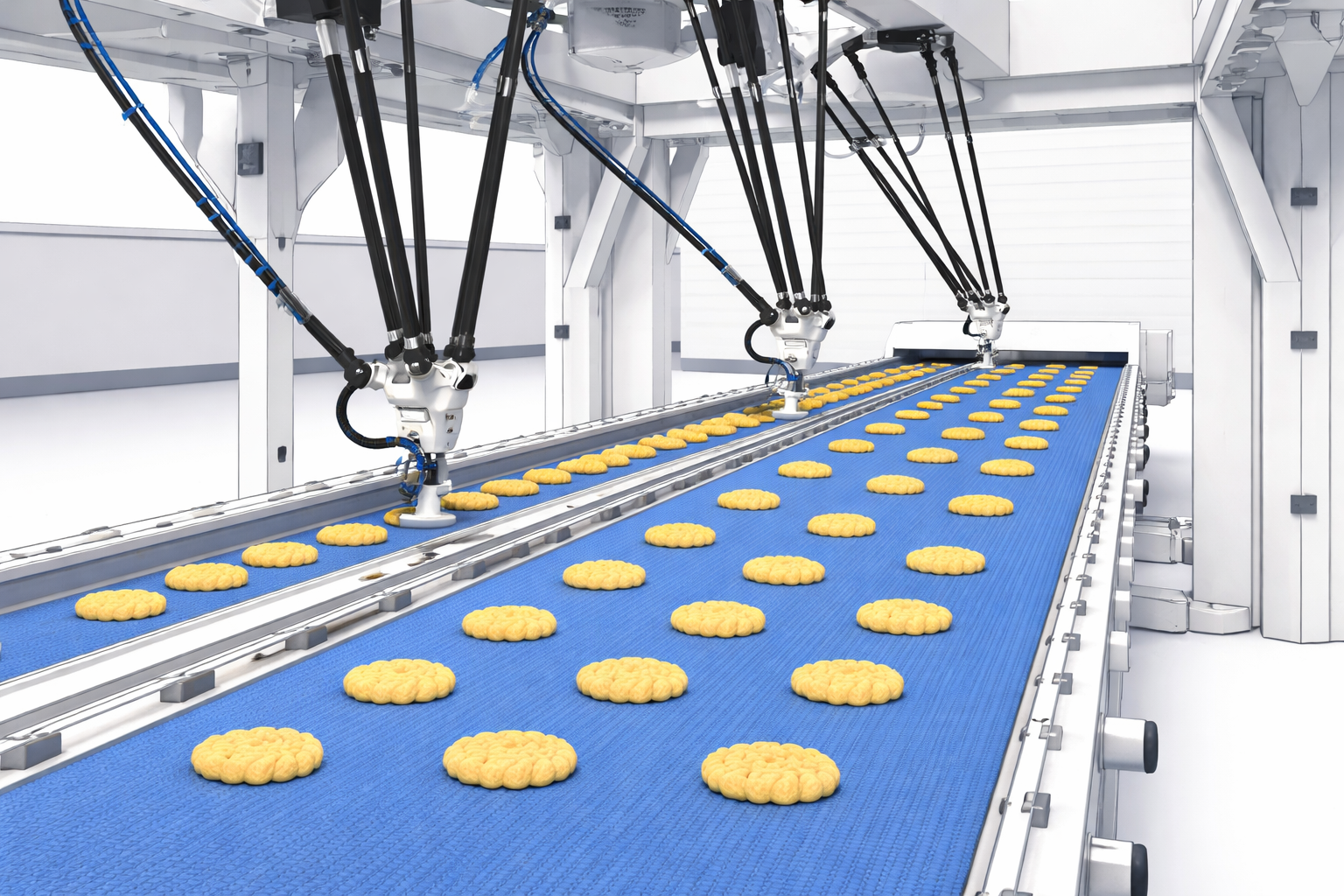
Delta robots are lightweight by design, the arms are not there to pick up heavy items, they are designed for speed. They are designed such that they can accelerate and stop without losing accuracy of position, meaning their function is not easy to replicate with any other type of robot.
If you are currently looking for a robot to help you automate a high volume production line where your products and small and lightweight then it is well worth looking at a Delta robot. A Delta is not a "jack of all trades" robot, it won't weld, palletise cases or reach round corners but what it does do, pick and place, it does very well.
How Does a Delta Robot Work?
The structure of the robot gives it it's name. Three thin arms attach to a fixed base at the top, each one built from 2 links joined in a parallelogram arrangement. Those 3 arms converge on a single triangular platform at the bottom and this is where you attach your End-of-Arm-Tooling (EOAT), which stays level regardless of how the arms move because of the geometry of the parallelogram joints.
Motors sit on the fixed base rather than on the moving parts. This helps to keep the mass in motion very low, which is what allows for the high cycle speeds. Each motor drives one upper arm, and the controller coordinates all 3 to position the platform anywhere within the workspace.
That workspace is dome-shaped, directly below the base. It's relatively compact and roughly circular, smaller than what an articulated arm of similar size could reach. You get exceptional speed within a tightly defined area, but the robot can't reach wide or lift high. That's the trade-off, and it's one worth knowing before you spec anything.
Where Would You Use a Delta Robot?
- Food Production
- Pharmaceutical Packing
- Electronics Manufacturing
Related Application Guides
Robot Palletising UK: Automating End-of-Line Stacking
Most production lines in the UK still end the same way they did 30 years ago with a person or persons lifting boxes onto…
View Guide
Robotic Pick and Place UK: Automation Guide
Robotic pick and place automates the repetitive movement of products, components or parts from one location to another.…
View Guide