
Gantry Robot
Why Look At a Gantry Robot?
The main thing a gantry robot brings to a factory is reach. A floor-mounted articulated arm has a fixed base and a workspace that radiates outward from it. A gantry can span an entire factory bay, 10 metres, 20, more if the rails are long enough. That makes it the natural choice when you need to move large or heavy things across a significant distance.
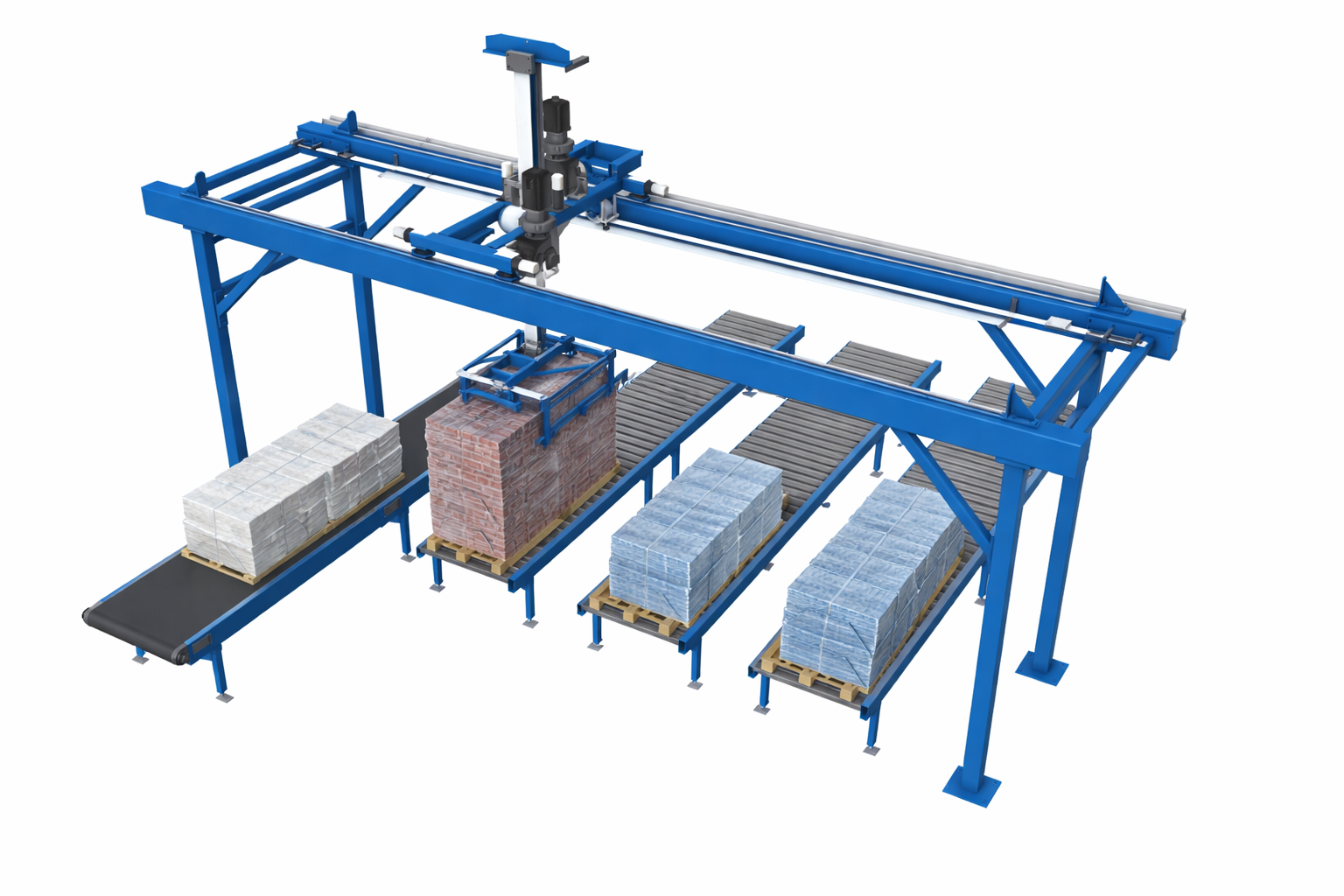
Programming is generally simpler than working with a multi-joint articulated arm. Movement is Cartesian, straight lines along fixed axes, so there's no inverse kinematics to solve. You tell it the coordinates and it goes. For in-house engineering teams without specialist robotics knowledge, that tends to mean faster commissioning and easier long-term maintenance.
Payload capacity is another genuine advantage. The rigid overhead framework will bear the brunt of the load rather than say, a cantilevered arm, so gantry robots can handle weights that would stress a comparably sized floor-mounted robot.
How Does a Gantry Robot Work?
The basic structure is 2 parallel rails running the length of the working area along the X axis. A crossbeam spans between them and travels in the Y direction. A carriage on the crossbeam carries the Z axis, a vertical slide that moves the end-effector up and down. Servo motors drive movement on each axis, usually via belt, rack and pinion, or lead screw depending on the speed and precision required.
The end-effector at the bottom of the Z axis can be a vacuum cup, a mechanical gripper, a welding torch, a drill. That part is modular. The rest of the system is the same regardless of what the robot is doing.
Some gantry systems add a rotational axis at the end-effector to let the robot orient a part, but the primary motion is always linear. That linearity is both the constraint and the strength. You can't approach a part from an unusual angle the way a 6-axis arm can, but within the envelope defined by the rails, positioning accuracy is consistent and straightforward to verify.
Where Would You Use a Gantry Robot?
- In automotive manufacturing, gantry robots move body panels and structural assemblies between workstations, components generally too large and heavy for a all but the largest conventional arms.
- Machine shops use overhead gantry systems to tend rows of CNC machines, loading raw stock and unloading finished parts across multiple machines running in parallel.
- Warehousing operations use gantry-style systems to retrieve pallets and large totes from high-bay racking.
- In aerospace, drilling and sealing operations on fuselage sections are a natural fit because the robot needs to work across a surface several metres wide without stopping. Scale and weight are what these applications share, not sector.
Related Application Guides
Robot Palletising UK: Automating End-of-Line Stacking
Most production lines in the UK still end the same way they did 30 years ago with a person or persons lifting boxes onto…
View Guide
Robotic Pick and Place UK: Automation Guide
Robotic pick and place automates the repetitive movement of products, components or parts from one location to another.…
View Guide