
End-of-Arm Tooling (EOAT)
Why is End-of-Arm-Tooling Important?
EOAT is probably the most under-discussed part of any robot system, and the most likely to cause problems if it's been poorly specified.
A robot arm is generic. The EOAT isn't. It has to handle your specific product reliably. Every size, weight, surface variation, and temperature it runs at, thousands of cycles a day, without dropping, damaging, or misplacing anything.
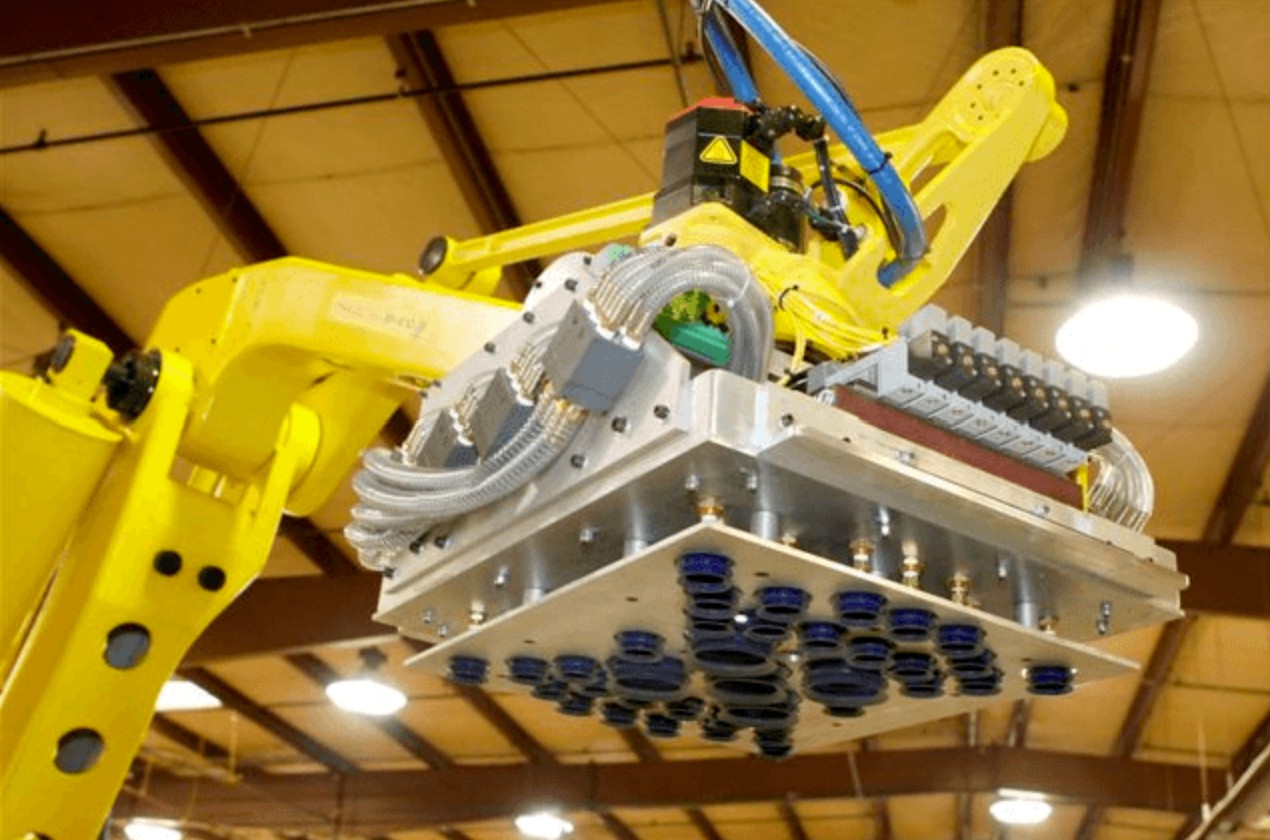
In palletising applications especially, a poorly designed EOAT is a frequent cause of unplanned downtime. Products that work fine in testing start slipping when the bags come off the line slightly overfilled, or when the cardboard cases go soft in a warm factory. Getting the tooling right upfront, and testing it properly on your actual product, saves a lot of painful troubleshooting after go-live.
How Does End-of-Arm-Tooling Work?
The most common type of EOAT, particularly in palletising and packaging applications, are vacuum cup tools. They work by creating negative pressure against the product surface to lift it, and work well on flat-topped cases, cartons, and most bagged products.
Where suction isn't a reliable method, for instance with irregular shaped product, porous surfaces or very heavy loads, mechanical grippers are the next solution to consider. Mechanical grippers work by clamping the product physically instead. Magnetic tooling covers metal components and sheet steel product.
Many cells use combination tooling: a single EOAT designed to handle more than one product type without a manual changeover between them. These are more complex to design and more expensive upfront, but on lines with multiple SKUs they're often worth it.
The tooling connects to the robot's wrist flange and is controlled through the robot controller. Pneumatic lines and signal cables run back up the arm through a cable management system. In washdown or high-temperature environments the tooling materials and seal ratings need to match the conditions, not just the product, which is a detail that occasionally gets missed in the specification stage.
Examples of Where Different Types of EOAT Would Be Used
- Vacuum cup EOAT - Used for picking cases in a food and beverage palletising cell
- Mechanical gripper - Used handling rigid pharmaceutical cartons
- Foam-padded clamp tooling - Used for fragile glass bottles
- Magnetic EOAT - Used for stacking and handling metal stampings
- Multi-product combination tool - Used for FMCG mixed palletising lines
UK Integrators Offering This Solution

Fox Precision Tooling
Precision Solutions for Automated Success

Piab
Vacuum automation, EOAT and gripping solutions for robots, cobots and automated production.

SCHUNK
Gripping, clamping, toolholding and automation technology for industrial robots and manufacturing.
Related Application Guides
Robot Palletising UK: Automating End-of-Line Stacking
Most production lines in the UK still end the same way they did 30 years ago with a person or persons lifting boxes onto…
View Guide
Robotic Pick and Place UK: Automation Guide
Robotic pick and place automates the repetitive movement of products, components or parts from one location to another.…
View Guide