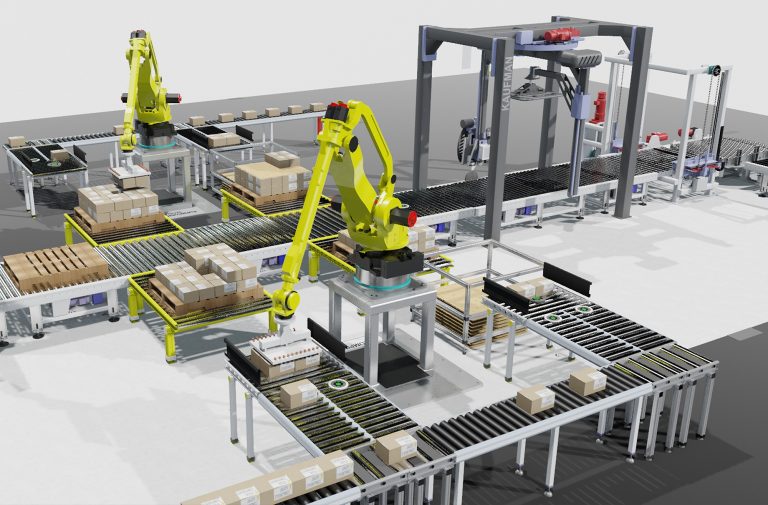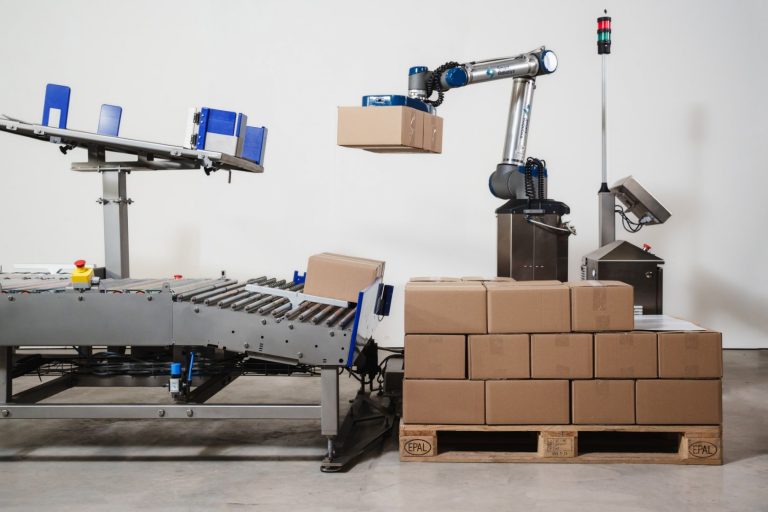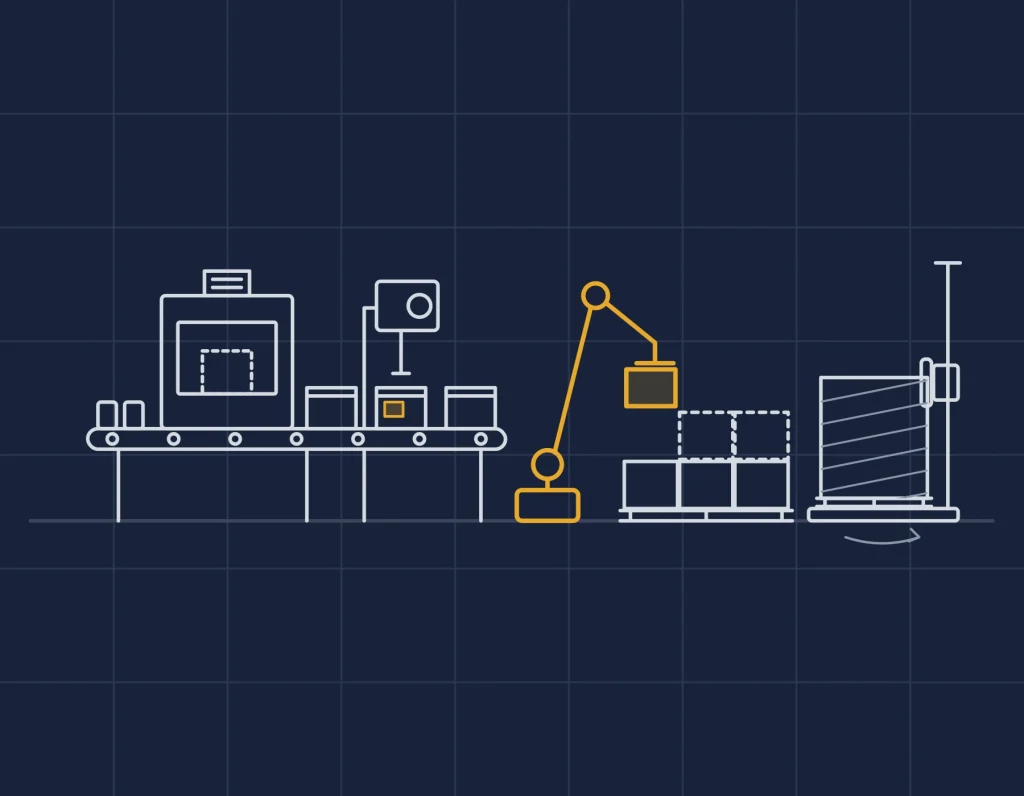







What is end-of-line automation?
It's everything that happens to a product after it's made: packing it into cases, labelling it, building pallets, wrapping them and moving them out for despatch. At many UK sites these are still the most manual jobs in the building.
You don't have to automate the whole thing. Plenty of manufacturers start with a single palletising cell, leave everything upstream alone, and add more once the first project has paid for itself.
Choosing an approach
The four routes buyers usually compare. Your product weight, case rate and number of SKUs will rule most of them in or out quickly.
| Cobot palletiser | Industrial robot palletiser | Layer palletiser | Dedicated case packer | |
|---|---|---|---|---|
| Best for | One slower line, tight space, first project | Heavier cases, faster rates, several lines | Very high, steady volumes | High volumes of one pack format |
| Throughput | Lower · up to ~10–12 cases/min | Medium–high · ~15–30+ cases/min | Very high | High · application dependent |
| SKU flexibility | ●●● High | ●●● High | ●○○ Lower | ●●○ Medium |
| Footprint | Compact | Larger guarded cell | Largest | Inline machine |
| Indicative cost | £60k–£120k+ | £100k–£250k+ | £100k–£300k+ | £50k–£150k+ |
Why manufacturers automate end-of-line processes
-
Less manual handling
Removes repetitive lifting and stacking from operators.
-
Consistent output
Repeatable cycle times and pallet quality, every shift.
-
More line capacity
Clearing the end-of-line bottleneck frees upstream machines.
-
Covers hard-to-staff shifts
Less reliance on recruiting for nights and weekends.
-
Better ergonomics
Fewer physically demanding roles at the end of the line.
-
Room to grow
A well-designed cell can take on more lines or SKUs later.
Common mistakes, and the fix
-
Mistake: Sizing the system for today’s product range
Fix Give suppliers your 3-year SKU and volume plan, not just current figures.
-
Mistake: Forgetting infeed buffering
Fix Specify how long the line must keep running if the palletiser stops.
-
Mistake: Testing only with perfect cases
Fix Send your worst real packaging for the FAT, not samples from the warehouse.
-
Mistake: Leaving customer pallet specs until late
Fix Include retailer pallet, height and label requirements in the brief from day one.
Free planning tools
Size your project before you speak to suppliers
- Palletising System Selector Find which palletising approach fits your products and rates. Open selector →
- Cobot Palletising Cycle Time Calculator Check whether a cobot can keep up with your case rate. Calculate →
- Automation ROI Calculator Estimate payback from shifts, labour and system cost. Work out ROI →
What to check with every supplier
Ask for evidence, not reassurance. If a supplier can't show you something on this list, treat it as a risk to manage.
| What to check | Evidence to ask for |
|---|---|
| SKU changeoverAdding products and pallet patterns | A live demo of creating a new pallet pattern, and the changeover time |
| Packaging variationSoft, damaged or inconsistent cases | Factory acceptance test (FAT) run with your own worst-case packaging |
| Infeed and accumulationWhat happens when the line stops | Layout drawing showing buffers, line speeds and fault recovery |
| Safety and guardingRisk assessment and conformity | Proposed guarding layout and a named, competent safety engineer |
| Labelling and wrappingSingle point of responsibility | Written scope stating who supplies and integrates each machine |
| AftercareSupport once you are live | Remote support terms, UK engineer response time and a spares list |
Before you ask for quotes
Have this ready and integrators can quote properly first time. It also makes quotes from different suppliers comparable.
Use it in the Project Matcher- Case dimensions, weights and rates for every SKU
- Pallet type, patterns and maximum stack height
- Floor plan with the space available, including access
- Shift pattern and current labour on the task
- Customer labelling and pallet requirements
- Your expected future volumes and SKU changes
Frequently asked questions
Cobots suit lighter cases, slower lines and tight spaces, and they are easier to move between lines. Industrial robots handle heavier loads, faster rates and multiple lines at once. Run your case rate through the cobot cycle time calculator before deciding.
Often, yes, as long as the combined case rate is within the robot’s capacity and the layout lets both infeeds reach the cell. Serving two lines from one cell is a common way to improve payback.
A single palletising cell can often be delivered within several months, although lead times vary considerably depending on system complexity, equipment availability and site requirements.
Every installation needs a risk assessment. Industrial robot cells are normally fenced or protected by scanners; cobot palletisers may use lighter measures such as area scanners, depending on what the assessment shows.
Case dimensions, weights and rates for each SKU, your pallet type, pattern and maximum height, a floor plan of the space, and your shift pattern. The more complete this is, the more comparable your quotes will be.
Multi-shift operations can often achieve a shorter payback because the automated system replaces or reduces manual work across more operating hours. Try our ROI calculator for a more accurate payback period.
Yes. You don't necessarily need to automate the entire end-of-line operation. Many projects start with a specific bottleneck such as palletising, case packing or wrapping and expand later if the initial system proves successful.