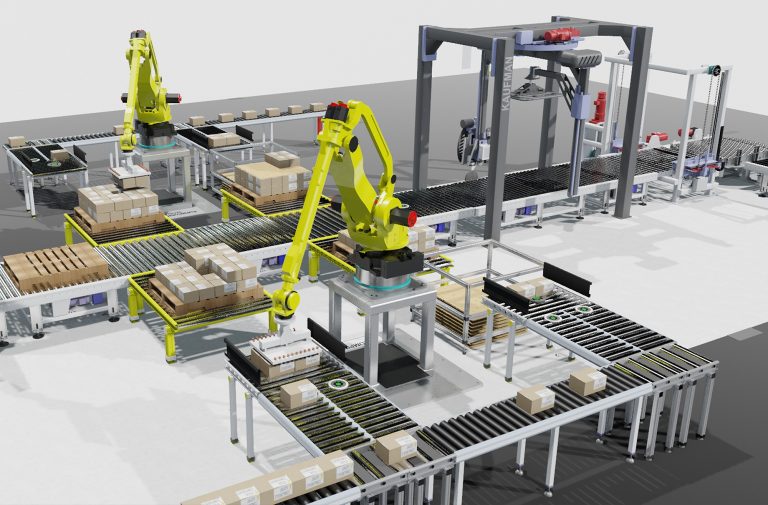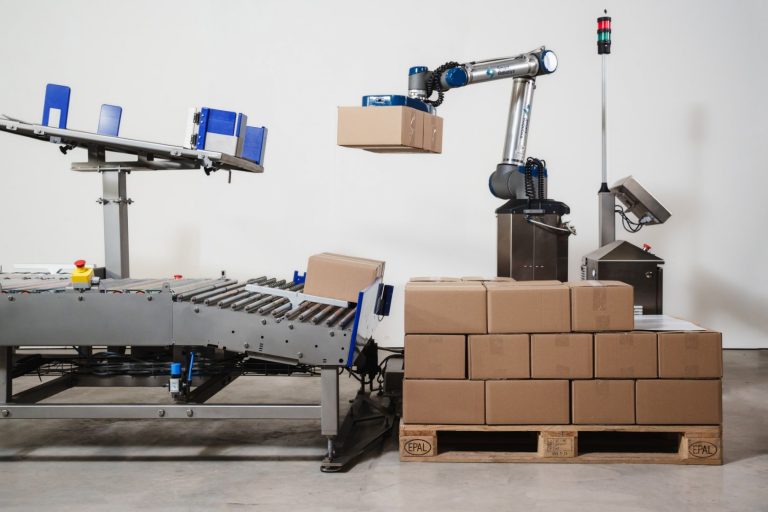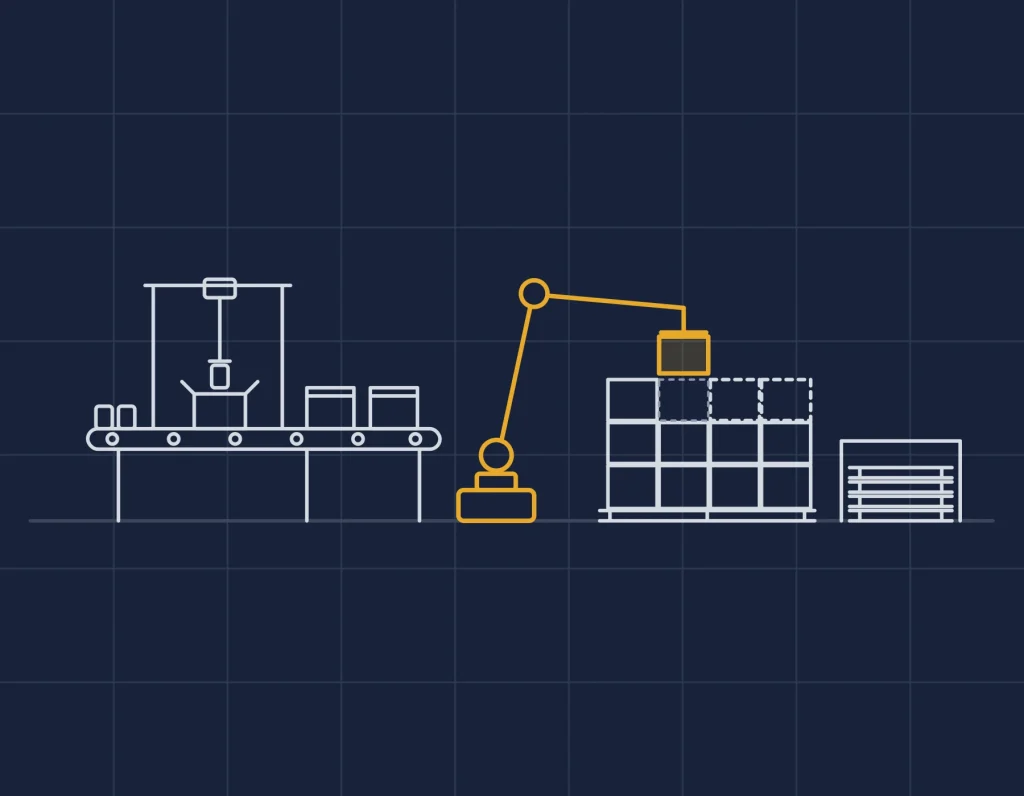











What is palletising and packing automation?
It's the robots and machines that put finished product into cases, then stack those cases onto pallets. Packing is the first half (picking product into trays, shrink packs or shipper cases). Palletising is the second half of the process, building a stable pallet, layer by layer to your customer's pattern.
Most projects start with the palletiser, because that's where the heavy lifting is. Someone stacking 12 kg cases can move 10 tonnes or more in an 8-hour shift, and it's usually the hardest job on site to keep staffed.
Automating the whole end of the line, from case erecting to stretch wrapping and despatch? Our End-of-Line Automation page covers that bigger picture. This page sticks to the palletising and packing cells themselves.
Cobot, robot or layer palletiser?
Case rate and case weight will rule most options out within a few minutes. Floor space and how many SKUs you run settle the rest.
| Cobot palletiser | Robot palletiser | Layer palletiser | |
|---|---|---|---|
| Typical case rate | Up to about 10–12 cases/min | Around 20–30 cases/min; higher with multi-pick tooling | Full layers at a time; highest throughput |
| Case weight | Up to about 20–25 kg, depending on cobot and gripper | Heavy cases, sacks and multi-picks | Best suited to consistent case formats |
| Footprint | Compact; can suit space-constrained areas | Typically a guarded or scanner-protected cell | Typically larger; requires product accumulation/infeed |
| Pattern changes | Intuitive pattern builder; changes can be made in-house | Software-based; may require trained staff or integrator support | Generally less flexible; changeover depends on machine design |
| Several lines or SKUs | Can serve multiple lines/SKUs; best suited to lower throughputs | Can serve multiple lines/SKUs with suitable buffering and tooling | Multi-line systems available; best suited to high-volume production |
| Indicative cost | £65k–£115k | £80k–£250k+ | Typically higher initial investment |
Is robotic palletising right for your line?
Run your line through this before you ring anyone. It won't give you a final answer, but it'll tell you which conversation to have.
Good fit
- Cases arrive on a conveyor, one at a time
- Someone stacks pallets for most of every shift
- Case weights between about 2 and 25 kg
- A handful of pallet patterns you repeat
- You run 2 shifts or more
- Staff turnover or back injuries on the task
Think twice
- Open trays or loose product that shifts when picked
- Dozens of SKUs mixed on every pallet
- A few pallets a day, and no plans to grow
- No room for pallet in and out positions
- Crushed or inconsistent packaging
- Freezer temperatures (check the kit is rated)
What's inside a palletising cell
-
Robot or cobot arm
Does the lifting. Its payload has to cover the case and the gripper together.
-
Gripper (EOAT)
Vacuum, fork or clamp. It decides which cases the cell can handle, so trial it early.
-
Infeed conveyor
Brings cases in, turns them and holds a buffer when the robot pauses.
-
Pallet positions
Usually 2, so the robot keeps building while a full pallet's taken away.
-
Safety system
Fencing, light curtains or area scanners, as set by the risk assessment.
-
Pattern software
Stores each SKU's stacking pattern. Ask who can edit it after handover.
Common palletising mistakes, and the fix
-
Mistake: Sizing the cell for your average case rate
Fix Size it for your busiest hour, then add some headroom for short stops upstream.
-
Mistake: Choosing the robot before the gripper
Fix Trial your 3 hardest cases on the proposed gripper before you sign off the robot.
-
Mistake: Forgetting how pallets get in and out
Fix Mark full and empty pallet routes for forklifts, pallet trucks or conveyors on the floor plan early.
-
Mistake: Night shift can't clear a jam on their own
Fix Agree who resets the cell at 3am and get them trained during commissioning.
Free planning tools
Size your palletiser before you talk to suppliers
- Palletising System Selector Find which palletising approach fits your products and rates. Open selector →
- Cobot Palletising Cycle Time Calculator Check whether a cobot can keep up with your case rate. Calculate →
- Automation ROI Calculator Estimate payback from shifts, labour and system cost. Work out ROI →
Choosing a palletising integrator
Most UK palletising integrators can build a cell that stacks boxes. The differences show up on your worst cases, at 3am, 2 years in.
| What to check | Evidence to ask for |
|---|---|
| Gripper trialsUsing your real cases | Video of a trial on your 3 hardest SKUs |
| Pattern softwareWho can change patterns after handover | A demo of adding a new SKU and its pattern |
| Similar installsSame case type and rate as yours | 2 reference sites you can call or visit |
| Line integrationTalking to your existing kit | A signal list for your packer, conveyor and wrapper |
| Safety sign-offWho owns the risk assessment | A named engineer, the standards used and UKCA marking |
| AftercareWhat happens when it stops | Response times, remote access and spares held in the UK |
Before you ask for quotes
Palletising quotes swing a lot on small details. Have these 5 things ready and you'll get quotes you can actually compare.
Use it in the Project Matcher- Case sizes, weights and rates for each SKU
- Pallet type and the patterns your customers ask for
- Photos of your worst cases, crushed ones included
- A floor plan with forklift routes marked
- Current shifts and how many people stack pallets
What does a palletising cell cost?
Budget for the whole cell. Once you add the gripper, conveyors, guarding and commissioning, the robot is often under half the bill.
-
Cobot palletiser
£50k–£115k
1 cobot, lift column, gripper and 2 pallet stations
-
Robot palletising cell
£80k–£150k
Industrial robot, infeed conveyor, guarding and 2 pallet positions
-
Multi-line or pack and palletise
£200k+
Several lines, case packing, or automatic pallet and wrap handling
What moves the price:
- Case rate
- Gripper type
- Number of lines
- Pallet handling
- Guarding
- Line integration
- Washdown or cold store
Indicative UK costs, excluding VAT. Actual project costs vary by application and specification.
Frequently asked questions
A single-pick cobot usually tops out around 10 to 12 cases a minute. Industrial robots run faster, and picking 2 or 3 cases at once pushes rates higher again. In our experience the gripper and the infeed conveyor set the real limit more often than the robot does.
Yes, and it's one of the better ways to improve payback. A robot sitting between 2 or 3 lines can build a separate pallet for each. It gets tricky when every line peaks at once, so ask for a simulation of your busiest hour.
Usually some. Palletising means quick moves with heavy cases at head height, so most cobot palletisers use area scanners that slow the robot when someone walks in. The risk assessment decides, and anyone promising 'no guarding' before they've seen your site is guessing.
With modern pattern software, adding a new case size is often a 10-minute job on a tablet. Check the gripper can hold the new case too, because that's where a quick change turns into a new tooling order.
If you're short of people at both stations, probably. One project means one set of conveyors and one commissioning period. On a tight budget we'd start with the palletiser (heavier lifting, simpler payback) and leave floor space for packing later.
Roughly 12 to 20 weeks from order to handover for a standard cell, and longer if new conveyors or building work are involved. The slowest part is usually agreeing the spec, so a clear brief saves more time than anything the integrator does.