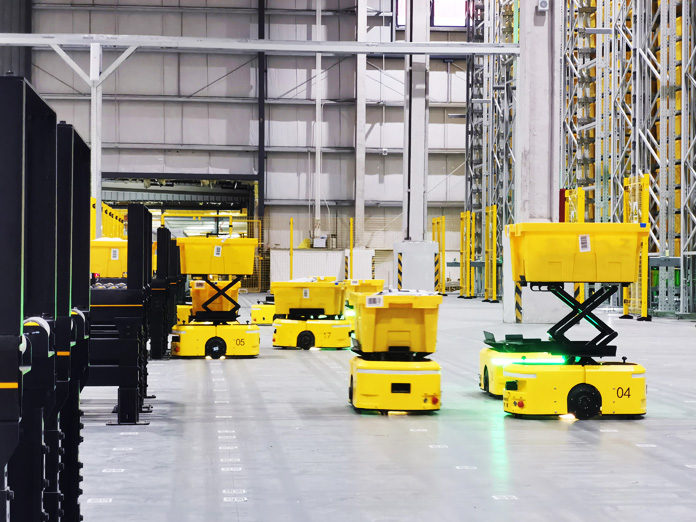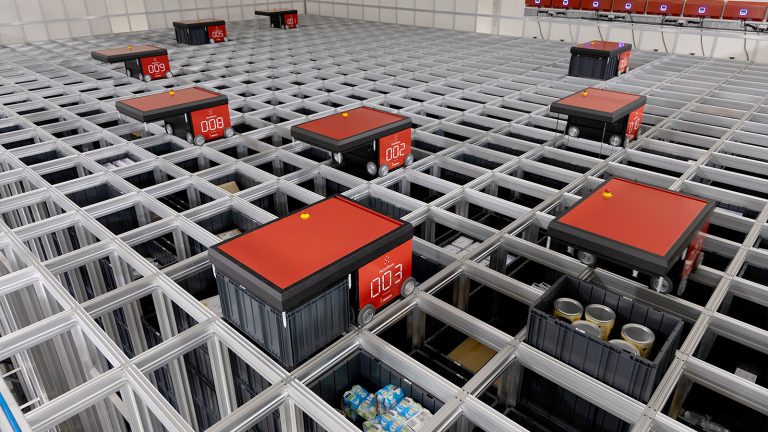









What are AMRs and AGVs?
Both are driverless vehicles that move materials around a site. An AGV (automated guided vehicle) follows a fixed route marked out with magnetic tape, reflectors or wires in the floor.
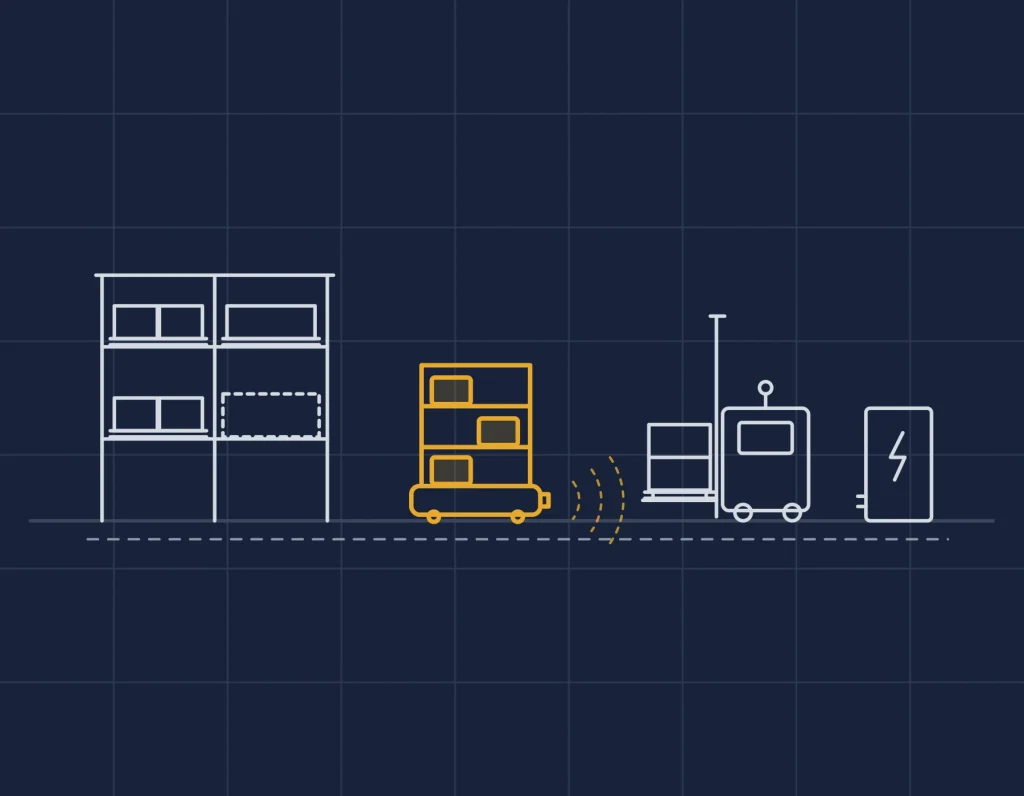
AMRs work differently. An autonomous mobile robot builds its own map of your building and plans a route through it, steering round people and the pallet someone left in the aisle.
That difference matters more than it sounds. AGVs are predictable and happy doing the same loop 10,000 times, while AMRs cope better when your layout, volumes or routes keep changing (which, in most UK factories, they do).
Most first projects are small. Think 1 to 3 robots on a single route, moving the carts or pallets someone pushes by hand today.
AMR or AGV?
The first question almost every buyer asks. How often your layout changes usually settles it.
| AMR | AGV | |
|---|---|---|
| Navigation | Maps the site and plans its own route | Follows tape, magnets, wires or reflectors |
| Obstacles | Steers round them where there is room | Stops and waits for the path to clear |
| Changing a route | Edit the map in software, often same day | Re-lay the guidance, usually a site job |
| Heavy loads | Up to around 1,500 kg on larger models | Several tonnes, including towing trains |
| Best for | Changing layouts and mixed traffic with people | Fixed, high-repeat routes |
| Indicative cost per vehicle | £25k–£65k before integration | £15k–£60k, plus route infrastructure |
Is a mobile robot right for your site?
If you can point to someone who spends most of their shift pushing a trolley between the same few places, you've probably found your first route.
Good fit
- Repeated moves between the same points
- Level floors and Wi-Fi along the route
- Loads on carts, totes or standard pallets
- You run 2 shifts or more
- Skilled staff losing time fetching and carrying
- Aisles wide enough for a pallet truck
Think twice
- Ramps, steps, dock plates or broken floors
- Heavy forklift traffic with no separation
- Loads that change shape every trip
- Doors or lifts on the route that can't be automated
- Outdoor routes or yard crossings
- Only a handful of moves a day
AMR myths, and the reality
-
Myth AMRs drive themselves straight out of the box
Reality Mapping is quick. Getting docking, doors, chargers and your WMS talking to each other takes most of the project.
-
Myth They'll replace your forklifts
Reality They take over the repetitive forklift journeys. You'll still want a driver for the awkward loads and the yard.
-
Myth More robots means more throughput
Reality Past a point, robots queue at the same pick station or door. Traffic simulation shows where that point is.
-
Myth Mobile robots are only for big warehouses
Reality Plenty of UK factories run 1 or 2 AMRs on a single line-side route and grow from there.
Free planning tools
Work out the numbers before you talk to suppliers
Choosing an AMR or AGV integrator
The robot brand matters less than you'd expect. Most of the work (and most of the risk) sits in connecting robots to your doors, lifts, conveyors and software.
| What to check | Evidence to ask for |
|---|---|
| Site surveyFloors, Wi-Fi, doors and traffic | A written survey with photos of problem areas |
| Fleet softwareTraffic control once you have 2+ robots | A demo of the fleet manager running your routes |
| Systems integrationLinks to your WMS, MES or ERP | Named interfaces, and who writes and supports them |
| SafetyRisk assessment | An example risk assessment from a similar site |
| Scaling upAdding robots and routes later | Prices for robots 4, 5 and 6, plus software licence terms |
| SupportUptime once you're live | Response times, remote monitoring and a spare robot option |
Before you ask for quotes
Mobile robot quotes depend on your routes more than anything else. Bring these 5 things and integrators can size the fleet properly.
Use it in the Project Matcher- A floor plan with each route and distance marked
- Load types and weights, plus what they sit on
- Moves per hour at your busiest time
- Doors, lifts, ramps and dock areas on the route
- The system that should send the robots their jobs
What do AMRs and AGVs cost?
Per-robot prices look modest. On a first project, fleet software, site work and system links can cost as much again.
-
Single AMR pilot
£25k–£65k
1 robot, top module, mapping and basic commissioning
-
Small fleet
£80k–£250k
3–6 robots, fleet software, integration and site interfaces
-
Site-wide fleet
£400k+
Larger fleets, pallet AMRs/AGVs and deeper systems integration
What moves the price:
- Payload
- Number of robots
- Top modules
- Doors and lifts
- WMS/ERP link
- Charging
- Floor repairs
- Rent or buy
Indicative UK costs, excluding VAT. Actual project costs vary by application and specification.
Frequently asked questions
An AGV follows a route laid in or on the floor, and an AMR works out its own. The line's blurring, because plenty of newer AGVs use natural navigation too. We'd judge any vehicle on how you change its route, whatever the brochure calls it.
Yes, that's what they're built for. Laser scanners slow them down and stop them, and UK sites should risk assess them against ISO 3691-4. The weak spot is usually forklifts, because a fork tine at shin height is hard for some scanners to see.
Often fewer than you'd expect for a first project. It comes from moves per hour at peak, trip times and charging. If an integrator quotes a fleet size without asking for your move data, ask how they got there.
Often, yes. Robot-as-a-service deals charge a monthly fee per robot with software and support bundled in. You'll pay more over 5 years, but it's a sensible way to prove a route before you commit capital.
A single-route AMR pilot can be running within a few weeks. A fleet linked to your WMS is more like 3 to 6 months, and most of that goes on integration and testing (the robots themselves are ready in days).
Probably, but check before you order. Cracks, expansion joints, dock levellers and slopes cause more trouble on AMR projects than anything else. Small floor repairs are cheap next to a robot that keeps getting stuck.