
SCARA Robot
Why Would You Use a SCARA Robot?
SCARA stands for Selective Compliance Assembly Robot Arm, which, in terms of describing a robot arm is very accurate. "Selective compliance" means the arm is stiff along the vertical axis but has controlled flexibility in the horizontal plane. In assembly work that's a useful property. You can push a component downward with controlled force without the arm buckling, while the horizontal flexibility absorbs small misalignments during insertion without jamming.
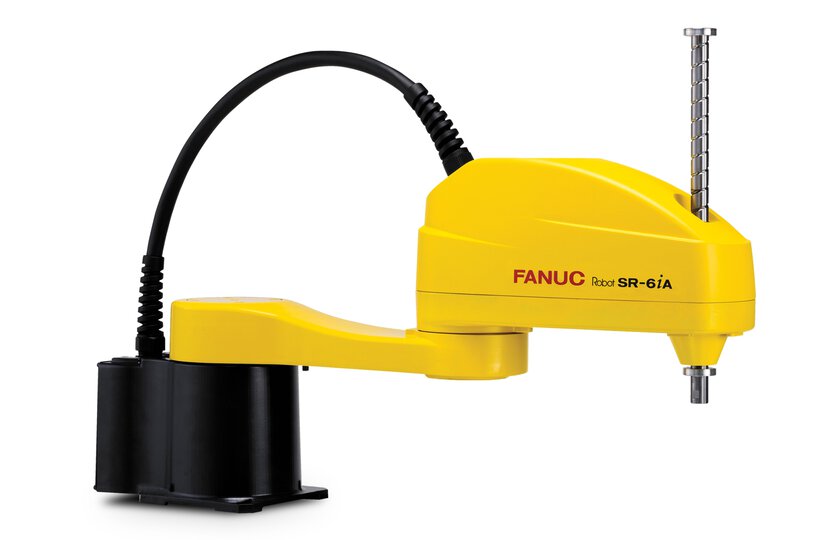
In speed terms, a SCARA is generally faster than a 6-axis articulated arm for flat-plane pick and place. It has fewer axes to coordinate, less moving mass, and a structure that keeps inertia low. For a high-volume assembly or packaging operation where the movement is essentially two-dimensional, that translates to more parts per hour for less money.
It won't substitute for a 6-axis arm where you need 3D reach or complex approach angles. There's no wrist articulation to tilt or rotate a tool in all directions. But if the task fits within what a SCARA can do, it'll do it faster and cost less to buy and run.
How Does a SCARA Robot Work?
The arm on a SCARA robot has 4 axes in total, a shoulder rotation, an elbow rotation, a vertical Z slide, and a wrist rotation around the vertical axis. The shoulder and elbow joints both rotate around vertical axes, sweeping the arm across a roughly circular horizontal workspace. The Z slide raises and lowers the end-of-arm-tooling, and the wrist rotates the tool for orientation.
Most of the arm's mass sits close to the base. That's a significant part of why SCARAs are fast. There's no heavy forearm hanging at full extension the way a 6-axis arm has when it reaches out, so acceleration and deceleration are quicker and the robot can sustain tight cycle times over a full shift without mechanical stress accumulating.
The working envelope is relatively flat. SCARAs aren't suited to reaching around obstacles or approaching a part from multiple angles. Within their disc-shaped workspace, though, positional accuracy is high and consistent.
Where Would You Use a SCARA Robot?
- Electronics assembly is the most natural fit. SCARA robots place PCB components, drive screws, dispense adhesive, and press connectors into housings. These are fast, repetitive operations in a spatially simple environment. The speed advantage over other robot types compounds quickly when you're processing thousands of boards a day.
- Consumer goods manufacturers use them to press lids onto containers, slot products into trays, and apply labels on packaging lines. Pharmaceutical labs use SCARAs for pipetting and sample handling, where the vertical precision of the Z axis matters as much as horizontal speed. A common characteristic across all of these applications is high repetition in a small, flat footprint. That's where a SCARA earns its place.
Related Application Guides
Robot Palletising UK: Automating End-of-Line Stacking
Most production lines in the UK still end the same way they did 30 years ago with a person or persons lifting boxes onto…
View Guide
Robotic Pick and Place UK: Automation Guide
Robotic pick and place automates the repetitive movement of products, components or parts from one location to another.…
View Guide