Application guide Robotic welding · 2026
Robotic Welding Systems Costs, ROI and suppliers in the UK
Finding and retaining skilled welders is a growing challenge for many UK manufacturers. Robotic welding can help automate repeatable, high-volume work where labour, consistency and throughput are limiting factors.
What is Robotic Welding?
Robotic welding cells are the most direct answer to that problem. A well-built, well-programmed cell can typically produce 2 to 5 times the output of a manual welder, runs across multiple shifts without a break, and produces highly repeatable welds when the parts, fixtures and welding process are well controlled. They're not cheap: expect to invest between £60,000 and £400,000 or more depending on the complexity of your application. But for manufacturers with repeatable, volume welding work, the numbers usually stack up faster than people expect.
This guide breaks down what a robotic welding system actually involves, what drives the cost up or down, how to assess your ROI, and what to look for when choosing a UK integrator.
Robotic welding is very much as it sounds, the use of an industrial robotic arm to perform a programmed welding process.. The robot will follow a strict, pre-programmed path to join parts together with precision and repeatability.
In highly repeatable applications, welding robots are an ideal solution. They can repeat programmed torch paths and welding parameters consistently across long production runs and can operate across multiple shifts with appropriate supervision, maintenance and material supply.
If you're welding the same bracket 400 times a day, that's your answer.
What payback looks like
Two welders on a day shift cost around £90,000 a year with consumables and rework. A £130,000 cell matching their output, saving £55,000–£65,000 a year, would have a simple payback of around 24 months.
Try the ROI calculatorGetting quotes? Ask at least two integrators: their designs will differ, and you'll learn from it.
Find welding integratorsWhy Companies Automate Their Welding
One of the main reasons companies choose to automate their welding process is straightforward: finding and keeping hold of reliable and skilled welders is becoming increasingly difficult.
Of course there are other reasons. Throughput being one, a well installed and programmed welding cell can typically produce up to 2-5 times more product than a manual welder. A cell can also support extended or multi-shift operation, provided material supply, maintenance, changeovers and downstream processes allow it.
Consistency is also a big factor. If your process is very repeatable in that you are producing large quantities of the same thing with the same welds then a robot can provide highly repeatable motion and process parameters. This leads to reduced re-work time, less scrap and can reduce process variation and rework, although inspection requirements remain dependent on the application and applicable standards.
The factor that most people look at of course is cost. There is a much larger up-front cost involved in getting a robotic welding cell installed however, once it is in and running the cost per weld begins to drop dramatically compared to labour rates.
This isn't always about replacing manual welders either. Installing a welding cell to complete the bulk, repetitive tasks can help to free up skilled welders to focus more on complex and low volume jobs that the robot is not suited for.
What does payback actually look like?
The numbers on this will vary massively depending on your application, but let's run a realistic scenario for a UK SME. Working on the assumption that the business is running two welders, on a single day shift. Using an illustrative fully-loaded employment cost of around £36,000 per welder. Add in consumables, rework time, and the occasional sick day and you're closer to £90,000.
A £130,000 robotic welding cell could match or exceed the output of those two welders where the parts, weld content and cell utilisation are suitable. Many cells run extended shifts or lights-out periods on top of that. At annual net savings of £55,000–£65,000, the simple payback would be around 24 months. That's before you factor in scrap reduction or quality gains.
The figures are indicative. Your numbers will depend on your shift pattern, part complexity, and the extent of the automation. But they illustrate why manufacturers who've done the analysis are rarely surprised by the result.
-
2–5×
More output than a manual welder
A well-designed welding cell can increase productive output on suitable repeatable work. In some applications, output can be several times higher than a manual welding station.
-
18–36 mo
Payback in about two years
In a typical SME scenario, a £130,000 cell replacing two welders' output pays back in 24 to 28 months, before scrap savings.
-
Repeatable welds
Repeatable paths mean less rework, less scrap and lighter inspection on high-volume work.
Honest qualifier This isn't always about replacing welders. A cell can take the bulk, repetitive work and free skilled welders for complex, low-volume jobs.
What is involved in a robotic welding cell?
Five stages, and the question worth putting to your integrator at each one.
-
Process and part review
MIG is the usual starting point; TIG suits precision work, and spot and laser welding can be automated too. Your integrator matches the process to your materials and joints.
Ask: Which process suits our materials and joint design?
-
Robot and mounting
Usually a 6-axis arm on a fixed base, or on a linear track for long assemblies. A fixed base is cheaper.
Ask: Fixed base or track for our parts?
-
Fixtures and positioners
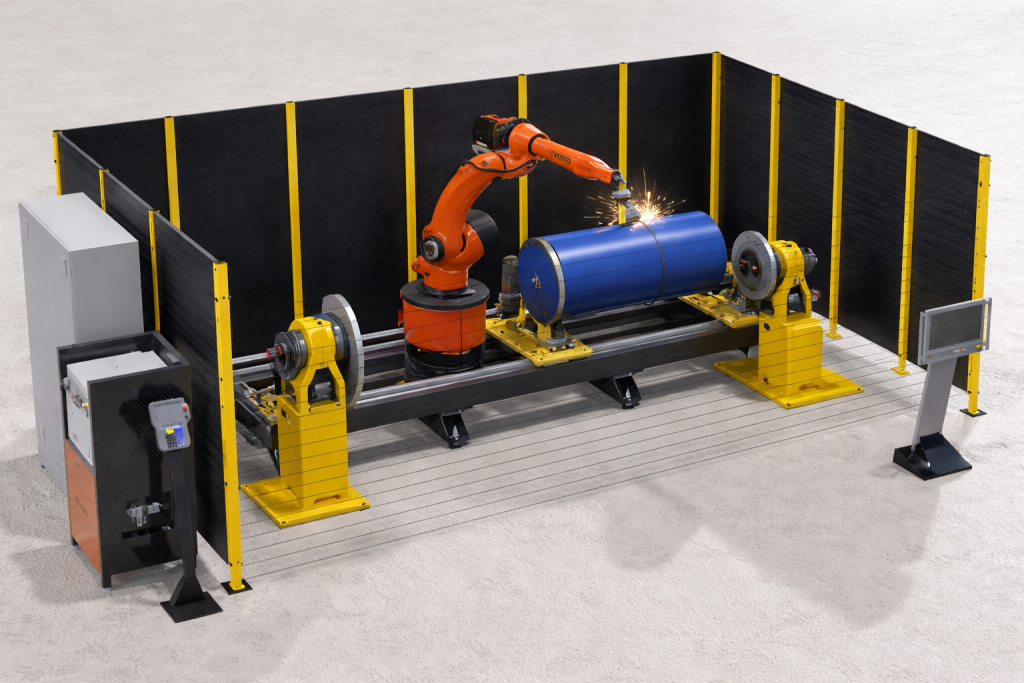
A fixture clamps the part for precise, repeatable welds. A rotary positioner lets the robot reach several sides, controlled by the robot controller.
Ask: Single or twin-station for our cycle times?
-
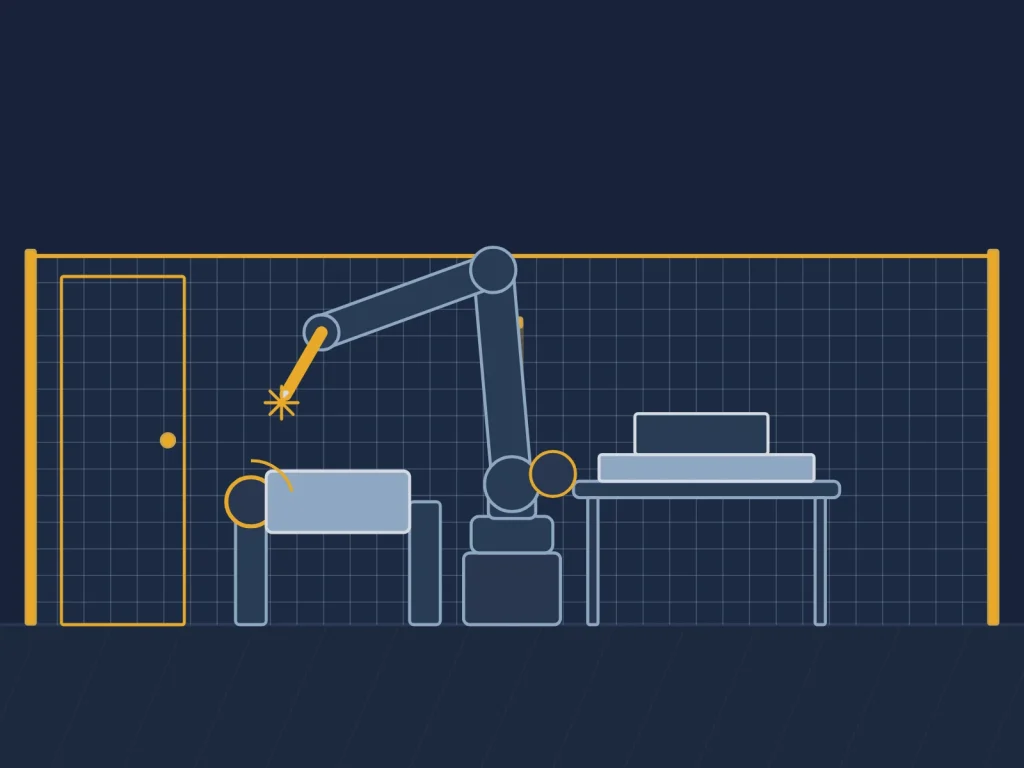
Guarding and interlocks Mandatory
The cell is enclosed, with arc-flash shielding and interlocked access doors that prevent hazardous robot operation whenever someone is inside.
Ask: How is access interlocked for loading and maintenance?
-
Programming and support
A qualified welder should be involved in programming and set-up, especially early on. Offline programming cuts changeover time.
Ask: What does the warranty cover, and what doesn't it?
Key components
-
Robot arm
Usually 6-axis, on a fixed base or a linear track.
KUKAFanucABBYaskawa
-
Welding equipment
Welding power source, torch, wire feed and shielding gas, integrated with the robot and cell controls.
-
Fixture or jig Sets the quality
Clamps the part firmly for precise, repeatable welds.
-
Rotary positioner
Turns the part so the robot can weld several sides.
-
Guarded cell
Enclosure, arc-flash shielding, interlocked access and appropriate fume extraction.
-
Twin-station loading
The operator loads one station while the robot welds the other.
Industries Using Robotic Welding
-
Agricultural and construction machinery
high-volume structural weldments
-
Automotive and Tier 1 suppliers
body panels, subframes, brackets
-
Metal fabrication
gates, racking, enclosures, structural steel
-
Pressure vessels and pipework
repeatable welding for demanding applications
-
Aerospace and defence
TIG welding of precision components
-
Rail
bogie frames and carriage components
-
ROI calculator
Will robotic welding pay back in your sector?
Put in your own wages, shifts and project cost to see a payback estimate in under a minute.
Work out your ROI
Sector guide: Automotive Automation in the UK | Robotics, Welding & Assembly Systems
What to Ask Before You Commit to an Integrator
Getting 2 or 3 quotes is worth doing, but not just to compare price. The more useful comparison is approach: what's included, what happens after go-live, and whether they've actually done your application before.
Some questions that you definitely should be putting to any potential integrator for a project are:
- Do they have reference customers in your sector they'll actually let you call?
- Who owns the robot program after handover, and can your team modify it without coming back to them?
- Is Factory Acceptance Testing (FAT) included as standard, or is it an optional extra?
- What does on-site support look like in the first 6 months, and are those engineers UK-based?
A few things that should make you pause. A quote that's just a day-rate with no fixed scope is a risk to you: costs can escalate quickly and accountability gets blurry. An integrator who won't provide reference customers worth calling isn't necessarily hiding something, but it's worth understanding why. And if anyone is pushing you to sign quickly, slow down. A well-run integration project takes weeks of scoping on both sides. Nobody should be rushing that.
How Much Does a Robotic Welding Cell Cost?
Investment range Indicative UK costs, excluding VAT
-
Simple system
A simple cell with straightforward fixturing and limited automation.
-
Medium complexity
A common range for a new SME production cell.
-
High throughput
Complex or high-throughput cells with advanced handling, sensing or extensive integration.
Project timeline 10–48 weeks, design to sign-off
-
4–12 weeks
Design
4–6 weeks for a simple cell, 6–12+ weeks for a complex one.
-
4–24 weeks
Build
4–8 weeks for a simple cell, 12–24+ weeks for a complex one.
-
1–6 weeks
Installation
1–2 weeks for a simple cell, 3–6 weeks for a complex one.
-
1–6 weeks
Commissioning
1–2 weeks for a simple cell, 3–6 weeks for a complex one.
Typical UK ranges from integrator quotes, for guidance only. Your cost depends on the parts, cycle time, safety and site.
UK integrators

Project Matcher
Get a shortlist of UK integrators for this job
Answer four questions about your project. We match you with UK integrators who do this work.
Get matchedFrequently asked questions
How quickly can I expect to see a return on investment from a robotic welding system?
Your ROI is dependent on a number of factors including the size of your operation, the type and number of welds, the number of different parts that the robot will need to weld and the full extent of the automation required. For small to medium sized manufacturers a payback period of 18 to 36 months is not out of the question. Higher-volume production environments can often see an ROI faster, mainly due to the significant reductions in labour costs and increased throughput from the cell.
Can I estimate ROI before purchasing?
Yes. Using our ROI calculator, you can input your production volume, labour costs, shift patterns, and material usage to generate an estimated payback period. Obviously this won't be an exact result but it's a valuable guide for making investment decisions.
How much labour can a welding robot replace?
A robotic cell can provide the productive capacity of one or more manual welding stations, depending on shifts, weld content and cell utilisation. This doesn't just save costs it also frees skilled welders for more complex tasks.
Will a robotic welding cell reduce scrap and rework?
Robotic welding can reduce process variation, rework and scrap where parts, fixtures and welding parameters are well controlled. It does not eliminate defects, and inspection requirements remain application-dependent.
What welding processes can be automated?
MIG (GMAW), TIG (GTAW), spot welding, and laser welding can all be automated. MIG/MAG is often a starting point for industrial robotic arc welding because of its speed and versatility. TIG is used for precision applications. Your integrator will recommend the right process based on your materials, joint design, and quality requirements.
Does robotic welding work for small batch or high-mix production?
Yes, though it requires careful consideration. Modern offline programming tools allow new part programs to be written away from the cell, reducing changeover time significantly. A well-designed cell with quick-change fixturing can make smaller batches commercially viable, depending on the weld content, changeover time and programming requirements. This is worth discussing directly with a UK integrator who has experience in high-mix environments.
Do I need a skilled welder to operate a robotic welding cell?
You don't need a welder to load and unload parts, but having a qualified welder involved in programming and process setup is strongly advisable, especially in the early months. Many integrators provide training as part of commissioning. Over time, operators develop the skills to manage minor program adjustments and fault diagnosis.
What happens if something goes wrong after installation?
Many integrators offer a warranty period, typically 12 months, which covers defects in the system they've built and faults in their programming. What it usually doesn't cover is wear on consumables, damage caused by operator error, or problems that trace back to your parts being inconsistent. Before you sign anything, ask specifically what the warranty covers and what it doesn't, and what the response time commitment is for a breakdown during that period.
Is it worth getting quotes from multiple integrators?
Yes, always. But the reason isn't mainly price. Two integrators quoting for the same application will often design it differently: different robot brands, different fixturing approaches, different ideas about whether you need a twin-station cell or a simpler single-station setup to start. You learn things from those differences that you won't get from one quote. It also tells you something about how they communicate. An integrator who asks detailed questions about your parts, your shift patterns, and your operators in the scoping conversation is approaching the project very differently from one who sends a ballpark figure within 24 hours. The quality of the questions they ask you is a reasonable proxy for the quality of the system they'll build.