Application guide Robot palletising · 2026
Robot Palletising UK Automating end-of-line stacking
Most production lines in the UK still end the same way they did 30 years ago with a person or persons lifting boxes onto a pallet, shift after shift, until something gives. Robotic palletising fixes that specific problem.
What is robot palletising?
A robotic palletising system automates end-of-line stacking, which can improve throughput, consistency and labour reliability across UK manufacturing and logistics operations.
Palletising is the process of grouping, stacking and securing products onto a pallet ready for transport or distribution. Traditionally, this means operators repeatedly lifting cases, bags or trays and building the pallet manually.
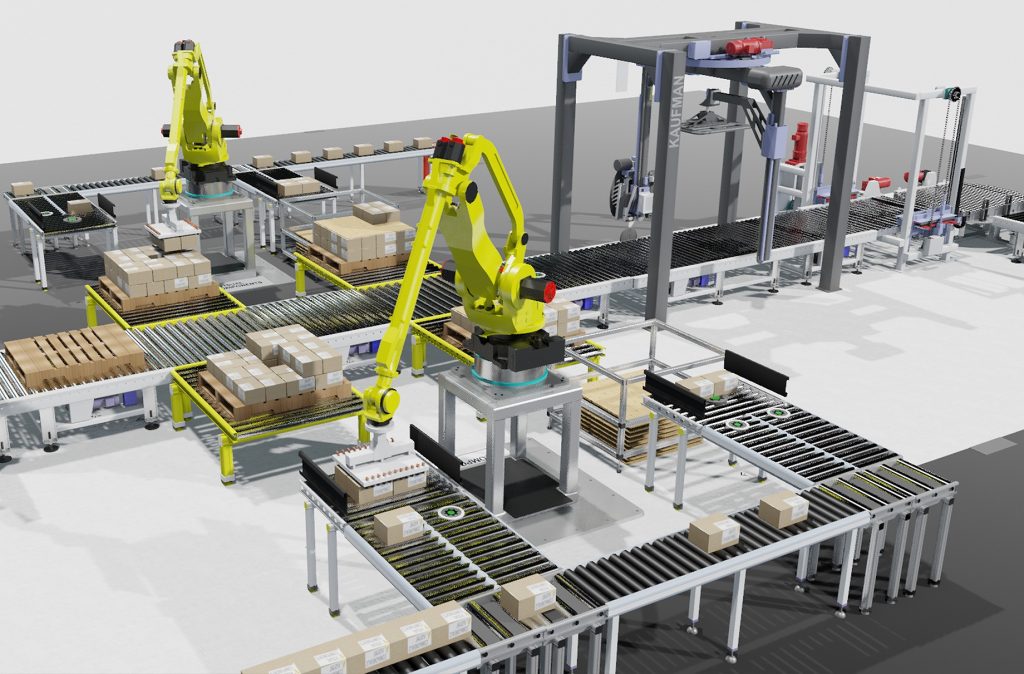
A robotic palletising system replaces that manual process with an automated cell. Products arrive at an infeed point, the robot picks them using purpose-designed end-of-arm tooling and places them onto a pallet according to a programmed pattern.
Most systems include more than the robot itself. Depending on the application, the cell may include an infeed conveyor, pallet dispenser, pallet handling, safety equipment, stretch wrapping and integration with the rest of the production line.
The engineering depends heavily on the application. A compact cell handling a few SKUs on a two-shift line is a very different project from a high-throughput FMCG system serving several production lines.
Cobot or industrial robot?
The choice usually comes down to throughput, product weight, available space, SKU mix and how the cell will be operated.
Cobots can be attractive for lower-throughput applications, mixed products and constrained spaces. Industrial robots become more attractive as payload, cycle rate and operating hours increase.
There isn't a universal pick-rate or payload at which one becomes "right". Your integrator should size the robot around the complete application, including tooling, product weight, reach and required cycle time.
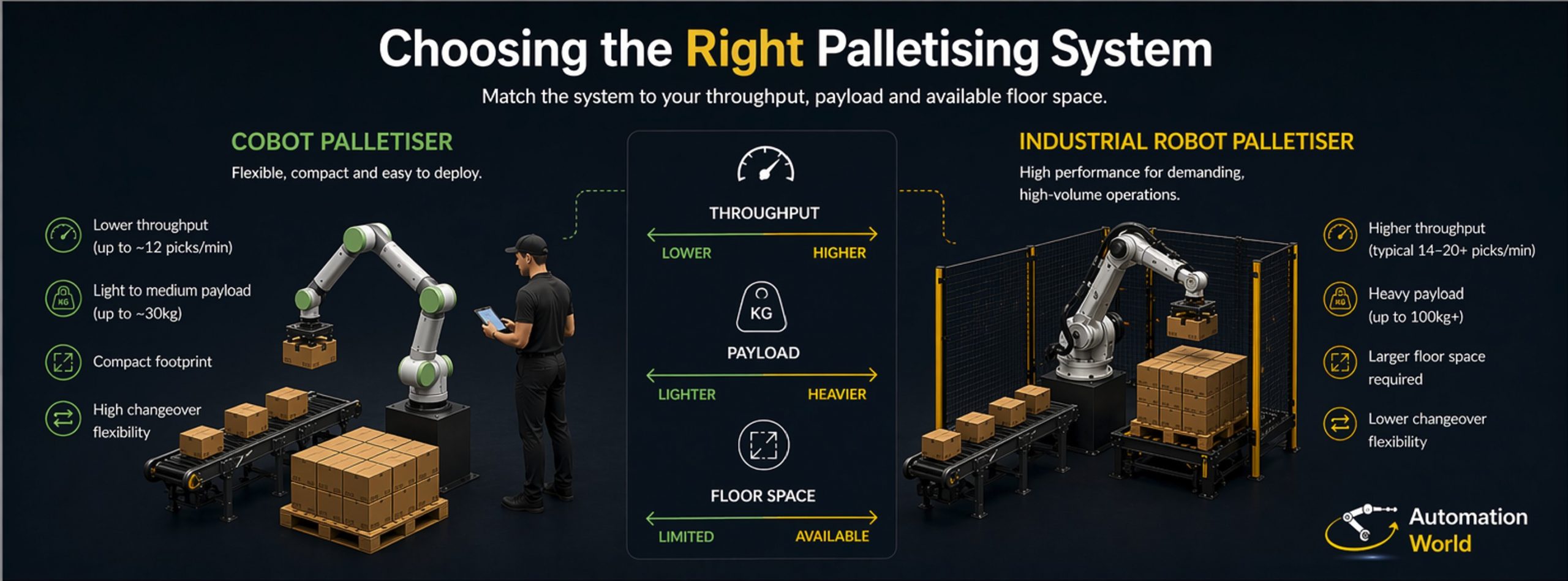
For a more detailed comparison, see Cobot Palletiser vs Robotic Palletiser: Which is Right for Your UK Production Line?
Your palletising cell is only as good as its end-of-arm tooling.
Cobot or industrial palletiser?
This choice comes down to a number of variables including your product size, weight and throughput, what space you have and how product will be fed. Give our article a read for much more detail.
Cobot palletiser vs robotic palletiserReady to compare suppliers? Start with UK palletising integrators.
Find palletising integratorsWhy automate with robot palletising?
The honest reason most manufacturers automate palletising is that it's a hard role to fill and keep filled. It's physically demanding, repetitive, and carries real injury risk over time. Back and shoulder problems from repetitive end-of-line lifting are common, and when someone goes off sick, the line backs up.
-
2–3 shifts
Payback without optimism
Labour cost and utilisation are major variables in the business case. A system operating across two/three shifts can have a very different payback from one replacing a single shift
-
10 hrs
No end-of-shift slowdown
A robot doesn't slow down at the end of a 10-hour shift, and takes the injury risk of repetitive lifting off your people.
-
The same stack every time
Consistent stacks matter when a retailer's load rules make a rejected delivery cost more than it was worth.
Honest qualifier Agree a bypass plan with your integrator: if the cell stops mid-shift, product can be palletised by hand so the line keeps running.
How does a robot palletising cell work?
Five stages, and the question worth putting to your integrator at each one.
-
Infeed
Product arrives on an infeed conveyor, often after a metal detector or checkweigher. The robot confirms its position by vision or a physical datum before picking.
Ask: Does my line give the robot a consistent infeed point?
-
End-of-arm tooling Critical
The cell is only as good as its tooling. If it hasn't been designed and validated around the products you actually run, picking problems can lead to downtime.
Ask: Has the gripper been tested on every product we run?
-
Layer pattern
The robot follows a programmed pattern, often alternating layer orientation for stability, like bricklaying. The pallet indexes down as each layer completes.
Ask: Who builds the stack patterns for our SKUs?
-
Pallet out, pallet in
Full pallets transfer out to a stretch wrapper, shuttle or AMR. An empty pallet drops from the dispenser and the line keeps running.
Ask: Where do finished pallets go, and how far?
-
Changeovers
Existing products and pallet patterns can often be selected from the HMI in a few minutes. Creating and validating a new SKU takes longer and depends on the product, tooling and pattern.
Ask: How long does adding a new SKU take?
Key components

-
Infeed conveyor
Brings product to the pick point, often after a metal detector or checkweigher.
-
Robot arm
Articulated 6-axis robots are common in flexible palletising cells, while dedicated layer palletisers can be advantageous for very high-volume, repeatable applications.
-
End-of-arm tooling Most critical
Designed around every variation of your product, or it becomes the source of downtime.
-
Pallet dispenser
Feeds empty pallets into position so the cycle carries on without stopping.
-
Stretch wrapper
Seals the finished load before it heads to despatch.
Industries Using Robotic Palletising
-
Food and Beverage
Food and beverage is a major application for robotic palletising in UK manufacturing.
-
Fast-Moving Consumer Goods (FMCG)
The palletising challenge in FMCG is usually mixed-SKU complexity rather than raw volume.
-
Pharmaceutical & Healthcare
Stricter requirements around traceability and load integrity change the brief here.
-
Building Materials
Bags of cement, plaster and aggregates can be heavy and deformable, making payload, reach, tooling and product stability important when specifying the robot.
-
Agricultural & Animal Feed
Heavy bags, dusty conditions, continuous operation and on top of that, seasonal throughput swings.
-
Logistics & 3PL
A different use case from the others.
-
ROI calculator
Will robot palletising pay back in your sector?
Put in your own wages, shifts and project cost to see a payback estimate in under a minute.
Work out your ROI
Is robot palletising right for your operation?
Not every production line needs a robot palletiser, and the honest answer depends on your specific situation. If you are curious, you can see the full signs your palletising operation is ready to automate:
- Your line produces consistent, repeatable product, cases, bags, trays, tins, bottles, rather than irregular or highly mixed loads
- You're running more than one shift, or struggling to staff the end of line reliably
- Manual palletising is a bottleneck that slows the rest of the line down
- You're dealing with repetitive strain injuries or safety concerns from manual handling
- Your throughput is growing and the current setup won't scale with it
- You run multiple SKUs and spend significant time managing changeovers manually
- Your pallets are inconsistent in quality, causing damage in transit or rejected loads at the customer
- A significant proportion of your labour cost is tied up in manual palletising.
How much does a robotic palletising cell cost?
Investment range Indicative UK costs, excluding VAT
-
Simple system
Lower-cost systems exist, but a complete installed cell with tooling, safety and integration can move substantially above the robot's headline price.
-
Medium complexity
Multi-SKU capability, pallet handling, safety systems, conveying and/or stretch-wrapper integration.
-
High throughput
High-throughput multi-line cell, conveyor network, automated pallet transfer, WMS integration
Project timeline 18–33 weeks, design to sign-off
-
4–8 weeks
Design
-
10–18 weeks
Build
-
2-3 weeks
Installation
-
2-4 weeks
Commissioning
Longer end of range if multiple SKU programmes need validating during live production
Typical UK ranges from integrator quotes, for guidance only. Your cost depends on the parts, cycle time, safety and site.
UK integrators
-
 View profile
Bulk Automation Claimed
Specialists in Automated Bagging & Palletising Systems
Food & Beverage, General Manufacturing
-
 View profile
-
 View profile
Project Matcher
Get a shortlist of UK integrators for this job
Answer four questions about your project. We match you with UK integrators who do this work.
Get matchedFrequently asked questions
Can I retrofit a palletising robot into an existing production line?
Usually yes, though the honest answer is that it depends how your line currently ends. The robot needs a consistent infeed point, enough floor space for the cell and guarding, and somewhere for finished pallets to go. Most existing lines can accommodate that with some conveyor modification.
Where retrofits get complicated is when the building itself is the constraint: low ceilings, awkward column positions, or a line that ends 6 metres from the nearest loading bay. A decent integrator will tell you early if the site is going to fight the installation.
How long does it take to program a new product or pallet pattern?
On a well-configured system, selecting an existing SKU and pallet pattern can take only a few minutes. Creating and validating a new SKU takes longer and depends on the product dimensions, pallet pattern, tooling and how much physical testing is required.
The first time, with an unfamiliar HMI and a product you're still dialling in, expect longer. The pattern logic itself isn't complicated, the robot needs the product dimensions, the pallet size(s) and your preferred layer orientation. Getting the first few physical picks right, especially on irregular or flexible packaging, takes some testing. You should factor this into your go-live planning if you're launching with more than 4 or 5 SKUs.
Is a cobot palletiser a cheaper alternative to a traditional robot cell?
Sometimes, but not automatically. A cobot can reduce the cost and footprint of a suitable palletising cell, particularly where throughput and payload requirements are modest. However, the complete system still needs an appropriate safety solution based on the application and risk assessment.
What happens when the robot breaks down mid-shift?
This is a discussion that you need to have with your integrator. Most modern palletising cells are reliable, when set up correctly, and breakdowns mid-shift are rare, that doesn't mean that they can't happen though. You need to discuss with your integrator options around bypassing the robot cell whilst it's being repaired so product can be manually palletised and the line(s) don't grind to a halt.
Also have a discussion around remote support as a good robotics integrator should be able to access the robot controller remotely to possibly diagnose an issue without an engineer being on site.
How do I choose the right gripper for robotic palletising?
The right end-of-arm tooling depends on the product, packaging, weight, surface and required cycle rate. Vacuum tooling can work well with many cartons and wrapped products, while mechanical or clamp grippers can be better suited to bags, sacks and products where vacuum pickup is unreliable. Fork-style and hybrid tooling can also be appropriate for specific applications.
Should palletising tooling be tested with my products?
Yes, wherever practical. The tooling should be designed around the actual product range and validated against representative samples before the system is commissioned.
Packaging variations such as damaged cartons, flexible bags, different fill weights or surface conditions can affect gripping performance. Ask the integrator which products and packaging conditions have been tested, and how the system will handle products that vary from the original specification.
How many SKUs can a robotic palletiser handle?
There is no fixed SKU limit. The practical number depends on product dimensions, weights, pallet configurations, tooling, pattern complexity and how often products need to be changed.
A cell handling four similar carton SKUs is a very different proposition from one handling dozens of bags, cases and trays with different gripping requirements. If you have a large or changing product range, discuss SKU management, tooling flexibility and product validation with the integrator before specifying the system.