
Articulated Robot
Why Would You Use an Articulated Robot?
The 6-axis articulated robot is the workhorse of industrial automation in the UK. It's the arm you'll find doing the majority of palletising, welding, packing or machine tending across UK manufacturing.
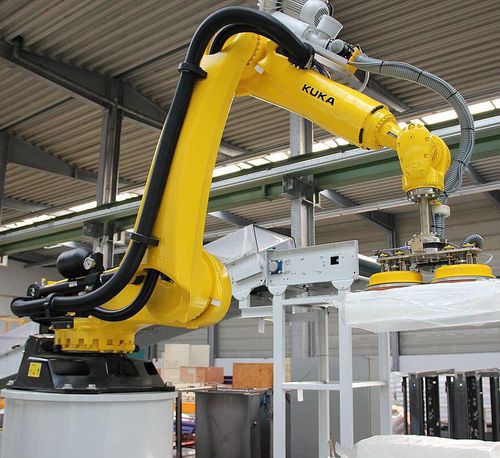
Its versatility comes from having 6 degrees of freedom. Each joint adds another axis of movement, and together they allow the arm to reach almost any position and orientation within its working/reach envelope. That matters on a real production line, where products aren't always presented perfectly, where the cell has to handle 15 different SKUs and where the robot needs to approach a pick point from an awkward angle because of how the line is laid out.
For most applications, an integrator's default starting point is a 6-axis articulated arm. The question is usually which one, and how big rather than whether to use one at all.
How Does an Articulated Robot Work?
Each joint is driven by a servo motor and controlled precisely by the robot controller. The base joint rotates the whole arm horizontally. Moving up the arm, joints 2 and 3 handle the main extension and elevation, reach and height. The final 3 joints control wrist orientation, which is what allows the end-of-arm tooling to approach a product from almost any angle without repositioning the whole arm.
The robot controller calculates the exact joint positions needed for every point in the robot's path, a process called inverse kinematics. From the outside it looks fluid. Behind that, the controller is solving geometry equations several hundred times a second.
Programming is mostly done at a teach pendant, where the operator physically guides the arm through its positions and records them, or offline using simulation software. Offline programming is faster for complex applications with multiple programs and is increasingly common on multi-SKU lines, because you can build and test new pallet patterns in software without stopping the live cell to do it.
Where Would You Use an Articulated Robot?
- End-of-line palletising in food and beverage production
- Arc and spot welding in automotive manufacturing
- Machine tending on CNC machining and injection moulding lines
- Pick and place in FMCG and pharmaceutical packaging
- Assembly operations in electronics manufacturing
UK Integrators Offering This Solution


CLOOS UK
Automated Welding Systems – from Ready-to-Weld to Concept System

Cobot Automation Ltd
Cobot Automation for UK manufacturers
Related Application Guides
![Machine Tending Robots UK: Costs, Systems & Integrators [2026]](https://automationworld.co/wp-content/uploads/cobot-machine-tending-300x184.jpg)
Machine Tending Robots UK: Costs, Systems & Integrators [2026]
A CNC machine's output depends on more than its programmed machining time. Every part also needs to be unloaded, replace…
View Guide![Collaborative Robots UK: Cobot Automation Guide for Manufacturing [2026]](https://automationworld.co/wp-content/uploads/cobot-300x200.png)
Collaborative Robots UK: Cobot Automation Guide for Manufacturing [2026]
Most UK manufacturers who've looked at collaborative robots and decided they aren't for them were looking at the wrong a…
View Guide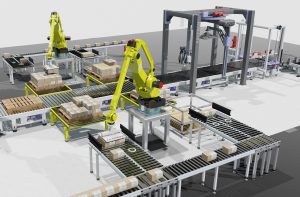
Robot Palletising UK: Automating End-of-Line Stacking
Most production lines in the UK still end the same way they did 30 years ago with a person or persons lifting boxes onto…
View Guide
Robotic Pick and Place UK: Automation Guide
Robotic pick and place automates the repetitive movement of products, components or parts from one location to another.…
View Guide![Robotic Welding Systems (UK Guide): Costs, ROI & Suppliers [2026]](https://automationworld.co/wp-content/uploads/robotic-welding-cell-1-300x200.png)
Robotic Welding Systems (UK Guide): Costs, ROI & Suppliers [2026]
Finding and retaining skilled welders is a growing challenge for many UK manufacturers. Robotic welding can help automat…
View Guide