
PLC
A PLC (Programmable Logic Controller) is an industrial computer used to control machinery and automated processes on a factory floor. It continuously reads inputs from sensors and switches, runs a stored control program, and sends outputs to actuators, motors and valves accordingly. PLCs are built to be far more rugged and reliable than a standard computer, and are the backbone of most automated production lines, robot cells and packaging machinery.
Why do PLCs matter?
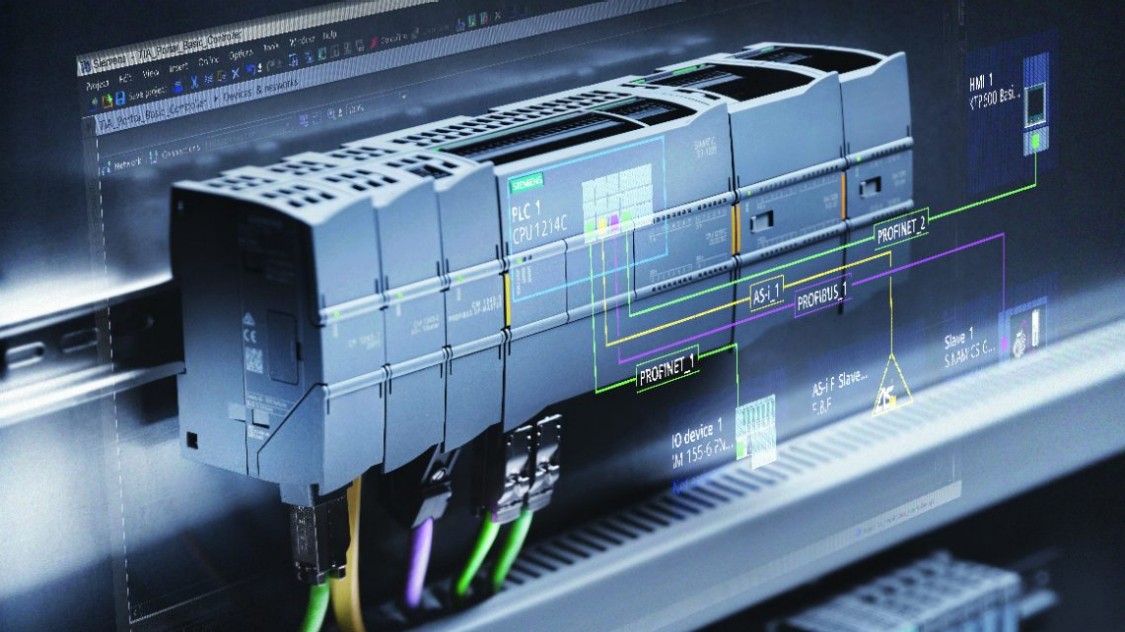
The PLC is the part of an automation system that decides what happens and when, it is the layer that coordinates conveyors, sensors, robots and safety devices so they act as one system rather than a collection of separate machines. For a manufacturer evaluating an automation project, the PLC and its programming is often underestimated compared to the more visible robot or machine hardware, but it is usually where a large share of the integration effort and cost sits. A well-programmed PLC is also what makes a cell easy to operate and maintain afterwards, clear fault messages, straightforward changeover between products, and a control system a plant’s own maintenance team can actually support, rather than one only the original integrator understands.
How does a PLC work?
A PLC runs a continuous scan cycle: it reads the state of all connected inputs (limit switches, photo-eyes, push buttons, sensor signals), executes its control logic against those inputs, then updates its outputs (relays, motor starters, valve solenoids, robot start signals), typically dozens or hundreds of times per second. The control logic itself is most commonly written in ladder logic, a graphical language designed to resemble electrical relay diagrams so that electricians and controls engineers can read and troubleshoot it without needing a software background, though structured text and function block programming are also used for more complex logic. PLCs communicate with other equipment, robots, HMIs, vision systems, drives, over industrial networks such as Ethernet/IP, Profinet or Modbus, which is what allows a robot cell’s PLC to tell a robot controller when it is safe to start a cycle, or to receive a part-good/part-bad signal from a vision system. Because PLCs are designed for harsh environments and long service life, the same physical unit often stays in service for a decade or more.
Where are PLCs used?
- Coordinating robot cells with conveyors and sensors
- Machine safety interlocking
- Sequencing multi-step packaging lines
- Monitoring and logging production line status
UK Integrators Offering This Solution

ADI Automation
Automated control solutions for process and machinery

Applied Integration (AIUK)
Deliver innovative digital and automation solutions that enhance efficiency, performance and measurable business value.

Beckhoff
PC-based control and automation technology for machines, production systems and intelligent manufacturing.
Related Application Guides
![Machine Tending Robots UK: Costs, Systems & Integrators [2026]](https://automationworld.co/wp-content/uploads/cobot-machine-tending-300x184.jpg)
Machine Tending Robots UK: Costs, Systems & Integrators [2026]
A CNC machine's output depends on more than its programmed machining time. Every part also needs to be unloaded, replace…
View Guide
Cobot Palletising: End-of-Line Automation with Collaborative Robots
Cobot palletising is an increasingly popular way for UK manufacturers to automate the repetitive task of stacking boxes,…
View Guide
Robot Palletising UK: Automating End-of-Line Stacking
Most production lines in the UK still end the same way they did 30 years ago with a person or persons lifting boxes onto…
View Guide